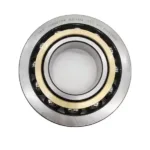
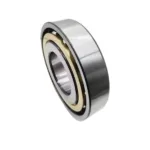
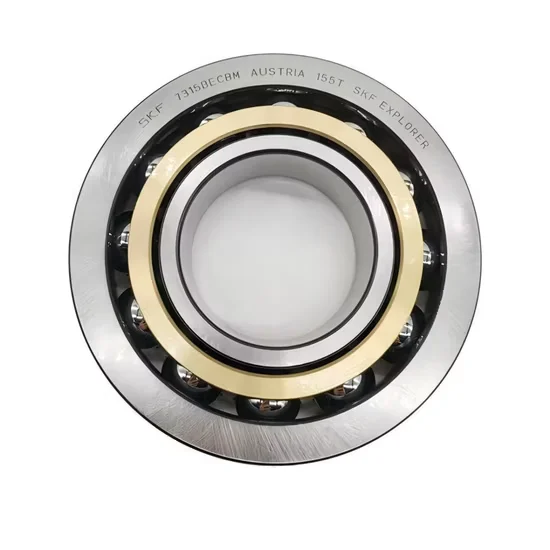
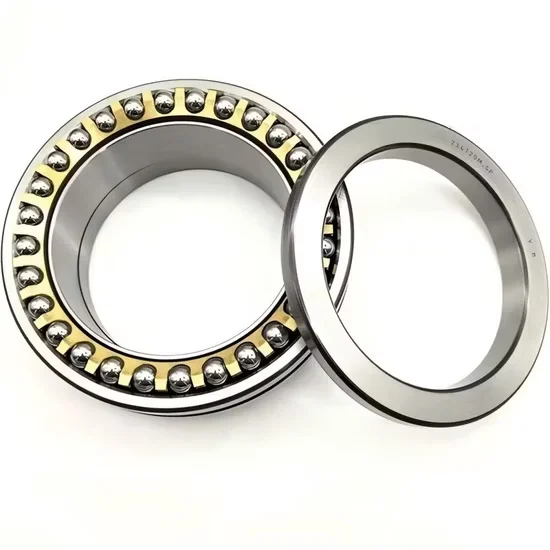
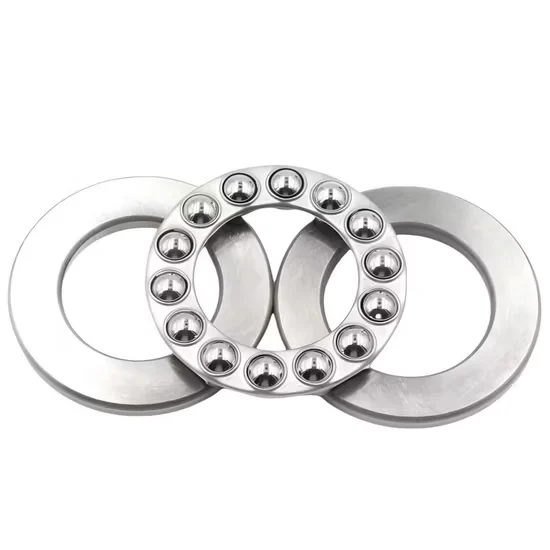
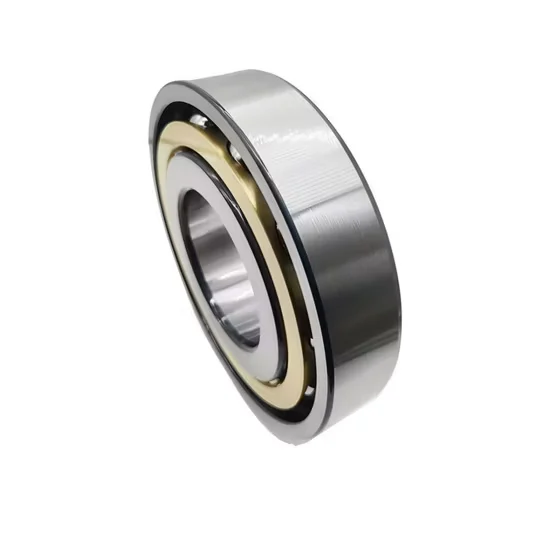
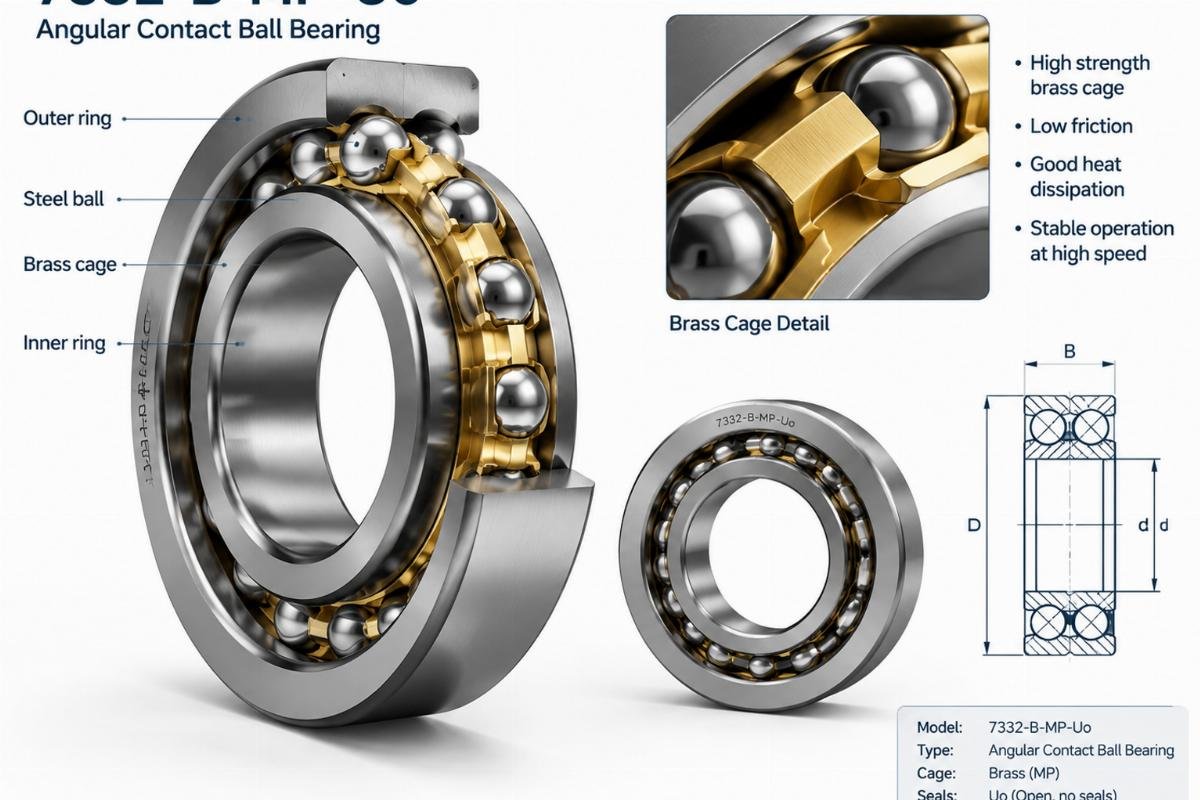
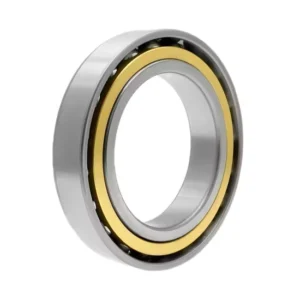
7332-B-MP-Uo Angular Contact Ball Bearing
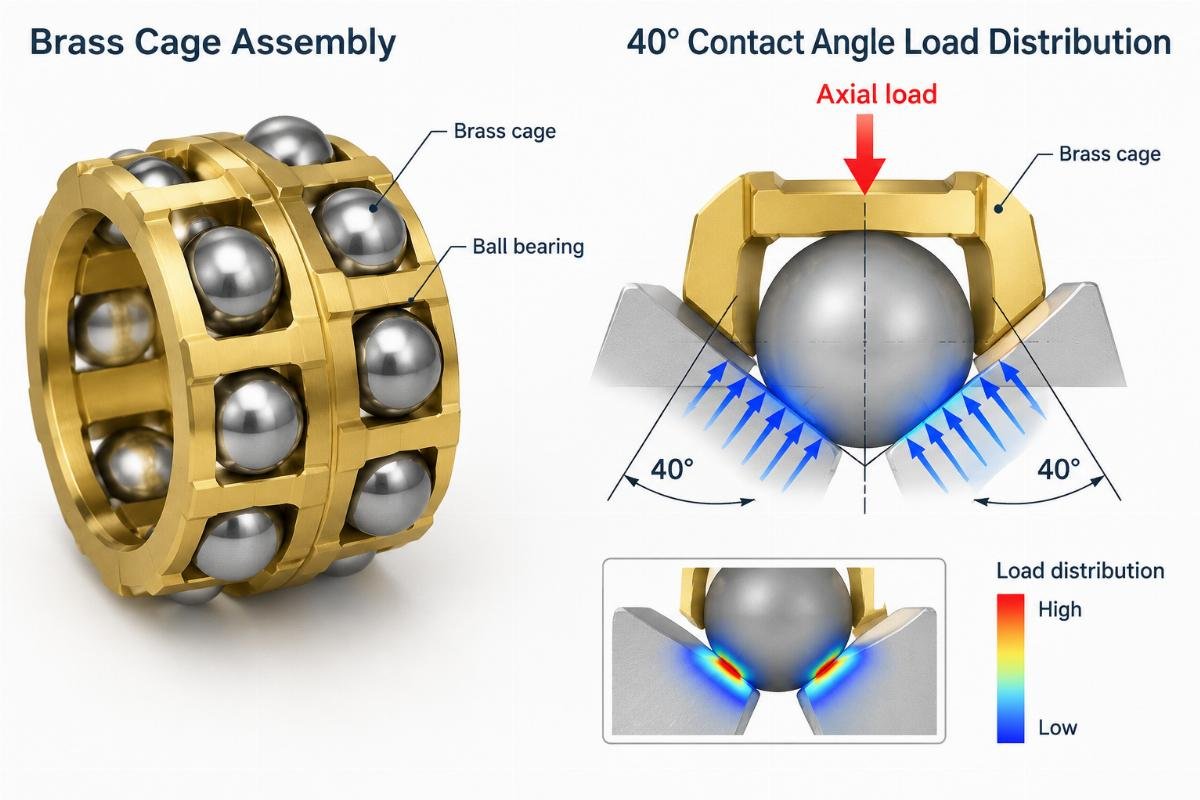
Features a 40° contact angle designed to handle heavy axial loads in complex machinery.
Utilizes an open seal configuration requiring external lubrication and proper environmental sealing.
Manufactured from Gcr15 bearing steel for reliable performance in demanding industrial applications.
Ensure strict alignment of clearance, cage material, and precision class during cross-reference verification.
Multi-Brand Sourcing — Consolidate your 7332-B-MP-Uo angular contact ball bearing orders with other premium lines in a single shipment without juggling multiple vendors.
Technical Specifications
Parameter
Value
Designation
7332-B-MP-Uo
Bearing Type
Angular Contact Ball Bearing
Bore Diameter (d)
160 mm
Outside Diameter (D)
340 mm
Width (B)
68 mm
Contact Angle
40°
Cage Material
Brass
Seal or Shield Type
Open
Precision Class
P0 to P2
Material
GCr15 (SUJ2) Bearing Steel
Note: Suffixes MP and Uo are marked as unverified in the initial draft and require manufacturer catalog confirmation for exact pairing and clearance specifics.
Application Suitability
Industry
Typical Applications
Machine Tool Manufacturing
Heavy-duty spindle assemblies requiring high axial rigidity
Precision fails when cross-referencing ignores suffix nuances.
During my early failure analysis days in Dubai, I dismantled a seized main spindle where the replacement bearing lacked the correct high-temperature clearance. The cage locked up under thermal expansion, halting the entire production line. When sourcing a 7332-B-MP-Uo angular contact ball bearing, assuming generic equivalence without verifying the exact contact angle and cage design leads to catastrophic downtime [NEED_CITE: rolling bearing failure mode classification per ISO 15243].
Matching Axial Rigidity to Continuous Thrust Environments
The 40° contact angle inherent to the B suffix allows this 7332-B-MP-Uo angular contact ball bearing to absorb substantial axial forces while maintaining radial stability. Our technical team cross-references your specific load profiles to ensure the selected precision class aligns with your spindle’s runout tolerances, preventing premature raceway fatigue.
Thermal Expansion and Lubrication Boundaries in Open Designs
Open-type bearings operating at elevated speeds generate significant internal heat, demanding precise external lubrication routing to prevent thermal seizure. The absence of integrated seals reduces friction but exposes the raceways to particulate ingress, making environmental sealing at the housing level critical. Furthermore, thermal growth dictates the initial clearance selection, where an incorrect fit quickly translates into excessive preload and cage failure [NEED_CITE: thermal effects on bearing internal clearance per ISO 281].
Decoding the Brass Cage and Contact Angle Configuration
The brass cage provides superior structural integrity under high-speed and high-vibration conditions compared to polymer alternatives. A 40° contact angle optimizes the load distribution for applications dominated by axial thrust, ensuring the rolling elements maintain optimal contact with the raceways. Selecting the appropriate precision grade, ranging from standard P0 up to ultra-precise P2, directly governs the rotational accuracy and vibration signature of the assembled machinery.
The Cascading Financial Impact of Improper Pairing
Installing a bearing with mismatched internal clearance or incorrect pairing arrangements voids equipment warranties and triggers unplanned downtime. According to failure analysis frameworks, improper mounting and selection account for a significant share of premature failures, often damaging adjacent shaft components and housings. The resulting secondary machining costs and lost production time far exceed the initial procurement savings of an incorrectly specified component [NEED_CITE: economic impact of unplanned machinery downtime].
Engineering Verification Beyond the Part Number
We scrutinize the exact suffix combinations, ensuring the cage material and universal pairing designations match your OEM specifications perfectly. Our inventory covers thousands of standard and special part numbers, allowing us to consolidate mixed-brand orders efficiently. Every shipment includes complete traceability documentation, and our engineers provide cross-brand equivalent model consultation to validate your selection before dispatch.
Documentation & Authenticity
Certificate of Conformity verifying the GCr15 material grade and heat treatment batch.
Original manufacturer batch traceability records linking the specific unit to its production run.
Dimensional and running accuracy inspection reports confirming the specified P-class tolerances.
Official QR code authentication for verifying the brass cage and open seal configuration.
Storage, Handling & Mounting
Retain the original vapor-phase inhibitor packaging until mounting to protect the open raceways from ambient humidity.
Use induction heating for the 160mm inner ring, strictly avoiding localized torch heating that alters the GCr15 microstructure.
Maintain strict cleanliness protocols, as the open seal design offers no built-in defense against microscopic particulate ingress.
Verify the universal pairing marks before installation to ensure the correct axial preload is achieved in the spindle assembly.
Technical Review and Selection Guidance
To finalize the optimal configuration, please share your operational parameters, including radial and axial load magnitudes, rotational speeds, and operating temperatures. Providing the OEM equipment model number allows our engineering team to perform a comprehensive cross-reference check and L10 life calculation, ensuring the selected bearing meets your exact rigidity and longevity requirements.
Frequently Asked Questions
Q: What does the 40° contact angle mean for my spindle application?
A: The 40° angle, denoted by the B suffix, maximizes axial load-carrying capacity, making it ideal for applications with heavy thrust loads. It ensures the bearing maintains rigidity under directional pressure, though it requires proper pairing to handle bidirectional forces or moment loads effectively.
Q: How do I verify the authenticity of the brass cage design?
A: Authenticity is confirmed through the manufacturer’s official QR code and batch traceability documents. We provide original certification that details the specific cage material and window design, ensuring it matches the heavy-duty requirements of your high-speed machinery and prevents premature cage failure.
Q: Can this open bearing be used in dusty environments?
A: While the open design minimizes friction and allows for custom lubrication, it lacks integral sealing. For dusty conditions, your housing must incorporate effective external labyrinth or contact seals to prevent particulate contamination from reaching the precision raceways and causing abrasive wear.
Q: What information is needed to cross-reference this model?
A: Please provide your current bearing’s full designation, including all suffixes, alongside the OEM equipment manual specifications. Our technical team will verify the dimensional boundaries, clearance class, and pairing arrangement to recommend the exact equivalent or an optimized alternative for your spindle.
Shipping Information
EU Warehouse
3-7 working days (bonded stock)
Direct from China
Shanghai & Ningbo hubs (bulk / FCL)
Markets Served
DE · IT · PL · ES · NL · FR · EU+
Incoterms
DDP / DAP available on request
Minimum Order
Contact us for MOQ details
Documents Included with Every Shipment
EN and ISO Quality Certificates
Batch traceability and manufacturing standard
Material & Heat-Treatment Reports
Full material composition and process records
CE Declaration of Conformity
For bearing units and motion products
RoHS Compliance Declaration
Restriction of hazardous substances
EUR.1 Movement Certificate
Preferential origin for EU customs
Certificate of Origin
Country of manufacture documentation
Correct HS Codes
Pre-classified for smooth customs clearance
Commercial Invoice & Packing List
VAT-compliant intra-EU invoicing
Transparent Landed Cost with Tax Explanation
SKFEU provides full price transparency so EU buyers know exactly what they pay. No hidden duties, no surprise charges at customs.
VAT-Compliant Invoicing
All intra-EU transactions are invoiced with correct VAT treatment. B2B buyers with valid EU VAT numbers receive zero-rated invoices where applicable.
No Unexpected Import Duties
Goods shipped from our EU bonded warehouse arrive as intra-EU movements -- no import duties, no customs delays for EU-based buyers.
EUR.1 & Origin Docs Ready
For shipments direct from China, EUR.1 movement certificates and certificates of origin are prepared in advance to minimise customs clearance time.
DDP Pricing Available
Ask for Delivered Duty Paid quotations -- we absorb all import costs so your landed cost is fixed and predictable from day one.
Need a landed cost breakdown? Contact Sofia at
sofia@skfeu.com
or via WhatsApp for a full DDP quotation including freight, duties and VAT for your country.
Send Inquiry
Request Pricing & Availability
Share your requirements and Sofia will respond within one working day with pricing, lead time and full documentation details.