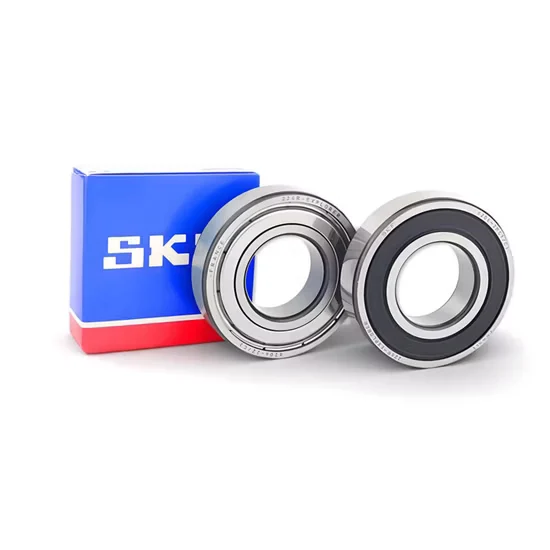
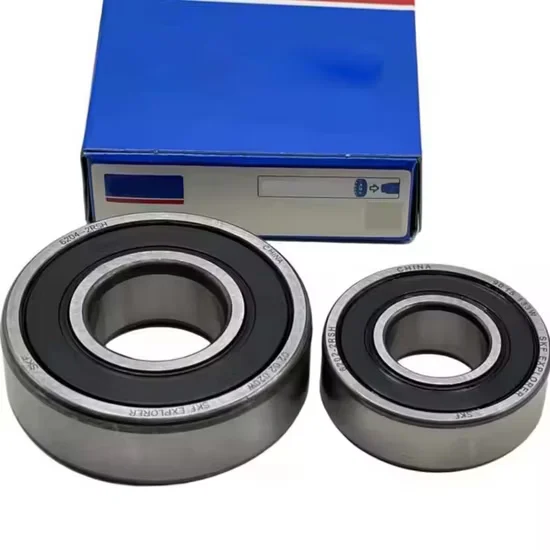
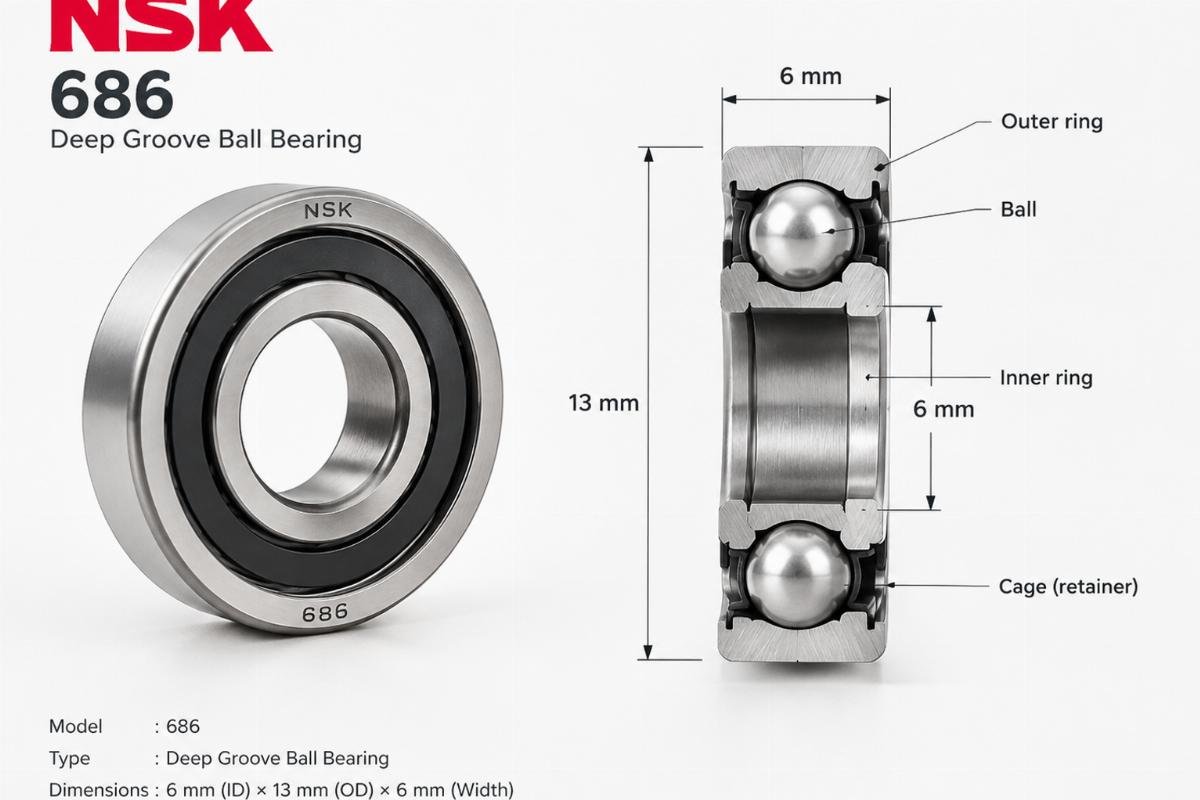
NSK 686 Mini Deep Groove Ball Bearing for Power Tools & Small Machinery
NSK 686 Deep Groove Ball Bearing handles standard radial loads in compact electric motors and small machinery applications. Lacking specialized sealing or clearance suffixes, this open mini bearing requires external lubrication and proper housing seals for reliable operation in power tool accessories.
Every shipment includes complete documentation packages featuring original material certificates and detailed dimensional inspection reports for full traceability.
Replies within 1 working day · Dedicated account manager
Specifications
Deep Groove Ball BearingGenuine BearingLow NoiseMini BearingNSK 686Power ToolsSmall Machinery
Lead Time
3-7 working days
EU bonded warehouse · Fast-moving stock
Compliance
Full EU package
EN · ISO · CE · RoHS · EUR.1
Cross-Reference Alignment — We verify dimensional and tolerance equivalency across premium brands when sourcing alternatives for your compact motor assemblies.
Technical Specifications
Parameter
Value
Designation
NSK 686
Bearing Type
Deep Groove Ball Bearing
Bore Diameter (d)
6 mm
Outside Diameter (D)
13 mm
Width (B)
3.5 mm
Seal or Shield Type
Open
Cage Material
Pressed Steel
Material
High-Carbon Chromium Bearing Steel
Application Suitability
Industry
Typical Applications
Power Tools
High-speed rotary switches and micro-spindle supports
Small Machinery
Precision instrument pivots and micro-gearbox shafts
Electric Motors
Miniature motor armature supports and cooling fan hubs
Why High-Speed Miniature Motors Reject Standard Clearance Bearings
Thermal expansion at extreme RPM quickly eliminates standard internal clearance, causing catastrophic seizure.
Early in my technical sales career, I supplied standard clearance micro-bearings for an electric tool manufacturer without accounting for their high-speed thermal profile. The resulting heat buildup eliminated the internal clearance, leading to motor lock-ups and a full batch rejection. That failure mode remains a critical checkpoint in our selection process. When specifying an NSK 686 deep groove ball bearing for compact power tools, engineers must anticipate how frictional heat alters the geometric fit inside the housing [NEED_CITE: thermal expansion effects on bearing internal clearance]. Ignoring this dynamic turns a precision component into a mechanical fuse.
Matching Micro-Bearing Tolerances to Compact Power Tool Demands
Sourcing an authentic NSK 686 deep groove ball bearing requires more than just matching the basic designation. Our technical team evaluates the specific radial loads and rotational speeds of your small machinery to recommend the optimal internal geometry. By providing cross-brand equivalent model consultation, we ensure your assembly line never stalls due to supply chain bottlenecks for specific micro-bearings.
Navigating Thermal and Friction Challenges in Miniature Spindles
Miniature electric motors operate at exceptionally high rotational speeds, generating significant frictional heat within a confined space. This thermal load directly impacts the lubrication film thickness and the effective internal clearance. If the operating temperature exceeds the thermal limit of standard bearing grease, the lubricant degrades rapidly, leading to metal-to-metal contact. Selecting the appropriate clearance class and high-speed lubricant is therefore mandatory to prevent premature wear [NEED_CITE: rolling bearing failure mode classification per ISO 15243]. Open-type configurations also demand strict contamination control during the assembly phase to protect the unprotected raceways.
Decoding the Baseline Architecture for Precision Applications
The baseline designation indicates an open-type bearing without integrated seals or shields, which minimizes frictional torque for high-speed applications. This lack of sealing means the bearing relies entirely on the housing design or external seals to prevent contaminant ingress. The standard pressed steel cage provides adequate strength for the low mass of the rolling elements while keeping the overall weight minimal. Engineers must carefully evaluate the clearance class; while standard clearance is suitable for general purposes, high-speed power tool motors often require a larger clearance to accommodate thermal expansion of the inner ring. Furthermore, the high-carbon chromium bearing steel construction offers excellent hardness and wear resistance, provided the operating environment remains free of corrosive agents.
The Hidden Downtime Cost of Overlooking Micro-Bearing Lubrication
Failing to match the lubrication strategy to the operational speed of a micro-motor results in unplanned downtime and catastrophic damage to the surrounding assembly. When the grease film collapses under high centrifugal forces, the resulting friction generates excessive heat that warps the miniature shaft. This cascading failure often voids equipment warranties and necessitates complete motor replacements rather than simple bearing swaps. Adhering to failure analysis frameworks helps identify these lubrication starvations before they escalate into systemic assembly defects [NEED_CITE: bearing damage and countermeasures per ISO 15243].
Securing Traceable Miniature Bearings for Critical Assemblies
Counterfeit micro-bearings frequently infiltrate the supply chain, exhibiting hardness levels well below specification and causing rapid raceway spalling. We mitigate this risk by supplying genuine original bearings with complete traceability documentation for every shipment. Our massive spot inventory covers thousands of standard part numbers, allowing us to fulfill urgent maintenance requirements without extended lead times. When you need to verify the authenticity of your miniature components, our team provides official app QR code scanning support and original batch documentation. This rigorous vetting process ensures that the precise tolerances required for your power tool accessories are consistently met.
Documentation & Authenticity
Official app QR code verification confirming genuine manufacturing origin.
Original batch traceability documents linking the micro-bearing to its production date.
Running accuracy inspection reports verifying the tight tolerances required for high-speed motors.
Material certification confirming the high-carbon chromium steel composition of the rings and balls.
Storage, Handling & Mounting
Store the open-type bearings in their original anti-corrosion packaging until the exact moment of assembly to prevent raceway oxidation.
Use lint-free cleanroom gloves when handling the 6 mm bore to avoid transferring skin acids that compromise the steel surface.
Apply the specified high-speed micro-motor grease immediately after unsealing to protect the unprotected rolling elements.
Maintain strict climate control in the storage area to prevent condensation inside the miniature bearing packaging.
Avoid using carbon steel tooling during the press-fit installation to prevent metallic cross-contamination on the precision ground surfaces.
Engineering Review for Your Miniature Motor Projects
To ensure optimal performance, please share your specific radial and axial load profiles, operating speeds, and expected thermal environments. Providing the exact housing tolerances and OEM equipment numbers allows our engineering team to perform a precise L10 life calculation and recommend the correct clearance class. This technical review guarantees that the selected micro-bearing aligns perfectly with your high-speed power tool requirements.
Frequently Asked Questions
Q: How can I verify the authenticity of the NSK 686 deep groove ball bearing?
A: You can verify authenticity by scanning the QR code on the packaging using the manufacturer’s official verification app. Additionally, we provide original batch traceability documents and anti-counterfeit hologram inspections upon request. This ensures every miniature bearing meets the strict quality standards required for precision power tools.
Q: What are the exact dimensional specifications for this micro-bearing?
A: The bearing features a 6 mm bore diameter, a 13 mm outside diameter, and a 3.5 mm width. These precise dimensions are critical for ensuring a proper interference fit in miniature motor armatures and small machinery housings. Always cross-check these values against your specific housing tolerances before assembly.
Q: Which lubrication strategy is recommended for high-speed power tool applications?
A: High-speed applications typically require specialized low-viscosity synthetic oils or high-speed micro-motor greases that resist centrifugal throw-off. Since this is an open-type bearing, the lubrication must be applied during the motor assembly process under strict contamination control. Proper lubricant selection prevents thermal degradation and extends the operational lifespan.
Q: How does the open design benefit small machinery operation?
A: The open design eliminates the friction and heat generated by integrated rubber seals or metal shields. This reduction in frictional torque is essential for miniature electric motors operating at extreme rotational speeds, allowing the bearing to run cooler and more efficiently while relying on the motor housing for environmental protection.
Q: What is the cross-reference equivalent for this bearing in other premium brands?
A: While this specific designation is standardized across the industry, equivalent models from other premium manufacturers share the same basic dimensions and load ratings. Our technical team can provide exact cross-reference consultations to identify alternative premium brand options if your primary supply chain experiences unexpected disruptions or shortages.
Shipping Information
EU Warehouse
3-7 working days (bonded stock)
Direct from China
Shanghai & Ningbo hubs (bulk / FCL)
Markets Served
DE · IT · PL · ES · NL · FR · EU+
Incoterms
DDP / DAP available on request
Minimum Order
Contact us for MOQ details
Documents Included with Every Shipment
EN and ISO Quality Certificates
Batch traceability and manufacturing standard
Material & Heat-Treatment Reports
Full material composition and process records
CE Declaration of Conformity
For bearing units and motion products
RoHS Compliance Declaration
Restriction of hazardous substances
EUR.1 Movement Certificate
Preferential origin for EU customs
Certificate of Origin
Country of manufacture documentation
Correct HS Codes
Pre-classified for smooth customs clearance
Commercial Invoice & Packing List
VAT-compliant intra-EU invoicing
Transparent Landed Cost with Tax Explanation
SKFEU provides full price transparency so EU buyers know exactly what they pay. No hidden duties, no surprise charges at customs.
VAT-Compliant Invoicing
All intra-EU transactions are invoiced with correct VAT treatment. B2B buyers with valid EU VAT numbers receive zero-rated invoices where applicable.
No Unexpected Import Duties
Goods shipped from our EU bonded warehouse arrive as intra-EU movements -- no import duties, no customs delays for EU-based buyers.
EUR.1 & Origin Docs Ready
For shipments direct from China, EUR.1 movement certificates and certificates of origin are prepared in advance to minimise customs clearance time.
DDP Pricing Available
Ask for Delivered Duty Paid quotations -- we absorb all import costs so your landed cost is fixed and predictable from day one.
Need a landed cost breakdown? Contact Sofia at
sofia@skfeu.com
or via WhatsApp for a full DDP quotation including freight, duties and VAT for your country.
Send Inquiry
Request Pricing & Availability
Share your requirements and Sofia will respond within one working day with pricing, lead time and full documentation details.