32008 Tapered Roller Bearing Specs: Wholesale Supplier for Sale
Stop relying on part numbers alone to prevent 32008 bearing failure in heavy-duty applications. Verify critical 40 mm bore dimensions, dynamic load ratings, and C3 clearance classes to avoid premature overheating. Ensure reliability with genuine traceability and precise cross-brand equivalents for mining and industrial machinery.

32008 Tapered Roller Bearing Specs: Wholesale Supplier for Sale
Matching a part number is not enough to prevent failure.
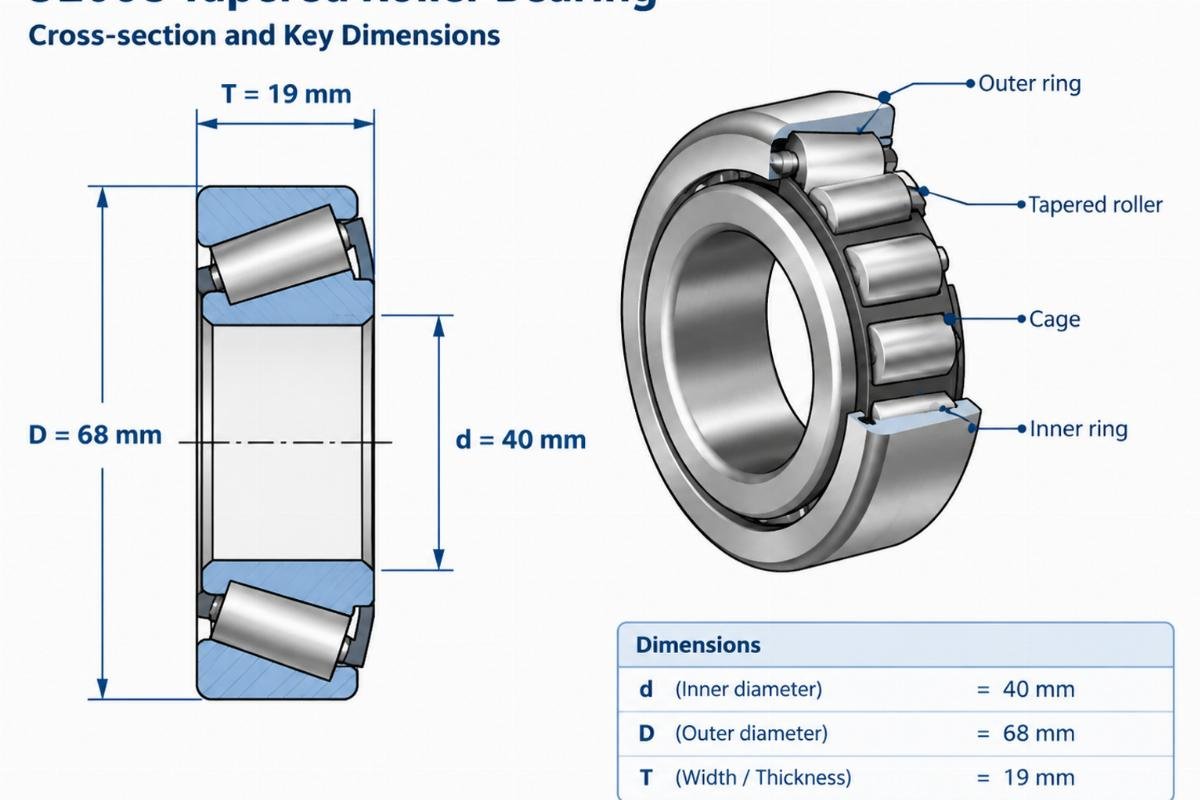
The core specifications for a 32008 tapered roller bearing are a bore diameter of 40 mm, an outside diameter of 68 mm, and a total width of 19 mm. However, selecting the correct unit for heavy-duty applications requires verifying dynamic load ratings, internal clearance classes such as C3 or C4, and cage material compatibility with operating speeds. Relying solely on dimensional matches without considering these technical parameters often leads to premature overheating and catastrophic equipment downtime.
I learned this lesson the hard way on a factory floor in Quang Ninh, Vietnam. A mining client had purchased a bulk shipment of tapered rollers that matched the part number perfectly. The dimensions were correct, but the internal clearance was standard C0, while the application involved high thermal expansion from continuous crushing operations. Within weeks, the bearings seized due to insufficient room for heat-induced expansion. That incident shifted my focus from simple part-number matching to a deeper analysis of load capacity and environmental suitability. When sourcing or advising on a 32008 bearing, I now prioritize traceability and technical alignment over initial cost savings. [NEED_CITE: ISO 355 standard for tapered roller bearing dimensions]
Understanding these nuances is critical for distributors and OEMs who need to ensure reliability in harsh industrial environments. The following sections break down the essential specifications, load considerations, and selection criteria that define a high-performance 32008 bearing.
What Are the Core Dimensions of 32008 Bearings?
Dimensions are the baseline, but tolerance defines quality.
The 32008 series follows the ISO 355 metric standard, ensuring interchangeability across major global brands. The primary dimensions are fixed: a 40 mm bore, 68 mm outer diameter, and 19 mm width. However, the manufacturing tolerance grades determine how well the bearing fits into housing and onto shafts under load. For heavy machinery, standard P0 tolerance may suffice, but precision applications often require P6 or higher grades to minimize vibration and noise. [NEED_CITE: ABMA standard tolerances for tapered roller bearings]
When comparing premium international brands with reliable domestic lines, the dimensional accuracy remains consistent if the manufacturer adheres to ISO standards. The difference often lies in the consistency of batch-to-batch production. A distributor stocking mixed brands must verify that each batch meets the specified tolerance class to avoid fitment issues during assembly.
| Parameter | Specification | Tolerance Class (Standard) | Application Note |
|---|---|---|---|
| Bore Diameter (d) | 40 mm | P0 / P6 | Shaft fit determines internal clearance |
| Outside Diameter (D) | 68 mm | P0 / P6 | Housing fit affects heat dissipation |
| Total Width (T) | 19 mm | P0 / P6 | Critical for axial positioning |
| Cup Width (C) | ~15 mm | N/A | Varies slightly by brand design |
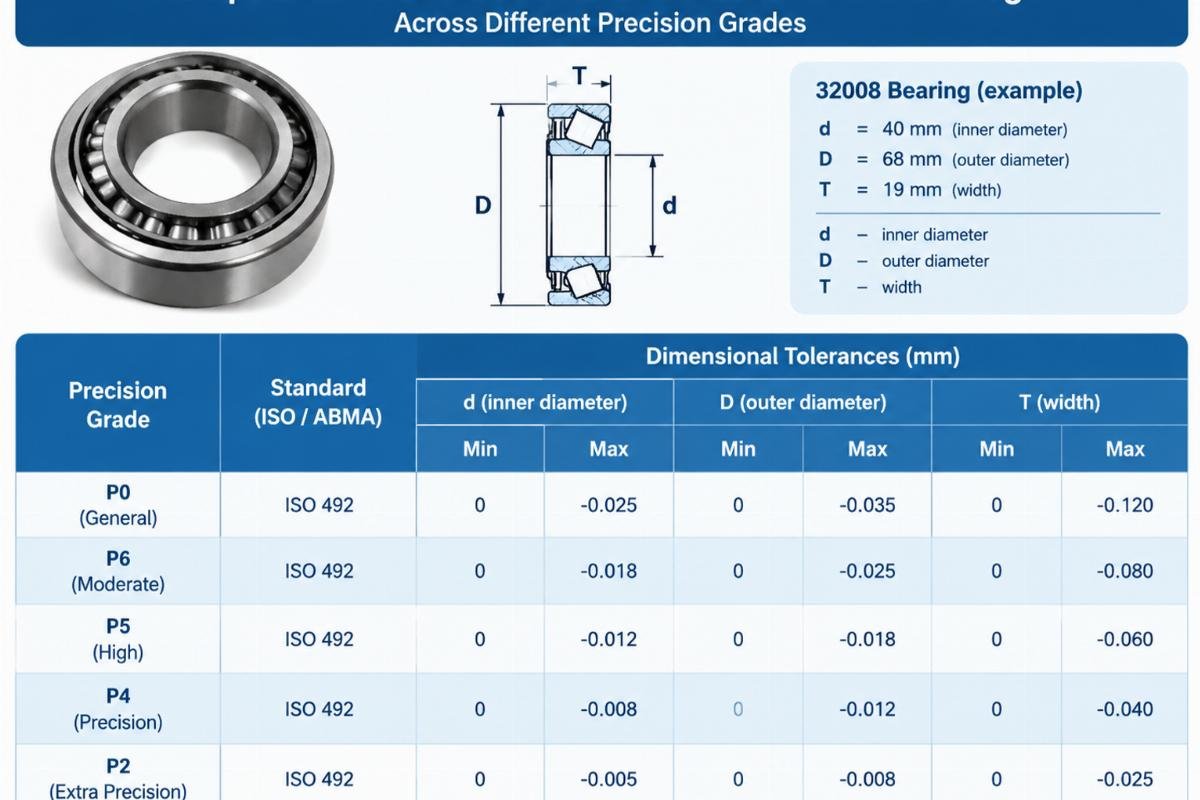
For a 32008 bearing, verifying these dimensions against the original equipment manufacturer’s drawings is the first step in procurement. Discrepancies in width or diameter, even within tolerance limits, can affect the preload setting in gearbox applications. Therefore, requesting inspection reports for critical batches is a prudent practice for MRO operators managing large fleets of machinery.
How Do Load Ratings Dictate 32008 Lifespan?
Load capacity is not a static number; it is a function of operating conditions.
The dynamic load rating indicates the load a bearing can endure for one million revolutions, while the static load rating represents the maximum load it can withstand when stationary. For a 32008 bearing, these values vary slightly between brands due to differences in steel purity and heat treatment processes. In mining crushers and aggregate conveyors, the actual load often exceeds calculated values due to shock impacts. [NEED_CITE: Calculation methods for bearing life under variable loads]
A common mistake is selecting a bearing based only on the basic dynamic load rating without accounting for the application factor. In dusty, high-vibration environments, the effective life can drop significantly if the bearing is not rated for such conditions. I have seen gearboxes fail prematurely because the selected 32008 bearing had a lower dynamic capacity than required for the peak torque events during startup.
| Load Type | Definition | Relevance to 32008 Application |
|---|---|---|
| Dynamic Load Rating | Load for 1 million revolutions | Determines fatigue life in rotating machinery |
| Static Load Rating | Max load without permanent deformation | Critical for stationary or slow-moving parts |
| Equivalent Dynamic Load | Calculated load including shocks | Used for accurate life prediction in harsh conditions |
Selecting the right 32008 bearing involves calculating the equivalent dynamic load based on radial and axial forces. If the axial load is significant, the contact angle of the tapered rollers becomes a crucial factor. Brands with optimized raceway geometry can handle higher axial loads, extending service life in applications like wheel hubs and pinion shafts. Distributors should provide technical data sheets that include these specific load ratings to help end-users make informed decisions.
Why Do Internal Clearances and Cages Matter?
Clearance and cage design dictate performance under stress.
Internal clearance refers to the space between the rolling elements and the raceways. Standard clearance (C0) is suitable for normal operating temperatures, but applications with high heat generation require greater clearance (C3 or C4) to accommodate thermal expansion. In the Quang Ninh case, the lack of adequate clearance led to metal-to-metal contact and rapid failure. For a 32008 bearing used in steel mills or cement plants, specifying the correct clearance class is non-negotiable. [NEED_CITE: Guidelines for selecting bearing internal clearance based on temperature]
Cage material also plays a vital role in high-speed or high-temperature environments. Steel cages are robust and suitable for heavy loads, but brass or polymer cages offer better performance in terms of weight and friction at higher speeds. In a recent project for a European wind farm operator, switching from a steel cage to a reinforced polymer cage in the gearbox reduced operating temperatures noticeably, enhancing the longevity of the 32008 bearing units.
| Cage Material | Characteristics | Best Suited For |
|---|---|---|
| Steel | High strength, durable | Heavy loads, moderate speeds |
| Brass | Good wear resistance, lower friction | High speeds, moderate temperatures |
| Polymer | Lightweight, low friction, corrosion resistant | High speeds, corrosive environments |
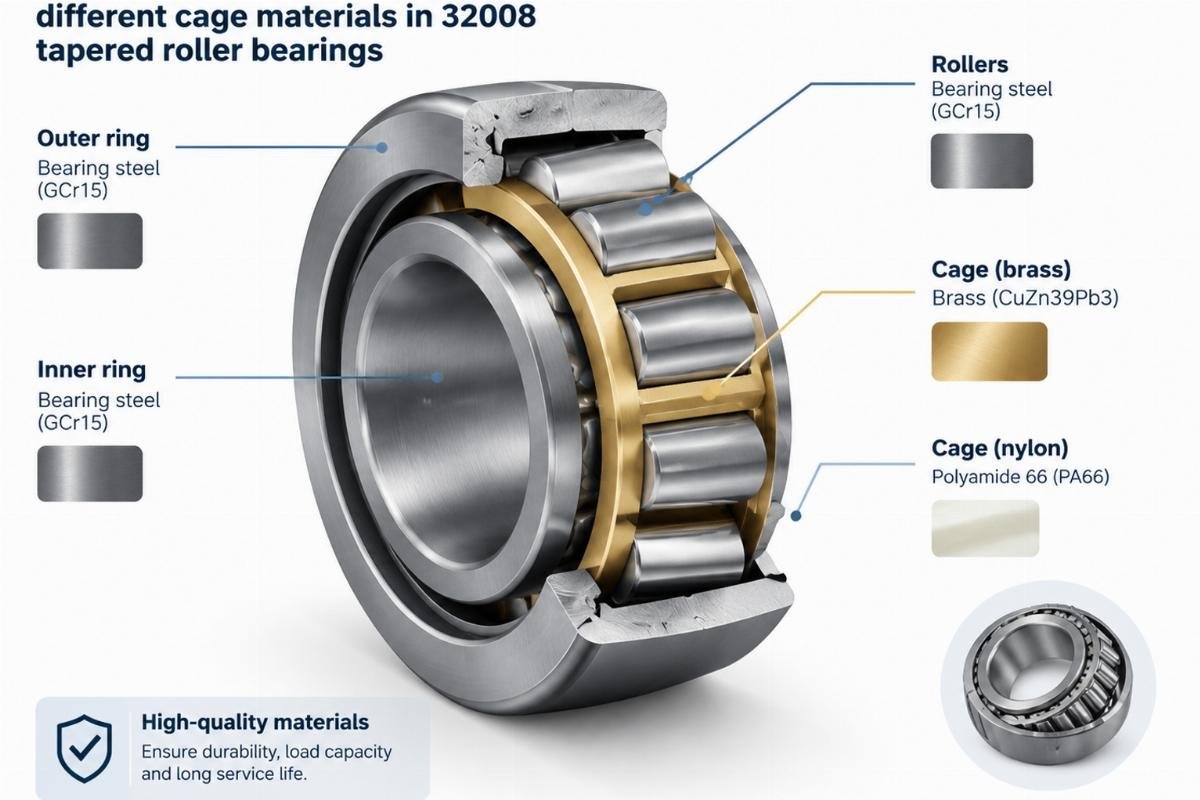
When sourcing a 32008 bearing, buyers should specify both the clearance class and cage material based on the operational profile. Ignoring these details can lead to unnecessary replacements and increased maintenance costs. Technical support from suppliers who understand these nuances can prevent such mismatches, ensuring that the selected bearing performs optimally in its intended environment.
How to Navigate Cross-Brand Equivalents?
Equivalency is about more than just matching part numbers.
Global supply chains often face stockouts, making cross-brand equivalents a viable solution. Major brands like SKF, TIMKEN, NSK, ZWZ, and HRB all produce 32008 bearing units that are dimensionally interchangeable. However, equivalence does not guarantee identical performance characteristics. Differences in steel quality, heat treatment, and manufacturing precision can affect lifespan and reliability. [NEED_CITE: Cross-reference guidelines for tapered roller bearings]
For distributors serving multiple regions, offering a mix of premium and reliable domestic brands provides flexibility. Premium brands are ideal for critical applications where failure is costly, while high-quality domestic lines offer a cost-effective alternative for less demanding roles. The key is transparency and traceability. Buyers need assurance that the equivalent 32008 bearing meets the required standards and comes with proper documentation.
| Brand | Origin | Typical Application Focus | Traceability Level |
|---|---|---|---|
| SKF | Sweden | High precision, heavy industry | Full batch-level |
| TIMKEN | USA | Heavy-duty, automotive | Full batch-level |
| NSK | Japan | Precision, low noise | Full batch-level |
| ZWZ | China | General industrial, cost-effective | Verifiable |
| HRB | China | Automotive, agricultural | Verifiable |
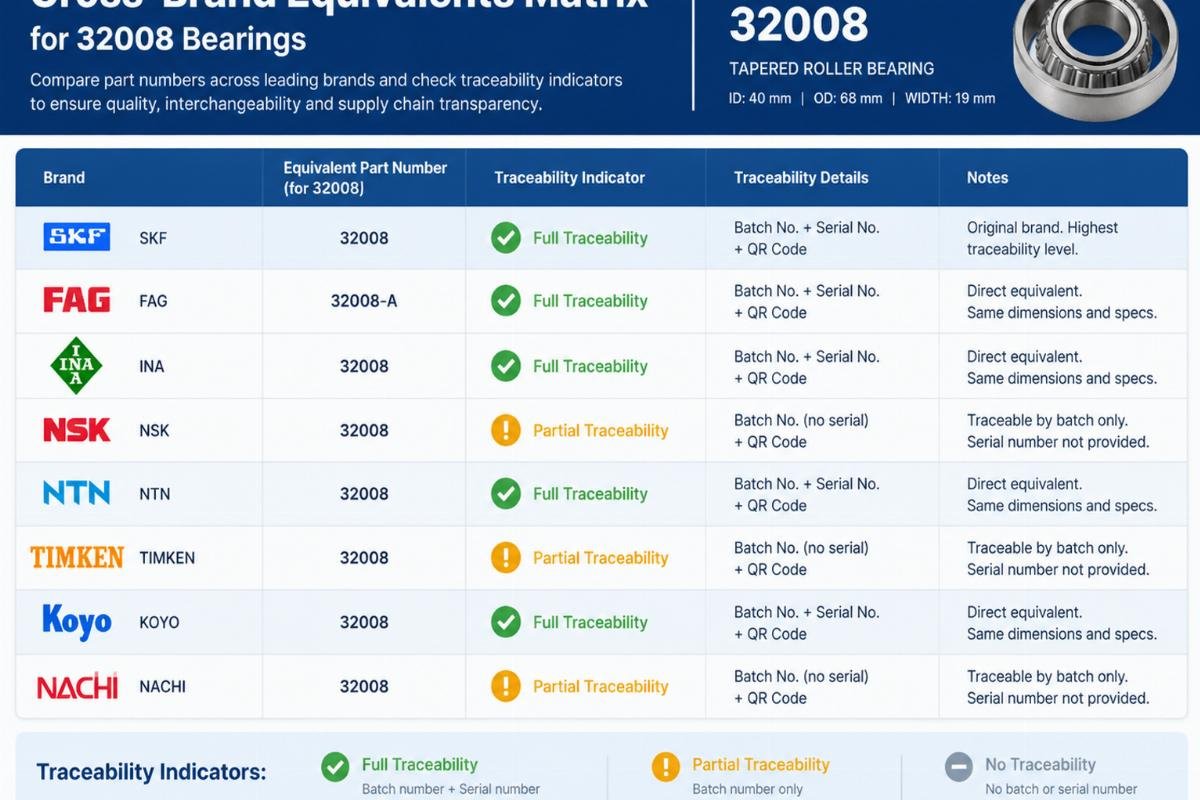
When evaluating equivalents, look for suppliers who provide genuine traceability documents. This ensures that the 32008 bearing you receive is authentic and meets the specified quality standards. Avoid sources that cannot provide proof of origin, as counterfeit products often lack the necessary material properties and precision, leading to early failure. A reliable supplier will offer technical selection support to help match the right equivalent to your specific application needs.
Conclusion
Specs are survival, not just numbers.
Selecting the right 32008 bearing requires a holistic approach that goes beyond dimensional matching. By considering load capacities, internal clearances, cage materials, and verified cross-brand equivalents, operators can ensure reliability and reduce downtime. Genuine traceability and technical expertise are essential for navigating the complexities of global bearing procurement.
Tagged

Written by
author
Editor covering global sourcing, supplier verification, and industrial product knowledge. Content is compiled from manufacturer specifications, industry standards, and hands-on experience with international B2B buyers. Every article is fact-checked before publishing to help procurement professionals make informed decisions.