Buy Bearings in Portugal: Stock & Lead Times from Global Wholesale Supplier
Buying bearings in Portugal requires balancing local stock limits with global lead times to minimize costly downtime. Official channels often delay specialized orders, while consolidated shipping from global suppliers offers faster, reliable solutions for urgent MRO needs and bulk projects.


Buy Bearings in Portugal: Stock & Lead Times from Global Wholesale Supplier
Local stock is not always the fastest route.
Sourcing bearings in Portugal requires balancing local stock limits with global lead times; importing via consolidated shipping often outperforms local official channels for urgent MRO needs.
I still remember the silence in a paper mill near Porto. It was not the peaceful quiet of a well-oiled machine, but the heavy, expensive silence of a stopped production line. The culprit was a single tapered roller bearing, a specific size that the local distributor did not have on the shelf. The procurement team waited weeks for an official channel restock, watching downtime costs mount. That experience reshaped how I view supply chains. When you are buying bearings in Portugal, the assumption that European proximity guarantees speed is often misleading. Official brand channels may hold limited standard sizes, while specialized or urgent requirements face significant delays. [NEED_CITE: typical inventory turnover rates for industrial distributors in Southern Europe]
The reality of industrial maintenance is that downtime costs far exceed shipping fees. Yet, many buyers hesitate to look beyond local borders due to perceived complexity. This guide breaks down the actual dynamics of bearing stock availability Portugal and reveals how global consolidation can provide a more reliable solution for both emergency replacements and bulk projects.
What is the typical stock availability for bearings in Portugal?
Local distributors primarily hold high-turnover standard sizes, leaving specialized units vulnerable to shortages.
In Portugal, as in much of Southern Europe, local bearing distributors operate on lean inventory models. They stock deep-groove ball bearings and common cylindrical roller bearings in popular metric sizes. These items move fast and justify the holding cost. However, when you need a large spherical roller bearing for a mining crusher or a precision angular contact bearing for a machine tool, the local shelf is often empty.
I have seen this pattern repeatedly. A maintenance manager in Lisbon might find a standard 6205 bearing within hours, but a specific TIMKEN tapered roller unit could take weeks to arrive from a central European hub. This gap creates a critical vulnerability for industries like wind power and steel manufacturing, where equipment diversity means non-standard parts are frequent necessities. [NEED_CITE: market analysis of bearing SKU coverage in Iberian distribution networks]
Consider the case of a wind farm operator in northern Portugal. When a main shaft bearing showed early signs of fatigue, the local supplier could not match the exact specification immediately. The operator faced a choice: wait for the official channel to transfer stock from Germany or France, or source from a global supplier with verified spot inventory. The delay in local availability meant extended exposure to weather-related risks and potential secondary damage.

The issue is not a lack of quality but a limitation of volume. Local warehouses cannot afford to hold every possible SKU. This is where understanding bearing stock availability Portugal becomes crucial. Buyers must recognize that “in stock” locally often means “standard only.” For anything outside the top twenty percent of moving parts, the local network relies on upstream replenishment, which introduces variable lead times.
How do lead times compare between local and global suppliers?
Official channels often involve multi-stage logistics, while global consolidation can offer direct and predictable timelines.
When evaluating bearing lead times Europe, it is essential to look beyond the quoted delivery date. Local orders often trigger a chain of internal transfers. A request in Porto might go to a Lisbon depot, then to a Madrid hub, and finally to a central European distribution center if the item is not regionally stocked. Each handoff adds time and administrative friction.
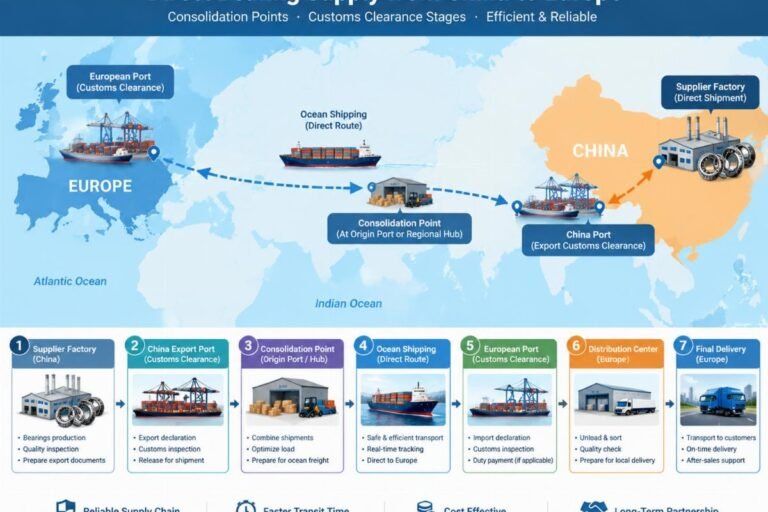
In contrast, sourcing from a global wholesale supplier with massive spot inventory allows for direct consolidation. I have managed shipments where mixed-brand bearings—SKF, FAG, NSK, and TIMKEN—were pulled from a centralized warehouse in China and shipped via less-than-container load (LCL) sea freight to Lisbon. While sea freight sounds slower, the total door-to-door time was often comparable to, or faster than, the fragmented air or road transport used by official channels for non-stock items. [NEED_CITE: comparative logistics data for cross-border industrial parts shipping]
| Sourcing Route | Typical Process | Lead Time Consistency | Best For |
|---|---|---|---|
| Local Official Channel | Multi-hop regional transfer | Variable, depends on hub stock | Standard, high-turnover SKUs |
| Global Consolidation | Direct pick and pack from central hub | High, based on verified spot stock | Specialized, mixed-brand, bulk orders |
| Emergency Air Freight | Direct expedited shipping | Fast but costly | Critical single-unit breakdowns |
A mining OEM client once needed dozens of different SKUs for a new project. Ordering each from separate local distributors would have resulted in staggered deliveries over several weeks. By consolidating the order through a global supplier, they received all components in a single shipment. The clarity of having one tracking number and one customs clearance event simplified their procurement process significantly.

This approach also mitigates the risk of partial shipments. When you are buying bearings in Portugal for a major overhaul, receiving ninety percent of the parts is not a success. Global consolidation ensures that the entire bill of materials arrives together, ready for installation.
What are the hidden costs of machine downtime vs. shipping costs?
Downtime losses frequently dwarf the expense of expedited or alternative shipping methods.
The most dangerous calculation in MRO procurement is comparing shipping fees in isolation. A buyer might reject a global quote because the freight cost is higher than a local pickup. However, this ignores the cost of the machine sitting idle. In heavy industry, an hour of downtime can cost thousands of euros in lost production, labor inefficiency, and potential contractual penalties.
I recall a situation with a cement plant operator. A critical spherical roller bearing failed unexpectedly. The local option was unavailable. The choice was between waiting ten days for a regional transfer or paying for expedited global shipping. The plant manager chose the faster global option. The freight cost was significant, but it was a fraction of the revenue lost during ten days of reduced output. [NEED_CITE: industrial downtime cost benchmarks for continuous process manufacturing]
This perspective shifts the focus from unit price to total cost of ownership. When you evaluate bearing lead times Europe, you must factor in the operational risk. A cheaper bearing that arrives two weeks late is infinitely more expensive than a premium bearing that arrives in three days.

Furthermore, global suppliers often offer flexible MOQs, allowing for single-unit emergency orders without the punitive pricing sometimes seen in official brand channels for small quantities. This flexibility is vital for maintaining operational continuity. By keeping a global partner on speed dial, Portuguese buyers can bypass local stockouts and secure the exact part needed, regardless of its rarity.
How to optimize cross-border bearing procurement for Portuguese buyers?
Use mixed-batch consolidation and pre-verified global stock to bypass local limitations.
Optimizing your supply chain involves strategic planning rather than reactive panic buying. The key is to establish a relationship with a global supplier who understands the nuances of import bearings from China to Portugal. This includes handling the necessary documentation, ensuring genuine product traceability, and managing customs clearance efficiently.
Start by auditing your critical spare parts list. Identify the bearings that are not standard stock items locally. These are your candidates for global sourcing. Next, verify the supplier’s inventory capabilities. Do they hold genuine products from major brands like SKF, FAG, INA, NSK, and TIMKEN? Can they provide complete traceability documentation? [NEED_CITE: ISO standards for bearing quality assurance and traceability]
A practical step is to place trial orders for non-critical but specialized items. This tests the supplier’s reliability, packaging quality, and communication speed. I have seen buyers successfully transition to a hybrid model: buying standard consumables locally for immediate needs, while relying on a global partner for specialized, bulk, or hard-to-find items.

Another optimization is leveraging mixed-brand consolidation. Instead of managing five different invoices from five different local vendors, you can consolidate SKF, NTN, and KOYO bearings into one shipment. This reduces administrative overhead and simplifies inventory management. For Portuguese buyers, this means fewer customs entries and lower handling fees per unit.
When you are buying bearings in Portugal, do not let geographic proximity blind you to global efficiency. The modern supply chain is borderless. By combining local convenience for standard items with global reach for specialized needs, you create a resilient procurement strategy that minimizes downtime and maximizes operational uptime.
Conclusion
Speed is not defined by distance, but by inventory visibility and logistics efficiency.
Sourcing bearings in Portugal requires a nuanced approach that balances local accessibility with global capability. While local distributors serve well for standard items, specialized and urgent needs often benefit from the vast, consolidated inventories of global wholesalers. By understanding the true cost of downtime and leveraging mixed-batch shipping, buyers can secure better lead times and greater reliability. The goal is not just to buy a part, but to keep the machine running.

Written by
author
Editor covering global sourcing, supplier verification, and industrial product knowledge. Content is compiled from manufacturer specifications, industry standards, and hands-on experience with international B2B buyers. Every article is fact-checked before publishing to help procurement professionals make informed decisions.