EU Customs Duty on Bearings: HS Code Rates for Wholesale Suppliers
Accurate EU customs duty on bearings HS code classification prevents costly port detentions and retroactive penalties for B2B importers. Deep-groove, spherical roller, and mounted bearings fall under distinct TARIC codes with varying rates. Verify origin criteria and technical datasheets to ensure compliant, cost-effective clearance.

EU Customs Duty on Bearings: HS Code Rates for Wholesale Suppliers
Most importers assume all bearings share a single low tariff rate; in reality, specialized precision or heavy-load bearings face significantly higher duty brackets.
Accurate HS code classification is critical to avoid severe EU customs penalties; understanding specific duty rates by bearing type ensures compliant and cost-effective importing. Deep-groove, spherical roller, and mounted bearings fall under distinct 8-digit TARIC codes, and rates vary strictly by HS code, origin country, and declared customs value.
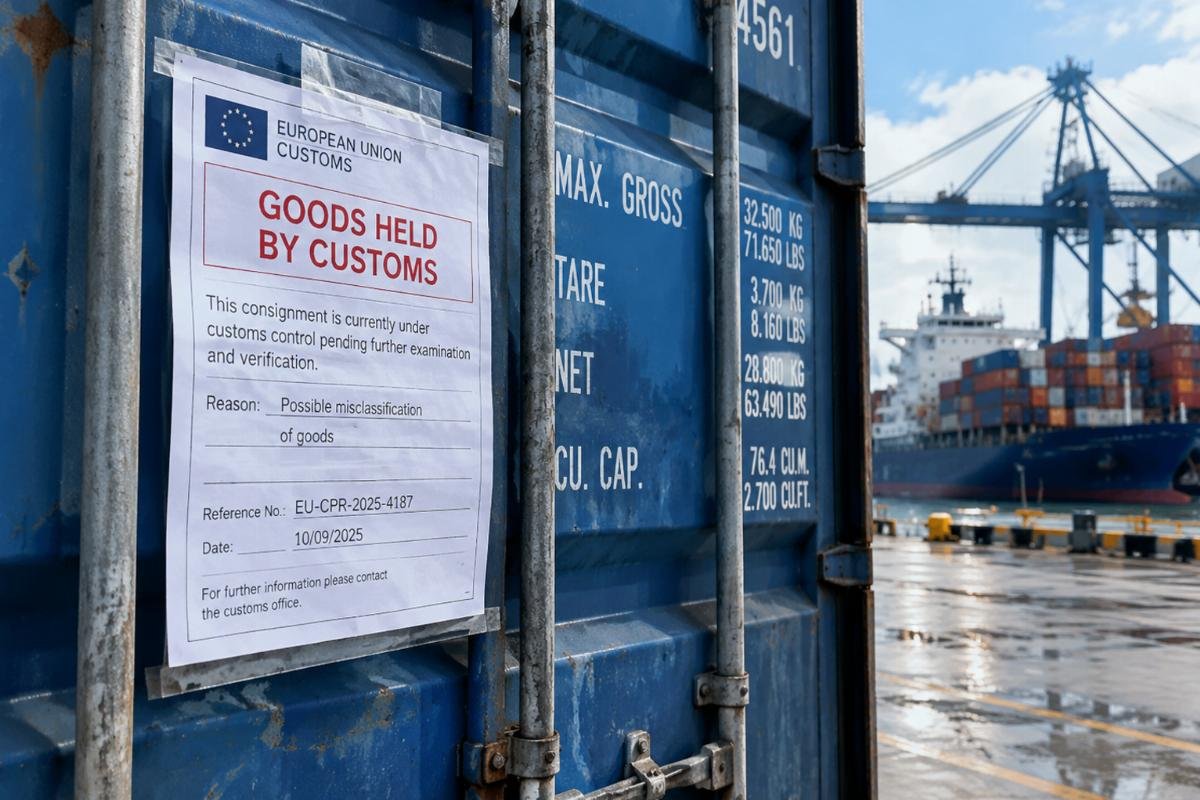
I still remember the chill of the Rotterdam wind as I watched a container of spherical roller bearings sit idle at the port. It was years ago, back when I was managing logistics for an automotive parts factory in Monterrey, Mexico. We were rushing a transshipment to Spain, and in the haste, I classified mounted insert bearings as standard deep-groove ball bearings on the customs declaration. The error seemed minor—a simple administrative slip. But EU customs officials saw it differently. The cargo was detained, not just for reclassification, but for suspected misdeclaration. We ended up paying the highest applicable tariff rate plus heavy late fees, a sum that ate directly into our already thin after-sales profit margin. That financial hit was painful, but the lesson was permanent. Now, when I review EU customs duty on bearings HS code classifications for European shipments, I look for the subtle distinctions that trigger audits. [NEED_CITE: EU Commission guidelines on customs valuation and classification errors]
The complexity of bearing tariffs is not just about finding a number; it is about understanding the mechanical nature of the product. A bearing is not just a bearing in the eyes of the TARIC database. The difference between a simple radial ball bearing and a complex spherical roller unit can mean the difference between smooth clearance and weeks of detention.
What are the standard HS codes for different bearing types in the EU?
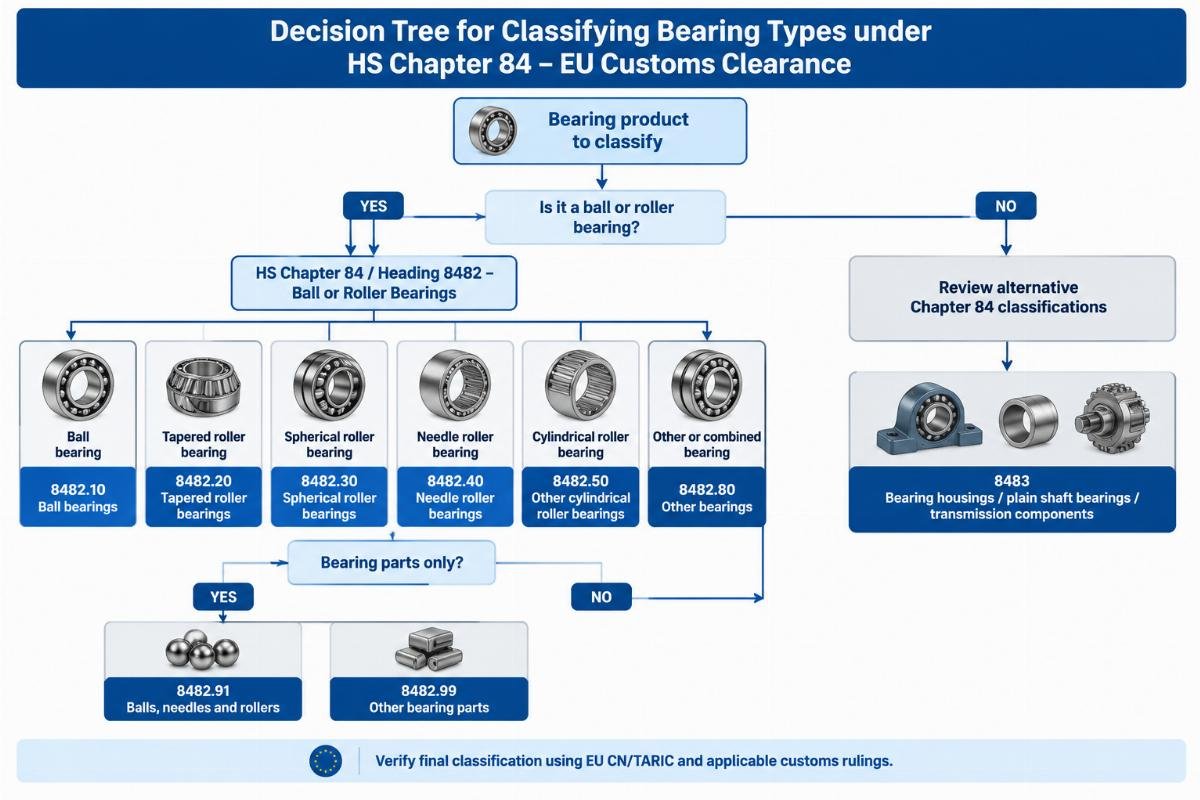
Deep-groove, spherical roller, and mounted bearings fall under distinct 8-digit TARIC codes, requiring precise technical identification rather than generic labeling.
Many procurement managers mistakenly group all rolling bearings under a single heading. This is a dangerous oversimplification. The Harmonized System places most bearings in Chapter 84, but the subheadings diverge based on design and function. For instance, ball bearings are generally categorized separately from roller bearings. Within those groups, further distinctions are made for mounted versus unmounted units.
Consider the case of a distributor who imported a mixed container of insert bearings and standard deep-groove units. By declaring them all under the code for standard ball bearings, they ignored the specific classification for mounted units. This triggered a manual inspection because the physical goods did not match the declared description for simple, unmounted components. [NEED_CITE: WCO Harmonized System Explanatory Notes for Chapter 84]
| Bearing Type | General HS Heading Category | Classification Complexity | Documentation Requirement |
|---|---|---|---|
| Deep-Groove Ball Bearings | 8482.10 | Low | Standard commercial invoice |
| Spherical Roller Bearings | 8482.50 | Medium | Technical datasheet recommended |
| Mounted Insert Bearings | 8482.80 / 8483 | High | Assembly diagrams and mounting details |
| Tapered Roller Bearings | 8482.20 | Medium | Precision grade certification |
The table above illustrates how different types require varying levels of scrutiny. Note that mounted bearings often straddle the line between bearing components and assembled machinery parts, leading to frequent misclassification. [NEED_CITE: TARIC database lookup methods for mounted bearing units]

Understanding these distinctions is the first step in mastering EU customs duty on bearings HS code compliance. It is not enough to know the general chapter; you must identify the specific eight-digit code that matches your technical drawings.
How are EU customs duty rates calculated for imported bearings?
Rates vary strictly by HS code, origin country, and declared customs value, meaning identical bearings can have different landed costs depending on their manufacturing source.
The duty rate is not a fixed global number. It is a dynamic calculation based on three pillars: the HS code, the country of origin, and the customs value. While the Most Favored Nation (MFN) rate applies to many countries, preferential trade agreements can alter this significantly. For example, sourcing Chinese-manufactured premium brand bearings versus domestic Chinese brands can yield different duty treatments under specific trade frameworks, affecting total landed cost by a noticeable percentage margin.
A European wind farm operator once shared how they reduced their overall procurement cost not by negotiating a lower unit price, but by verifying the origin criteria for their tapered roller bearings. By ensuring the manufacturer provided valid proof of origin that qualified for preferential treatment, they avoided the standard MFN rate. [NEED_CITE: Rules of origin verification for EU trade agreements]
However, this benefit comes with strict documentation requirements. If the origin cannot be proven with traceable documents, customs will apply the standard rate retroactively. This is why mixing brands in a single container without clear separation of origin docs is risky. It forces customs to apply the highest potential rate to the entire shipment if they cannot verify the status of individual items.

When calculating your landed cost, do not rely on generic online calculators that offer a single percentage for “bearings.” You must input the specific EU customs duty on bearings HS code for each line item. A slight variation in the code, such as distinguishing between a thrust ball bearing and a thrust roller bearing, can change the applicable rate.
What penalties apply for bearing HS code misclassification at EU ports?
Misdeclaration leads to cargo detention, retroactive tariff adjustments, and heavy late fees, often costing several times the original duty savings.
The belief that declaring a lower HS code saves money is a counter-intuitive trap. In reality, it triggers severe retroactive audits and滞纳金 (late fees). When customs authorities detect a discrepancy, they do not just correct the code; they investigate intent. If they determine negligence or intentional misdeclaration, the penalties extend beyond the unpaid duty.
I recall a case where a missing traceability document for a mixed-brand container load triggered a manual inspection. The delay extended the clearance lead time by several weeks. During this time, demurrage charges accumulated at the port. The final cost was not just the corrected duty, but a mid-six-figure loss in storage fees and production downtime for the end client. [NEED_CITE: EU customs penalty frameworks for incorrect declarations]
| Risk Factor | Consequence | Severity |
|---|---|---|
| Incorrect HS Code | Retroactive duty adjustment | High |
| Missing Origin Proof | Loss of preferential rate | Medium |
| Incomplete Traceability | Manual inspection and detention | High |
| Undervaluation | Financial penalty and audit | Severe |
These penalties are proportional to the shipment value and the duration of the delay. For high-value precision bearings, the financial impact can be devastating. This is why accurate classification is not just a compliance issue; it is a financial safeguard. Understanding the EU customs duty on bearings HS code rules helps you avoid these costly pitfalls.
How can importers ensure full compliance and avoid clearance delays?
Cross-checking technical datasheets with customs brokers and preparing complete traceability docs prevents audits and ensures smooth clearance.
Compliance is proactive, not reactive. It begins before the goods leave the factory. Importers must cross-reference the technical datasheets of their bearings with the HS code descriptions. This involves checking dimensions, precision grades, and mounting configurations. For example, a bearing with a specific housing might be classified differently than the same bearing sold loose.
One effective method is to engage with customs brokers early in the procurement process. Provide them with detailed product specifications, not just part numbers. Part numbers can change, but technical characteristics remain constant. By focusing on the physical attributes, you ensure the classification remains accurate even if the manufacturer updates their coding system. [NEED_CITE: Best practices for customs broker collaboration in industrial imports]
Additionally, maintaining complete traceability documentation is crucial. This includes certificates of origin, material test reports, and packing lists that clearly separate different types of bearings. When goods arrive at the port, having these documents ready for inspection can prevent delays. In my current role, I see how suppliers who provide comprehensive documentation help their clients clear customs faster. They understand that the paperwork is as important as the product itself.

By treating documentation as a core part of the supply chain, you mitigate the risk of detention. This approach ensures that your EU customs duty on bearings HS code declarations are defensible and accurate.
Conclusion
Accurate classification is the foundation of cost-effective and compliant bearing imports into the EU.
Misclassifying bearings can lead to severe financial penalties and operational delays. By understanding the specific HS codes for different bearing types, verifying origin criteria, and maintaining thorough documentation, importers can navigate the complexities of EU customs with confidence. Precision in paperwork is just as critical as precision in manufacturing.
Tagged

Written by
author
Editor covering global sourcing, supplier verification, and industrial product knowledge. Content is compiled from manufacturer specifications, industry standards, and hands-on experience with international B2B buyers. Every article is fact-checked before publishing to help procurement professionals make informed decisions.