EU Late Payment Directive: B2B Bearing Wholesale Supplier
Clarify the EU Late Payment Directive for B2B transactions to protect cash flow against delayed acceptance tactics. The standard legal term is 30 days, with statutory interest accruing automatically at the ECB rate plus eight percentage points. Define verification periods clearly to enforce these mandates.


EU Late Payment Directive: B2B Bearing Wholesale Supplier
Most buyers assume the 60-day payment window is a statutory right. It is not.
Under the EU Late Payment Directive, the standard legal payment term for B2B transactions is 30 days from the date of invoice or receipt of goods, whichever is later. Extending this to 60 days requires an explicit contractual clause that is not grossly unfair to the creditor. Statutory interest for late payments is automatically applicable at the European Central Bank reference rate plus at least eight percentage points, without the need for a formal reminder. For a B2B bearing wholesale supplier, understanding these mandates is critical to protecting cash flow against delayed acceptance tactics and ensuring compliance in European trade.
Navigating the complexities of cross-border industrial supply chains often reveals that contractual ambiguities are more costly than mechanical failures. I recall a shipment of spherical roller bearings destined for a heavy-equipment manufacturer in Northern Europe. The buyer invoked an internal quality inspection process to delay payment well beyond the typical window, claiming the goods were not yet accepted. This tactic effectively turned a standard transaction into an interest-free loan for their operations. Such experiences highlight why precise knowledge of the EU Late Payment Directive is not just legal theory but a practical tool for financial survival in the bearing industry.
What are the statutory payment deadlines under the EU Directive?
The default statutory deadline is 30 days, not 60.
Many procurement officers operate under the misconception that 60 days is the standard legal limit for B2B payments in Europe. In reality, Directive 2011/7/EU establishes 30 days as the baseline [NEED_CITE: EU Directive 2011/7/EU Article 3]. Extensions up to 60 days are permissible only if expressly agreed in the contract and provided they are not grossly unfair to the supplier. Any term exceeding 60 days is presumed to be grossly unfair unless the debtor can prove otherwise.
For distributors and OEMs sourcing from a B2B bearing wholesale supplier, this distinction is vital. Contracts that vaguely state net 60 without specific justification may be challenged. The directive aims to protect smaller enterprises from the abuse of bargaining power by larger entities. Therefore, payment terms must be clear, written, and mutually agreed upon before the delivery of goods.
| Payment Term Scenario | Legal Status under EU Directive | Requirement |
|---|---|---|
| Up to 30 days | Standard Statutory Right | No specific clause needed |
| 31 to 60 days | Permissible Exception | Must be explicitly agreed in contract |
| Over 60 days | Presumed Grossly Unfair | Debtor must prove fairness |
| Undefined Terms | Defaults to 30 Days | Statutory baseline applies |
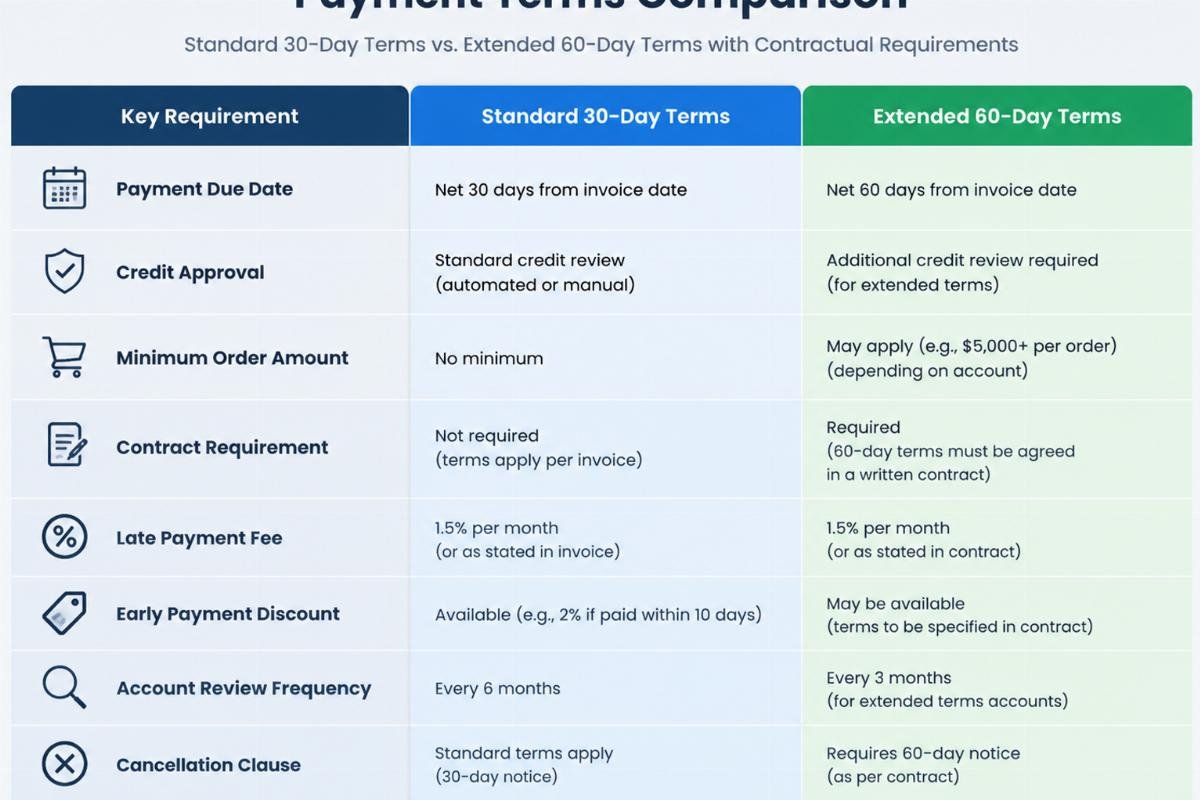
When negotiating with a B2B bearing wholesale supplier, ensure that any extension beyond 30 days is justified by the nature of the transaction. For instance, complex custom bearings might warrant longer verification periods, but standard off-the-shelf items like deep-groove ball bearings do not. Clarity here prevents disputes and ensures that payment obligations are enforceable under national laws implementing the directive.
How is statutory interest calculated for late B2B payments?
Statutory interest is an automatic right, not a negotiated penalty.
Upon the expiration of the agreed payment period, interest begins to accrue automatically. There is no need for the creditor to send a formal reminder or notice of default. The rate is set at the European Central Bank reference rate plus a minimum of eight percentage points [NEED_CITE: EU Directive 2011/7/EU Article 4]. This high margin is designed to deter late payments and compensate the supplier for the cost of borrowing and administrative burden.
For a B2B bearing wholesale supplier, this mechanism provides a powerful lever for recovering funds. If a buyer delays payment for a batch of tapered roller bearings, the supplier can claim this interest without prior warning. The calculation starts from the day following the due date. National laws may provide for higher rates, but they cannot go below this EU-mandated minimum.

It is crucial to note that this interest applies to the entire overdue amount. In cases where partial payments are made, interest continues to accrue on the remaining balance. This automatic entitlement shifts the burden of punctuality onto the buyer. When dealing with a B2B bearing wholesale supplier, buyers should be aware that ignoring invoices does not stop the clock. The legal framework ensures that cash flow disruptions are financially penalized, encouraging timely settlements.
Can buyers use internal acceptance processes to delay payments?
Verification periods must be reasonable and defined, not indefinite.
A common tactic used by large industrial buyers is to extend the payment period by claiming that internal acceptance procedures are ongoing. The EU Late Payment Directive addresses this by stating that the period for verifying conformity of goods must be explicitly agreed and must not exceed 30 days unless strictly necessary due to the nature of the goods [NEED_CITE: EU Directive 2011/7/EU Article 3]. Using vague internal audits to delay payment for standard bearings is considered an abusive practice.
In my experience, a mining equipment operator once delayed payment for a urgent order of insert bearings by citing an undefined internal review process. This pushed the payment date months past delivery. Such actions violate the spirit and letter of the directive. The verification period must be objective and tied to the technical complexity of the product. For standard industrial bearings, extensive testing is rarely justified.

Suppliers should insist on defining the acceptance criteria and timeline in the contract. If a buyer attempts to use internal processes to delay payment, the supplier can refer to the directive’s provisions on grossly unfair terms. A B2B bearing wholesale supplier can argue that standard products like cylindrical roller bearings do not require prolonged verification. This protects the supplier from having their capital tied up in disputed receivables.
How to structure bearing contracts to enforce these terms?
Tie payments to delivery milestones, not end-user acceptance.
To mitigate the risk of delayed payments, contracts should be structured to link payment obligations to clear, objective milestones. Instead of relying on final acceptance by the end-user, which can be delayed by third parties, payments should be triggered by delivery and initial inspection. This aligns with the directive’s emphasis on certainty and fairness.
For example, a contract might specify that 50% of the payment is due upon shipment and the remaining 50% within 30 days of receipt. This structure reduces the risk associated with long-term projects where final acceptance might be delayed. When sourcing from a B2B bearing wholesale supplier, such terms provide clarity and reduce the scope for dispute.
| Contract Clause Element | Best Practice | Risk if Omitted |
|---|---|---|
| Payment Trigger | Delivery + Initial Inspection | Delayed by end-user acceptance |
| Verification Period | Fixed, short duration (e.g., 7-14 days) | Indefinite delays via internal audits |
| Interest Clause | Reference to EU statutory rate | Ambiguity in penalty enforcement |
| Dispute Resolution | Clear timeline for claims | Prolonged non-payment during disputes |

Additionally, including clear documentation requirements helps speed up the process. Providing traceability documents and certificates of conformity at the time of delivery allows the buyer to complete their verification quickly. A B2B bearing wholesale supplier who offers comprehensive documentation supports the buyer in meeting their own compliance needs, facilitating faster payment cycles. This approach transforms the supplier-buyer relationship from adversarial to collaborative, ensuring smooth transactions.
Conclusion
Compliance with the EU Late Payment Directive protects both suppliers and buyers.
Understanding the statutory 30-day baseline and the automatic nature of statutory interest empowers businesses to negotiate fair terms. By defining verification periods clearly and linking payments to objective milestones, companies can avoid the cash flow traps associated with delayed acceptance. For any B2B bearing wholesale supplier, these practices are essential for maintaining healthy financial operations in the European market.
Tagged

Written by
author
Editor covering global sourcing, supplier verification, and industrial product knowledge. Content is compiled from manufacturer specifications, industry standards, and hands-on experience with international B2B buyers. Every article is fact-checked before publishing to help procurement professionals make informed decisions.