ISO 15243 Bearing Damage Classification Guide from Global Supplier
Master ISO 15243 bearing damage classification to distinguish installation errors from material defects. Identify plastic deformation and smearing through visual inspection to pinpoint root causes like misalignment. Prevent unnecessary warranty disputes and downtime by applying standardized failure analysis for accurate maintenance decisions.

ISO 15243 Bearing Damage Classification Guide from Global Supplier
Most bearing failures are not manufacturing defects.
ISO 15243 provides a standardized visual framework to classify rolling bearing damage, enabling engineers to distinguish between material fatigue and installation-induced plastic deformation. By identifying specific failure modes such as smearing, spalling, or corrosion through macroscopic inspection, maintenance teams can pinpoint root causes like misalignment or improper lubrication rather than prematurely blaming product quality.
The dust in the Ethiopian mine was thick enough to taste. I stood next to a primary crusher that had been down for three days. The local maintenance crew insisted the spherical roller bearing was junk. They pointed at the shattered outer ring and demanded a warranty replacement from the manufacturer. I picked up a magnifying glass and looked closely at the raceway. There were no signs of subsurface fatigue cracks typical of material defects. Instead, I saw distinct hammer marks and localized plastic deformation on the outer ring bore. The bearing had not failed because it was weak; it failed because someone had used a sledgehammer to drive it onto the shaft. This scene repeated itself across multiple sites until I realized that visual literacy in failure analysis is more critical than inventory depth. Understanding ISO 15243 bearing damage classification transforms how we approach maintenance, turning guesswork into actionable engineering data. [NEED_CITE: ISO 15243 standard scope and application]
This guide breaks down the standard’s categories, focusing on how to identify installation errors that are frequently misdiagnosed as product faults. For distributors and MRO engineers, mastering these visual cues prevents unnecessary warranty disputes and ensures the correct corrective actions are taken.
What is ISO 15243 and Why Does It Matter?
Before ISO 15243, failure analysis was often subjective. One engineer’s “wear” was another’s “corrosion.” The standard introduced a unified terminology and visual reference system for classifying damage modes in rolling bearings. It categorizes failures into six primary groups: fatigue, wear, corrosion, electrical passage, plastic deformation, and fracture/crack. [NEED_CITE: Six primary damage categories in ISO 15243]
For global suppliers and end-users, this standardization matters because it creates a common language. When a customer in Southeast Asia sends a photo of a damaged cylindrical roller bearing, referencing ISO 15243 allows for precise diagnosis without physical inspection. It shifts the conversation from “your product broke” to “this specific damage mode occurred due to this operational condition.”
The core value lies in its ability to separate inevitable end-of-life fatigue from preventable premature failures. Fatigue is expected after a calculated service life. However, if a bearing shows signs of plastic deformation within weeks of installation, the issue is not the steel quality but the handling process. Recognizing this distinction saves significant costs in warranty claims and downtime. [NEED_CITE: Relationship between damage mode and root cause identification]

How to Identify Installation-Induced Damage?
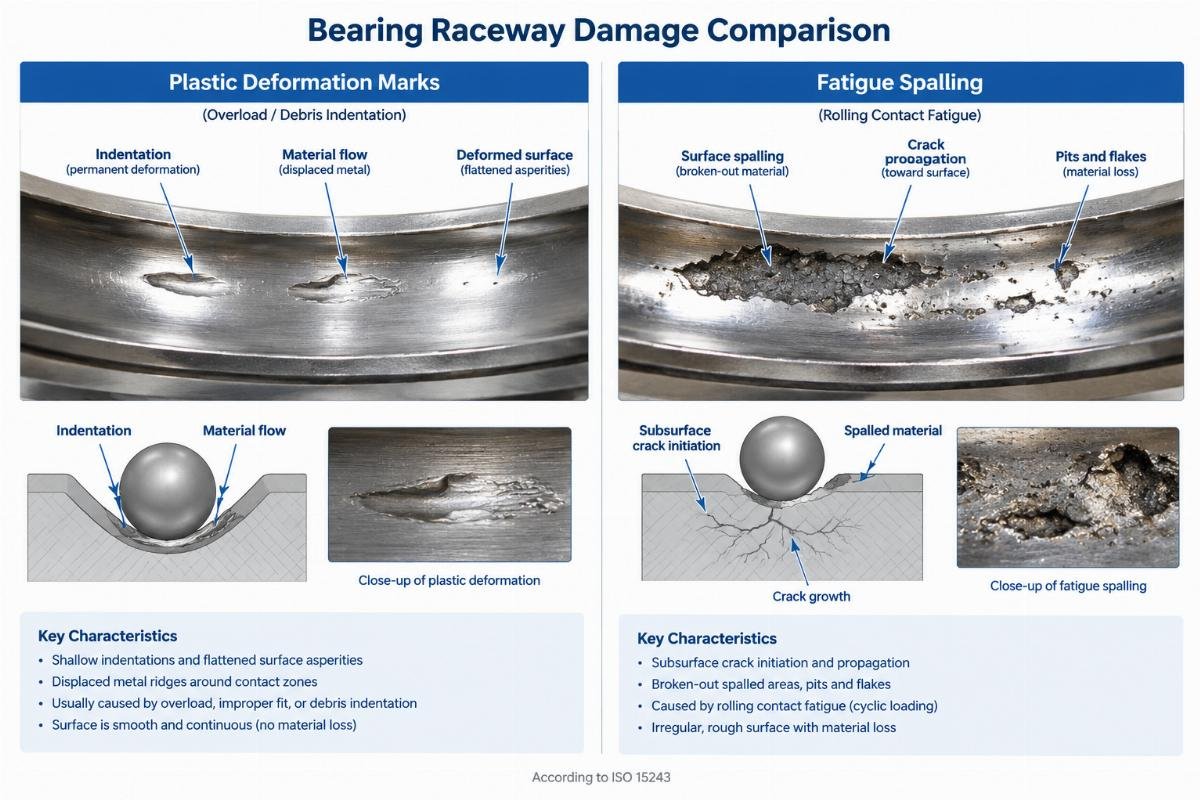
Installation errors are among the most common causes of premature bearing failure, yet they are often overlooked. ISO 15243 classifies these under “Plastic Deformation,” which includes indentations, elongated holes, and smeared surfaces caused by excessive load during mounting or operation.
In my experience, the most frequent culprit is direct impact. Using a hammer to install a bearing transfers kinetic energy directly into the rolling elements and raceways, creating micro-cracks or permanent dents. These dents act as stress concentrators, leading to early spalling that mimics fatigue failure. However, unlike true fatigue, which starts subsurface, impact damage originates at the surface.
To identify this, inspect the non-rotating ring. If the bearing was driven onto a shaft, look for damage on the inner ring bore. If it was pressed into a housing, check the outer ring outside diameter. Look for bright, shiny spots or rough textures where the metal has been displaced. [NEED_CITE: Visual characteristics of mounting damage in ISO 15243]
Another common installation error is misalignment. When a spherical roller bearing is forced into a misaligned housing, edge loading occurs. This creates a distinct wear pattern on the raceway edges, often accompanied by high operating temperatures. The ISO 15243 standard helps differentiate this from normal running-in wear by highlighting the localized nature of the stress concentration.
| Damage Feature | Visual Indicator | Likely Root Cause |
|---|---|---|
| Indentations | Circular or elliptical dents on raceway | Foreign particles or impact during mounting |
| Smearing | Metallic transfer between surfaces | Slippage due to insufficient preload or lubrication |
| Elongated Holes | Distorted cage pockets | Excessive acceleration or vibration during start-up |
| Edge Loading | Wear concentrated on raceway edges | Shaft or housing misalignment |
Using these visual cues, technicians can determine if the failure was due to poor installation practices. This insight is crucial for preventing recurrence. Simply replacing the bearing without correcting the mounting procedure will lead to the same failure. [NEED_CITE: Preventive measures for installation-related damage]

What Are the Common Misdiagnosed Failure Modes?
Misdiagnosis leads to incorrect corrective actions. A prevalent myth is that spalling always indicates poor steel quality. While material defects can cause spalling, ISO 15243 reveals that many cases stem from operational issues like inadequate lubrication or contamination.
Lubrication failure often manifests as discoloration or bluing of the bearing components due to overheating. This thermal damage weakens the steel structure, making it susceptible to rapid spalling. Without recognizing the discoloration, an engineer might replace the bearing with a higher-grade steel unit, which will still fail if the lubrication system remains flawed. [NEED_CITE: Thermal damage indicators in rolling bearings]
Contamination is another frequent misdiagnosed cause. Abrasive particles entering the bearing create fine scratches on the raceways, known as abrasive wear. Over time, this increases clearance and vibration, leading to secondary fatigue. Operators often blame the seal design, but the root cause may be poor maintenance hygiene during storage or installation. ISO 15243 provides clear images of abrasive wear patterns, distinguishing them from adhesive wear or corrosion.
Electrical passage damage is also commonly confused with corrosion. Stray currents passing through a bearing cause localized melting and pitting, known as fluting. This looks similar to corrosion pits but has a distinct rhythmic pattern corresponding to the rolling element spacing. Identifying this correctly requires checking the grounding of the motor or generator, not just changing the bearing type. [NEED_CITE: Differentiation between electrical pitting and corrosion]
By accurately classifying these modes, maintenance teams can address the real issues. Whether it is improving filtration, fixing grounding, or adjusting lubrication intervals, the solution depends on the correct diagnosis.

How to Prevent Premature Bearing Failures?
Prevention starts with understanding the root causes identified through ISO 15243 classification. For mining crushers and heavy equipment, the focus must be on proper installation and environmental protection.
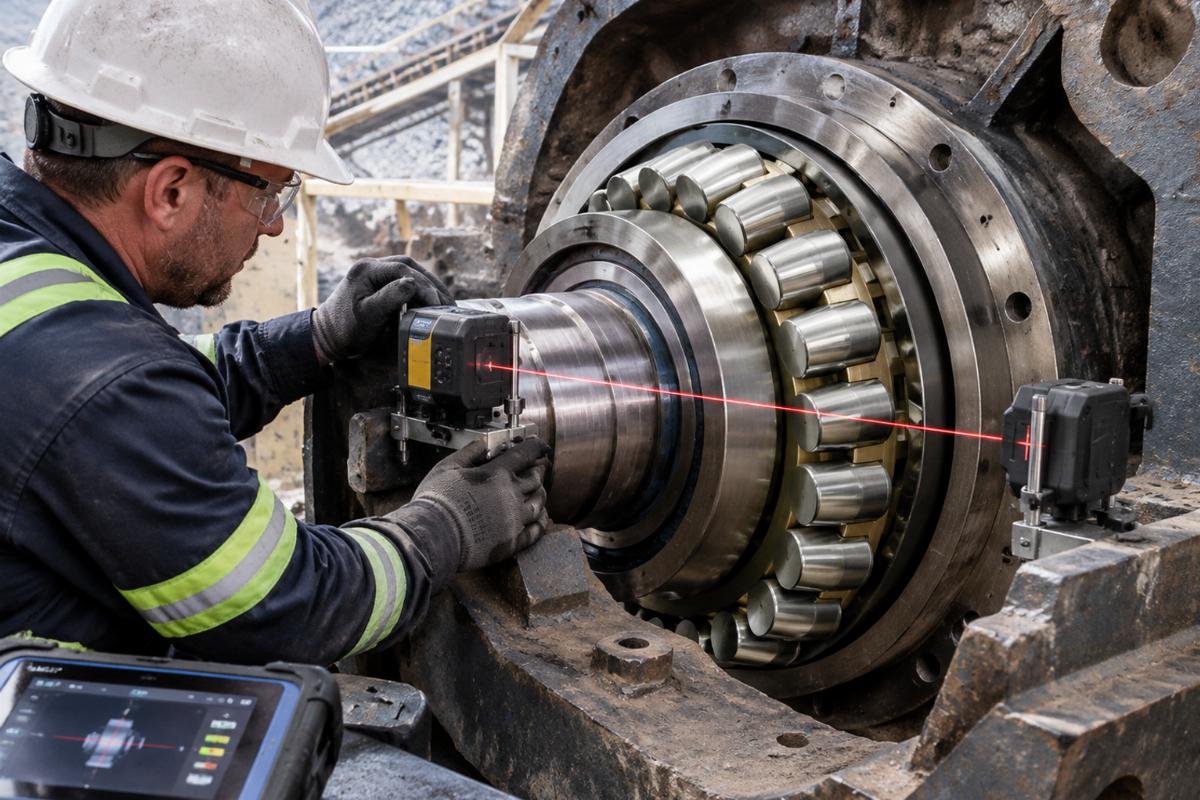
Standardized installation protocols are essential. Use induction heaters or hydraulic presses instead of hammers. Ensure shafts and housings are clean and free of burrs. Verify alignment using laser tools rather than visual estimation. These steps eliminate the primary causes of plastic deformation and edge loading. [NEED_CITE: Best practices for bearing mounting and alignment]
Lubrication management is equally critical. Select the right grease or oil viscosity for the operating temperature and speed. Implement regular monitoring programs to detect contamination early. In harsh environments like mines or steel mills, use sealed bearings or enhanced shielding to protect against dust and moisture.
Training maintenance staff on ISO 15243 visual inspection techniques empowers them to catch issues before catastrophic failure. Regular audits of failed bearings can reveal systemic problems in maintenance practices. For example, if multiple bearings show signs of abrasive wear, it indicates a breach in the sealing system or contaminated lubricant supply.
As a global supplier, we support these efforts by providing genuine bearings from brands like SKF, FAG, and TIMKEN, along with technical consultation. Our team helps customers select the right bearing type and sealing solution for their specific application, reducing the risk of premature failure. We also offer failure analysis support, helping engineers interpret damage patterns and implement effective corrective actions. [NEED_CITE: Importance of technical support in bearing selection]
Conclusion
Visual inspection guided by ISO 15243 bearing damage classification is the most effective tool for diagnosing bearing failures.
It moves maintenance from reactive replacement to proactive problem-solving. By distinguishing between installation errors, operational stresses, and material defects, engineers can extend bearing life and reduce downtime. Accurate diagnosis ensures that the right solutions are applied, whether it is improving installation techniques, enhancing lubrication, or upgrading sealing systems. For global industries relying on heavy machinery, this knowledge is not just technical detail; it is a cornerstone of operational reliability.
Tagged

Written by
author
Editor covering global sourcing, supplier verification, and industrial product knowledge. Content is compiled from manufacturer specifications, industry standards, and hands-on experience with international B2B buyers. Every article is fact-checked before publishing to help procurement professionals make informed decisions.