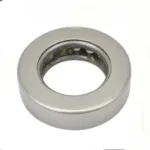
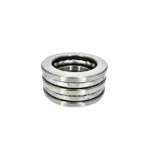
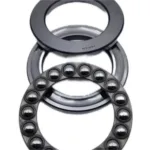
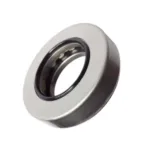
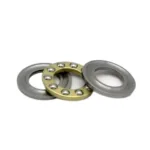
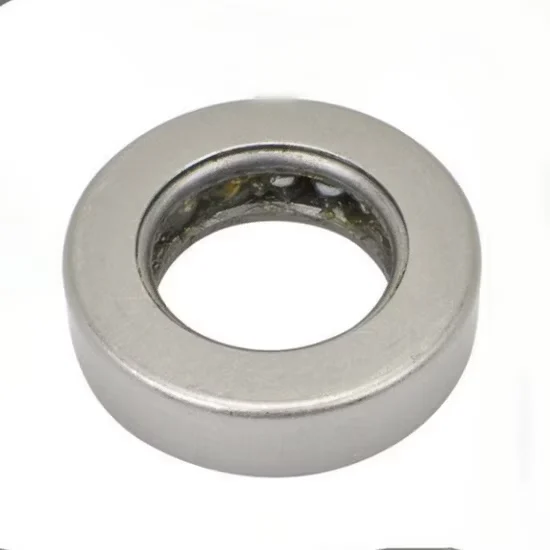
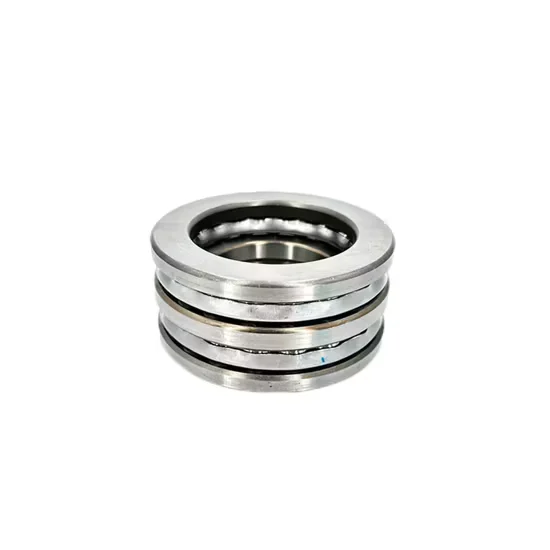
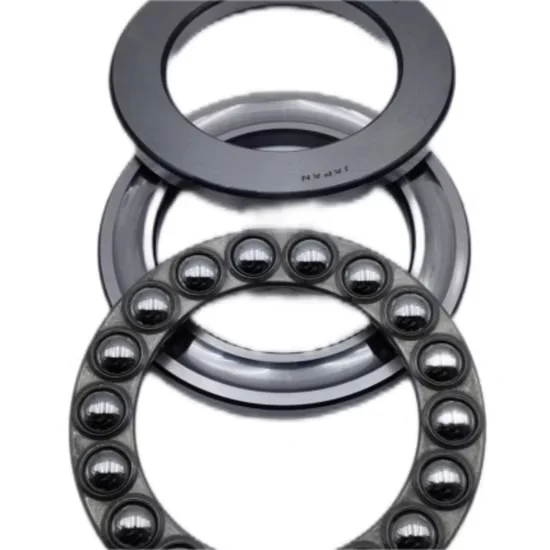
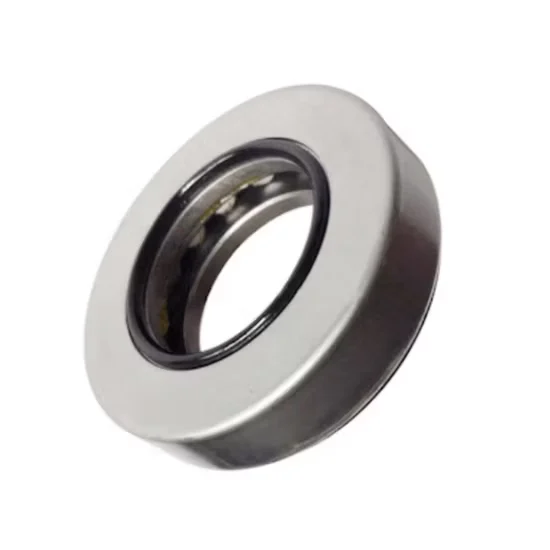
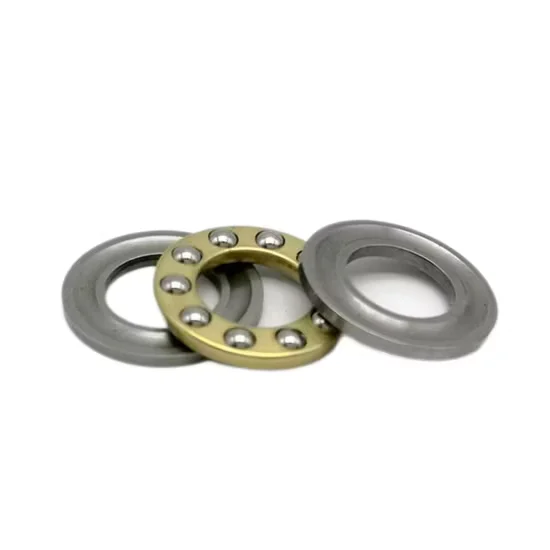
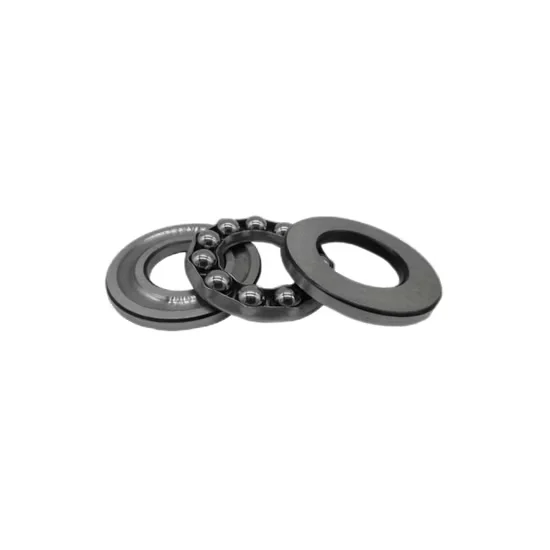
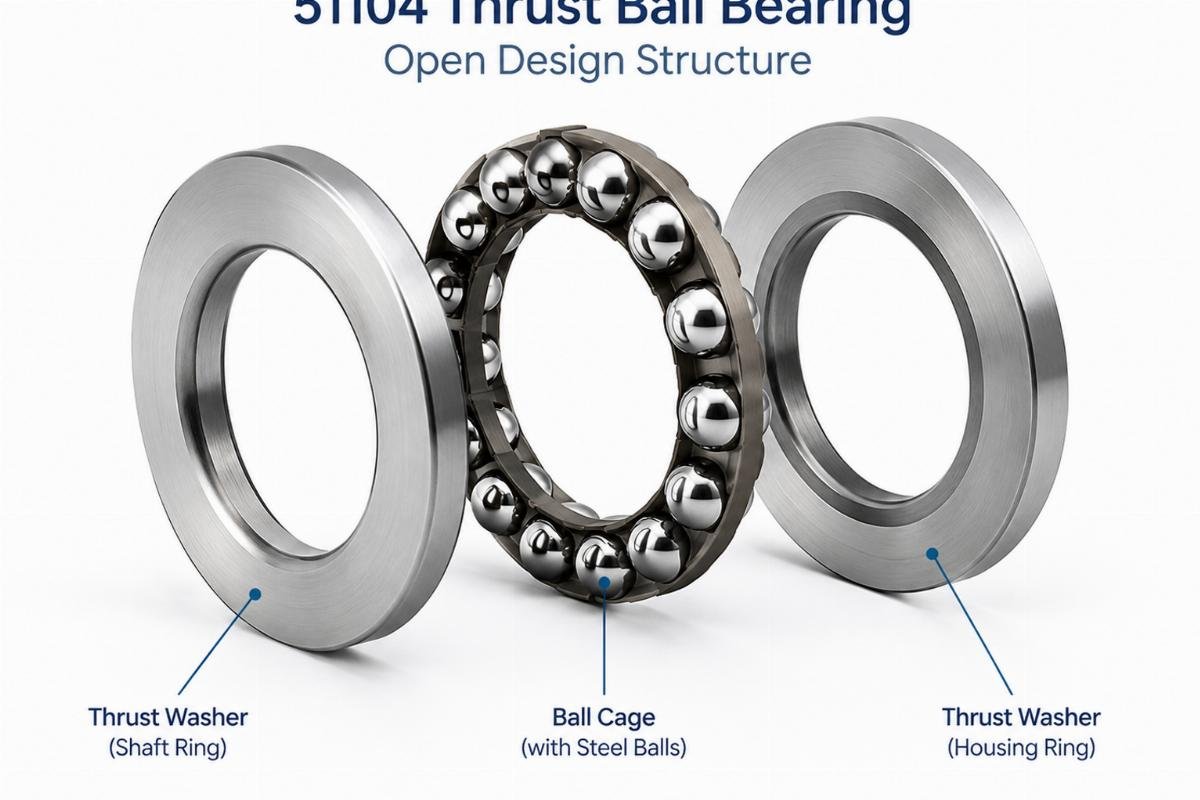
51104 Thrust Ball Bearing 20×35×10 mm P0/P6/P5 — open design requires external lubrication and proper sealing arrangements.
Handles unidirectional axial loads effectively in machine tool spindles and crane hooks.
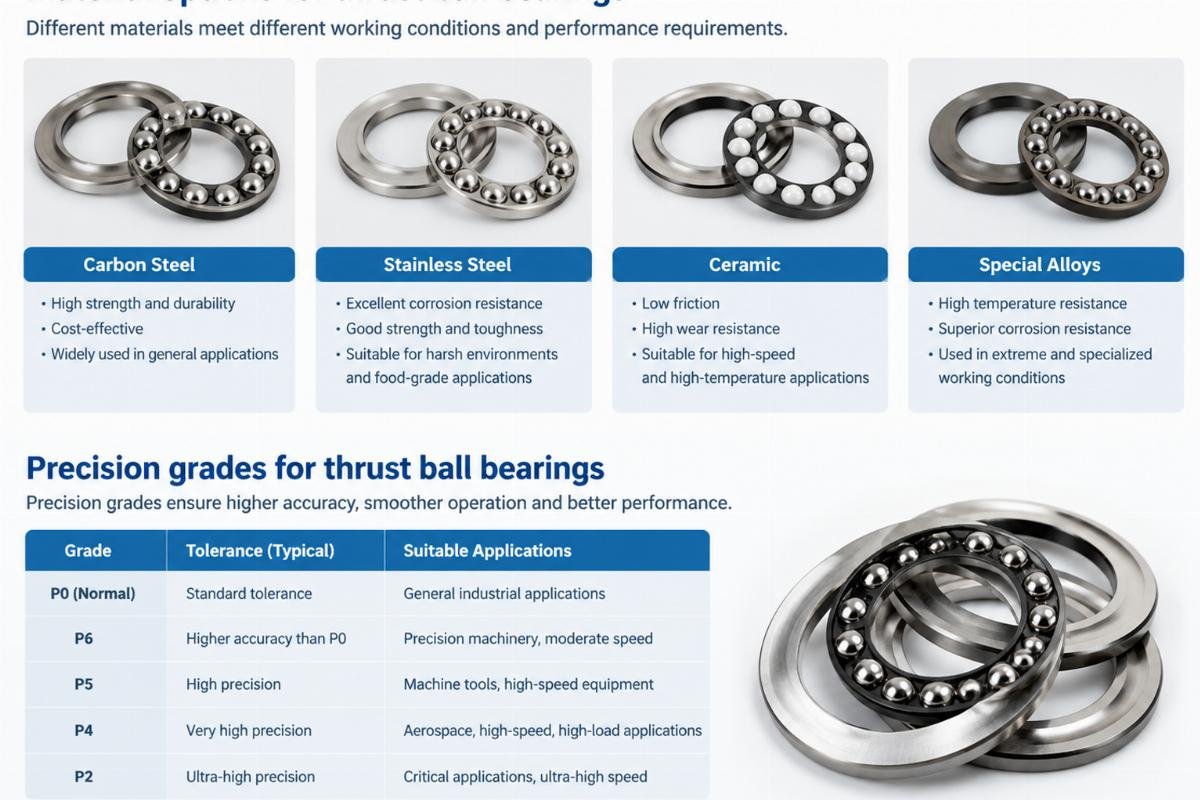
Offered in P0, P6, and P5 precision classes for varied operational stability needs.
Cross-reference 8104 validated for exact dimensional and tolerance alignment.
Scan the official app QR code on the packaging to instantly verify product authenticity and trace batch origins.
Traceable Batch Origins — Every 51104 thrust ball bearing ships with verifiable manufacturer lot documentation to confirm material pedigree.
Technical Specifications
Parameter
Value
Designation
51104
Bearing Type
Thrust Ball Bearing
Bore Diameter (d)
20 mm
Outside Diameter (D)
35 mm
Width (T)
10 mm
Seal or Shield Type
Open
Precision Class
P0, P6, P5
Material
Available in standard bearing steel or stainless steel variants
Origin
Shandong, China
Application Suitability
Industry
Typical Applications
Material Handling
Crane hook swivel mechanisms
Machine Tools
Vertical spindle thrust supports
Automotive
Steering column thrust washers
Fluid Management
Vertical pump shaft axial positioning
Why Open-Design 51104 Thrust Ball Bearings Fail in High-Heat Environments
Cage material mismatch causes catastrophic fatigue before the raceways even show wear.
I once specified a standard stamped steel cage for this exact dimension in an Ethiopian mining site, only to face premature cage fracture under sustained thermal stress. The rolling elements remained completely intact, but the thin separator disintegrated, halting production entirely and causing severe secondary damage to the housing. Selecting the correct cage material and internal clearance for your specific thermal profile prevents these costly blind spots. Many maintenance teams overlook the thermal limits of standard pressed steel cages, assuming the bearing steel itself dictates the temperature threshold. When ambient heat combines with frictional heat from heavy axial loads, the cage experiences rapid metal fatigue [NEED_CITE: rolling bearing failure mode classification per ISO 15243]. Understanding these failure mechanisms is critical for specifying the right 51104 thrust ball bearing for demanding industrial environments.
Matching the 51104 Thrust Ball Bearing to Axial Load Profiles
This specific 51104 thrust ball bearing handles unidirectional axial loads efficiently within compact vertical assemblies where radial space is strictly limited. Our global sourcing network secures these precise 20x35x10 mm dimensions across multiple precision grades, ensuring you receive the exact tolerance required for your specific spindle or hook application. We rigorously verify the internal geometry and ball complement to guarantee optimal load distribution across the contact surfaces. Proper load distribution prevents localized stress concentrations that lead to premature spalling. By aligning the dynamic load rating with your actual operational forces, we help you avoid the common pitfall of over-specifying or under-specifying the component, thereby optimizing both performance and procurement costs.
Navigating Thermal Expansion and Lubrication Starvation Challenges
Vertical installations frequently suffer from gravity-induced lubrication migration, leaving the upper raceway starved during continuous high-speed operation. When operating temperatures rise significantly, thermal expansion alters the internal clearance, potentially causing excessive preload or dangerous mechanical slack within the assembly. Open designs require consistent external relubrication schedules to flush out particulate contamination that accelerates abrasive wear on the raceways [NEED_CITE: lubrication starvation effects on bearing service life]. Choosing the appropriate precision class directly mitigates vibration-induced fretting in sensitive machine tool spindles, where even microscopic axial play can ruin surface finish quality. Furthermore, understanding the thermal characteristics of your housing material ensures that the bearing outer ring remains properly seated without creeping under fluctuating thermal loads.
Decoding Precision Grades and Material Configuration Options
The available P0, P6, and P5 precision options dictate the running accuracy and axial play of the entire mechanical assembly. While P0 suffices for general axial positioning in heavy crane hooks, machine tool spindles strictly demand P5 tolerances to minimize axial runout and maintain precise cutting depths. Regarding material configuration, these components are available in standard bearing steel or stainless steel variants, allowing buyers to match the corrosion resistance to their specific environmental exposure without over-engineering the solution. Standard bearing steel offers superior fatigue strength for heavy load applications, whereas the stainless options provide essential protection against moisture and chemical degradation. Evaluating the trade-offs between load capacity and environmental resistance ensures the selected 51104 thrust ball bearing delivers reliable service life.
The Financial Impact of Ignoring Cage and Clearance Specifications
Substituting a standard stamped steel cage in high-temperature or high-vibration applications inevitably leads to rapid metal fatigue and sudden separator collapse. This unplanned downtime cascades into missed delivery deadlines, idle machinery, and expensive emergency freight for replacement parts. Furthermore, ignoring thermal expansion when selecting internal clearance results in premature spalling on the raceways, voiding manufacturer warranties and triggering catastrophic damage to adjacent shaft components [NEED_CITE: ISO 281 bearing life calculation principles]. The hidden costs of incorrect specification extend far beyond the initial purchase price, encompassing labor for teardowns, lost production revenue, and potential safety hazards. A thorough engineering review of the operating conditions prevents these compounding financial losses and ensures long-term operational stability.
Securing Authentic Components Through Verified Procurement Channels
We eliminate the risk of receiving counterfeit or substandard batches by providing complete traceability for every 51104 unit shipped from our facilities. Our technical team meticulously cross-references the 8104 legacy designation to ensure dimensional and precision alignment with your older legacy equipment. Whether you need a single emergency spare part for an immediate breakdown or a full consolidation container for a planned maintenance shutdown, our flexible sourcing model adapts to your schedule. We maintain strict ISO-compliant quality checks on all incoming inventory, verifying the authenticity of the packaging and the physical dimensions before dispatch. This rigorous approach guarantees that the 51104 thrust ball bearing you install performs exactly as the original engineering specifications intended.
Documentation & Authenticity
Certificate of Conformity verifying the specific P0, P6, or P5 tolerance class achieved.
Original manufacturer batch traceability documents linking the 51104 to its production lot.
Material inspection reports confirming the exact steel grade used for the rings and balls.
Dimensional inspection records validating the 20x35x10 mm geometry before dispatch.
Storage, Handling & Mounting
Store the open-type 51104 in its original VCI packaging to prevent surface corrosion on exposed raceways.
Use clean, lint-free gloves when handling P5 precision variants to avoid acidic skin residue etching the steel.
Apply recommended thrust load during mounting to prevent balls from skidding and damaging the 20 mm bore shaft seat.
Maintain strict separation between stainless steel variants and carbon steel tools to prevent galvanic cross-contamination.
Preparing Your Technical Parameters for Engineering Selection Review
Share your specific axial load magnitude, operating speed, and ambient temperature range so our engineers can validate the L10 life and recommend the optimal cage material. If you are replacing an existing unit, provide the OEM equipment serial number or the legacy 8104 designation for precise cross-reference verification and dimensional checking. Detailing the environmental exposure helps us confirm whether the standard or stainless steel variant is required for your specific application. Supplying information about the housing material and shaft tolerances allows us to advise on the correct fitting practices, ensuring the bearing operates with the intended internal clearance once mounted and brought up to operating temperature.
Frequently Asked Questions
Q: How does the 8104 cross-reference relate to the 51104 designation?
A: The 8104 is the legacy designation for the same 20x35x10 mm thrust ball bearing geometry. While the physical dimensions remain identical, modern 51104 production often features updated cage designs and tighter precision tolerances. We verify the exact dimensional alignment and running accuracy to ensure seamless interchangeability in your existing housing.
Q: What are the practical differences between P0, P6, and P5 precision levels?
A: P0 is the standard clearance suitable for general axial positioning in crane hooks. P6 offers reduced axial runout for smoother operation in gearboxes, while P5 provides the strict dimensional tolerances required for machine tool spindles to maintain precise cutting depths and minimize vibration during high-speed rotation.
Q: Why is the open sealing type preferred for certain vertical pump applications?
A: Open designs allow maintenance teams to flush out contaminated lubricant and introduce fresh grease directly into the ball complement. In vertical pumps handling abrasive fluids, this regular relubrication cycle extends service life significantly compared to sealed variants, which would trap particulate matter inside the raceway and accelerate abrasive wear.
Q: How do I choose between standard bearing steel and stainless steel variants?
A: Standard bearing steel provides optimal load capacity and fatigue resistance for dry or well-lubricated indoor environments. Stainless steel variants are necessary when the 51104 thrust ball bearing faces direct moisture exposure, chemical splashes, or washdown procedures, though they carry a slightly lower dynamic load rating due to the softer material properties.
Shipping Information
EU Warehouse
3-7 working days (bonded stock)
Direct from China
Shanghai & Ningbo hubs (bulk / FCL)
Markets Served
DE · IT · PL · ES · NL · FR · EU+
Incoterms
DDP / DAP available on request
Minimum Order
Contact us for MOQ details
Documents Included with Every Shipment
EN and ISO Quality Certificates
Batch traceability and manufacturing standard
Material & Heat-Treatment Reports
Full material composition and process records
CE Declaration of Conformity
For bearing units and motion products
RoHS Compliance Declaration
Restriction of hazardous substances
EUR.1 Movement Certificate
Preferential origin for EU customs
Certificate of Origin
Country of manufacture documentation
Correct HS Codes
Pre-classified for smooth customs clearance
Commercial Invoice & Packing List
VAT-compliant intra-EU invoicing
Transparent Landed Cost with Tax Explanation
SKFEU provides full price transparency so EU buyers know exactly what they pay. No hidden duties, no surprise charges at customs.
VAT-Compliant Invoicing
All intra-EU transactions are invoiced with correct VAT treatment. B2B buyers with valid EU VAT numbers receive zero-rated invoices where applicable.
No Unexpected Import Duties
Goods shipped from our EU bonded warehouse arrive as intra-EU movements -- no import duties, no customs delays for EU-based buyers.
EUR.1 & Origin Docs Ready
For shipments direct from China, EUR.1 movement certificates and certificates of origin are prepared in advance to minimise customs clearance time.
DDP Pricing Available
Ask for Delivered Duty Paid quotations -- we absorb all import costs so your landed cost is fixed and predictable from day one.
Need a landed cost breakdown? Contact Sofia at
sofia@skfeu.com
or via WhatsApp for a full DDP quotation including freight, duties and VAT for your country.
Send Inquiry
Request Pricing & Availability
Share your requirements and Sofia will respond within one working day with pricing, lead time and full documentation details.