DIN 625 Ball Bearings Cross-Reference Chart by Brand
Find the right DIN 625 Ball Bearings Equivalent Designations by matching internal clearances and cage materials, not just dimensions. Avoid costly downtime from mismatched SKF, FAG, or NSK substitutes. Verify suffix codes and lubrication compatibility to ensure reliable cross-brand performance for your industrial applications.

DIN 625 Ball Bearings Cross-Reference Chart by Brand
Identical dimensions do not guarantee identical performance.
A true DIN 625 ball bearings equivalent requires matching internal clearances and cage materials, not just basic bore and outer diameter measurements. Substituting based solely on dimensional data often leads to premature failure because different manufacturers use distinct suffix codes for lubrication, shielding, and tolerance classes that are not universally interchangeable without technical verification.
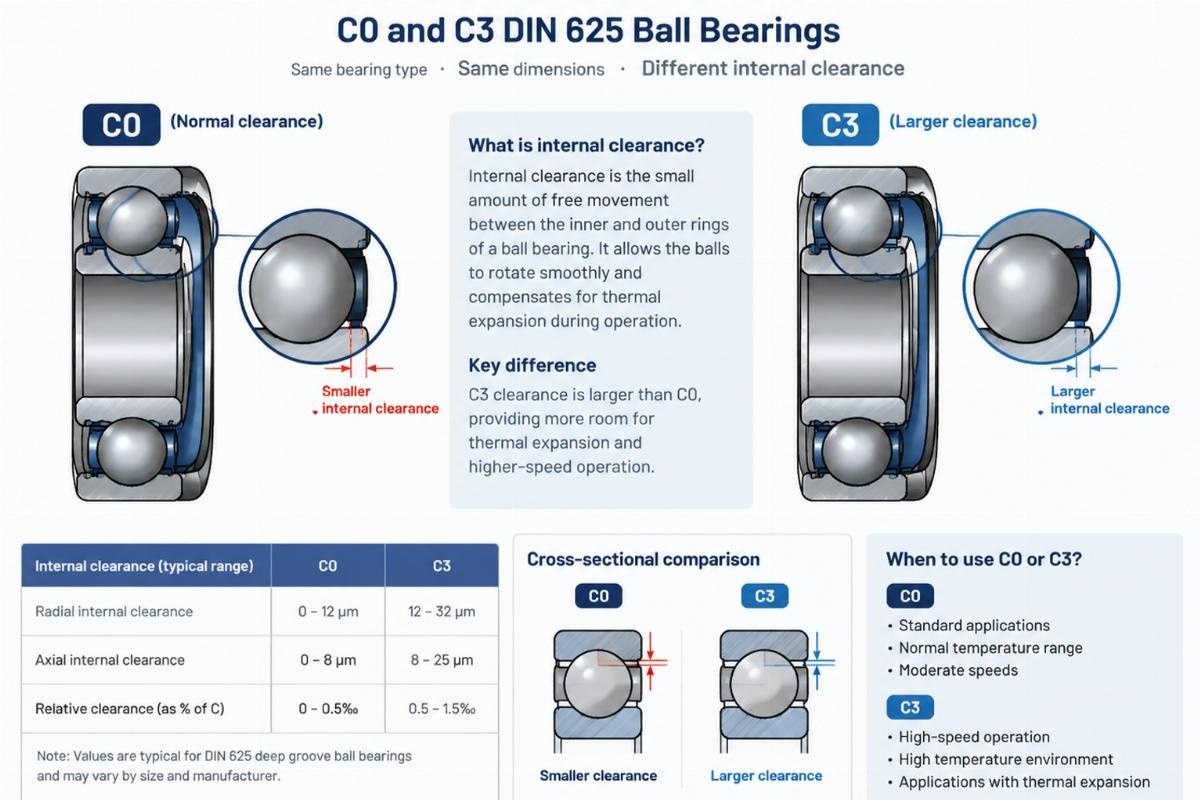
I still remember the heat radiating from a seized conveyor pulley in a Qingdao mining facility. The maintenance team had replaced a failed SKF unit with a visually identical alternative brand. The part number looked correct on the box, and the physical dimensions matched perfectly during installation. Yet, within weeks, the bearing overheated and locked up, causing days of unplanned downtime. The issue was not the size, but the internal clearance. The original specification required a C3 clearance for high-temperature operation, while the replacement was a standard C0 clearance. This costly error shifted my focus from simple parts trading to rigorous technical cross-referencing. Understanding the nuances of DIN 625 ball bearings equivalent designations is critical for avoiding such catastrophic mismatches in industrial applications. [NEED_CITE: impact of internal clearance mismatch on bearing lifespan]
Navigating the complex landscape of global bearing brands requires more than a simple part number lookup. It demands a deep understanding of how major manufacturers map their specific engineering choices to the DIN 625 standard.
What Defines a True DIN 625 Equivalent?
True equivalence extends far beyond external geometry to include internal tolerances and material specifications.
The DIN 625 standard defines the dimensions and load ratings for single-row deep groove ball bearings, but it does not dictate every internal variable. Manufacturers have significant freedom in designing cage structures, selecting lubricants, and setting internal radial play. When sourcing a DIN 625 ball bearings equivalent, buyers must verify three critical parameters: dimensional tolerance class, internal clearance group, and cage material.
Dimensional tolerances are typically classified as P0 (normal) or P6 (higher precision). While P0 is sufficient for most general industrial applications, P6 is required for electric motors and high-speed spindles. Mixing these classes can result in excessive vibration or premature wear. Internal clearance groups, ranging from C2 to C5, determine how much room exists between the rolling elements and raceways. A C3 clearance, for instance, allows for thermal expansion in hot environments, whereas a C2 clearance provides tighter control for quiet, low-temperature operations. [NEED_CITE: ISO 15 internal clearance standards]
Cage material is another frequent point of failure. Steel cages are robust and suitable for heavy loads, while polyamide (nylon) cages offer lighter weight and better lubrication retention but may degrade under extreme heat or chemical exposure. Brass cages provide a balance of strength and corrosion resistance. Substituting a polyamide cage with a steel one, or vice versa, without checking compatibility can lead to cage fracture or lubricant breakdown.
| Parameter | Standard Specification | Critical Variation Risk |
|---|---|---|
| Dimensional Tolerance | P0 (Normal) | P6 required for high precision; mixing causes vibration |
| Internal Clearance | C3 (Common for industry) | C0/C2 too tight for heat; C4/C5 too loose for precision |
| Cage Material | Steel / Polyamide / Brass | Chemical incompatibility or thermal degradation |
| Lubrication | Grease type/quantity | Incompatible grease mixing causes sludge formation |

How Do Major Brands Map to Each Other?
Suffix codes vary significantly between SKF, FAG, NSK, and NTN, requiring careful translation.
One of the biggest challenges in finding a DIN 625 ball bearings equivalent is deciphering the manufacturer-specific suffixes. While the base number (e.g., 6205) remains consistent across brands due to the DIN standard, the suffixes indicating seals, shields, and internal features differ. A direct substitution without decoding these suffixes can result in receiving an open bearing when a sealed one was required, or vice versa.
SKF typically uses suffixes like Z for a metal shield on one side and 2Z for both sides. FAG often uses RSR for contact seals and RS for non-contact seals. NSK uses VV for non-contact rubber seals and DU for contact seals. NTN has its own distinct coding system. Misinterpreting these codes can lead to incorrect sealing protection, allowing contaminants to enter the bearing or preventing proper lubrication flow. [NEED_CITE: manufacturer suffix code comparison guide]
For example, an SKF 6205-2Z/C3 specifies a double-shielded bearing with C3 clearance. A direct FAG equivalent might be designated as 6205-2RSR/C3. While the function is similar, the sealing mechanism differs. In dusty environments, the choice between contact and non-contact seals can significantly impact bearing life. Contact seals offer better protection against fine particles but generate more friction and heat. Non-contact seals allow higher speeds but may permit minor ingress of contaminants.
| Feature | SKF Suffix | FAG Suffix | NSK Suffix | NTN Suffix |
|---|---|---|---|---|
| Metal Shield (1 side) | Z | RSR | V | ZZ (often double) |
| Metal Shield (2 sides) | 2Z | 2RSR | VV | ZZ |
| Rubber Seal (Contact) | RS1 | RSR | DU | LLU |
| Rubber Seal (Non-Contact) | RSH | RS | VV | LLB |
| Polyamide Cage | TN9 | TVH | CA | – |
Understanding these mappings is essential for MRO buyers who need to consolidate inventory from multiple brands. Relying on a comprehensive DIN 625 ball bearings equivalent database helps ensure that the functional characteristics of the replacement match the original equipment manufacturer’s intent.

Why Do “Identical” Substitutes Fail Prematurely?
Ignoring lubrication compatibility and cage dynamics leads to hidden failures under load.
Even when dimensions and clearances match, substitutes can fail due to subtle differences in lubrication and cage design. Many standard bearings come pre-lubricated with generic lithium-based grease. However, specific applications may require high-temperature, food-grade, or water-resistant lubricants. If a replacement bearing contains incompatible grease, mixing can occur, leading to softening, hardening, or separation of the lubricant. This results in increased friction, overheating, and eventual seizure. [NEED_CITE: effects of incompatible grease mixing]
Cage dynamics also play a crucial role. In high-speed applications, the mass and balance of the cage affect centrifugal forces. A heavier steel cage may perform well at low speeds but can cause instability at high RPMs compared to a lighter polyamide cage. Conversely, polyamide cages may absorb moisture or degrade in certain chemical environments, leading to brittleness and fracture.
A case in point involved a pump manufacturer who switched to a lower-cost domestic brand for non-critical sizes. The initial tests showed no issues, but after several months, field reports indicated increased noise and vibration. Upon inspection, it was found that the cage material had degraded due to exposure to a specific cleaning agent used in the plant. The original premium brand used a chemically resistant polymer, while the substitute used a standard grade. This highlights the importance of verifying material specifications beyond just the DIN 625 ball bearings equivalent part number.
Furthermore, surface finish and raceway geometry, though within tolerance, can vary between manufacturers. These micro-geometric differences affect how the lubricant film forms between the rolling elements and races. A poorer surface finish may require a higher viscosity lubricant to maintain adequate separation. Using a standard lubricant with a bearing designed for high-viscosity oil can lead to metal-to-metal contact and spalling.

How to Verify Equivalents During Procurement?
Requesting traceability documentation and technical datasheets is non-negotiable for critical substitutions.
To ensure reliability, buyers must move beyond catalog comparisons and demand technical verification. When sourcing a DIN 625 ball bearings equivalent, always request the manufacturer’s technical datasheet for the specific batch. This document should confirm the internal clearance class, cage material, and lubrication type. Without this data, you are guessing, not engineering.
Traceability documentation is equally important. Genuine bearings come with certificates of conformity that link the product to its production batch. This ensures that the bearing meets the stated standards and has not been counterfeited. Counterfeit bearings often mimic the packaging and markings of premium brands but lack the internal quality controls. They may use inferior steel or improper heat treatment, leading to early fatigue failure. [NEED_CITE: risks of counterfeit bearings in industrial supply chains]
A practical checklist for procurement includes:
- Verify the base number matches the DIN 625 standard.
- Confirm the suffix codes translate correctly for seals and cages.
- Check the internal clearance class (C2, C0, C3, etc.) against application requirements.
- Request material certificates for cage and lubricant compatibility.
- Ensure traceability documents are provided for batch verification.
In emergency MRO situations, having access to a supplier who can provide immediate technical support and verified cross-references is invaluable. Mixing brands like FAG and SKF equivalents requires precise knowledge to minimize stockouts without compromising performance. A reliable partner can help navigate these complexities, ensuring that the chosen DIN 625 ball bearings equivalent truly meets the operational demands of your machinery.

Conclusion
Dimensional matching is only the first step in finding a reliable bearing substitute.
Successful cross-brand substitution requires a holistic view of internal clearances, cage materials, and lubrication compatibility. Ignoring these factors turns a cost-saving measure into a costly liability. By rigorously verifying technical specifications and demanding traceability, buyers can optimize inventory and maintain operational reliability. A well-executed DIN 625 ball bearings equivalent strategy balances cost efficiency with engineering integrity, ensuring that every replacement performs as intended.
Tagged

Written by
author
Editor covering global sourcing, supplier verification, and industrial product knowledge. Content is compiled from manufacturer specifications, industry standards, and hands-on experience with international B2B buyers. Every article is fact-checked before publishing to help procurement professionals make informed decisions.


