EU Food Contact Bearings: Grease & Materials Wholesale Supplier
Selecting EU food contact bearings requires verifying NSF H1 grease and seal compliance, not just stainless steel housings. This guide details migration limits, material choices like AISI 440C, and documentation standards to prevent chemical contamination and ensure full regulatory adherence for European markets.


EU Food Contact Bearings: Grease & Materials Wholesale Supplier
Stainless steel housings alone do not make a bearing food-safe.
Compliance for EU food contact bearings hinges on the migration limits of lubricants and seal materials, not just the metal grade. Selecting components requires verifying NSF H1 registration for grease and ensuring all non-metallic parts meet EU Framework Regulation standards to prevent chemical contamination.
I still remember the smell of rancid oil mixing with fresh juice in a bottling plant in Southeast Asia. It was not a mechanical failure that stopped the line; it was a regulatory one. The maintenance team had swapped out standard bearings for stainless steel units to resist corrosion, assuming this solved the hygiene issue. They kept the original industrial grease. Under the high heat and humidity of the pasteurization zone, that grease migrated. It did not just leak; it seeped into the product stream. The resulting recall cost far more than the entire production line. That incident shifted my perspective entirely. In food processing, the bearing is not just a mechanical component; it is a potential vector for chemical contamination. When sourcing for European markets, the scrutiny is even higher. Buyers often focus on the steel, but the real risk lies in the invisible layers: the lubricant and the polymer seals.
Understanding this distinction is critical for anyone managing supply chains for food equipment. The market is flooded with components that look compliant but lack the necessary documentation. This guide breaks down the specific regulatory hurdles and material choices that define true compliance.
What Are the Core EU Regulations for Food Contact Bearings?
Regulatory compliance is a system-wide requirement, not a single certificate.
Many buyers assume that if a bearing is made of stainless steel, it is automatically safe for food contact. This is a dangerous misconception. The European Union regulates food contact materials under a framework that considers every substance that might touch the food, directly or indirectly. For bearings, this includes the base metal, the rolling elements, the cage, the seal, and critically, the lubricant.
The primary reference is the EU Framework Regulation, which sets general safety requirements. However, the specific rules for plastics and lubricants are where most failures occur. Lubricants used in areas where incidental food contact is possible must be evaluated for their migration potential. This means testing how much of the chemical substance moves from the grease into the food simulant under specific temperature and time conditions. [NEED_CITE: EU migration testing protocols for food contact lubricants]
A common pitfall is relying solely on national standards from outside the EU. While some certifications are mutually recognized, the EU has its own strict interpretation of safety margins. A bearing assembly might use a cage made of a polymer that is approved in other regions but fails the specific migration limits set by European authorities. Therefore, when evaluating EU food contact bearings, you must demand a Declaration of Compliance (DoC) that covers the entire assembly, not just the outer ring.
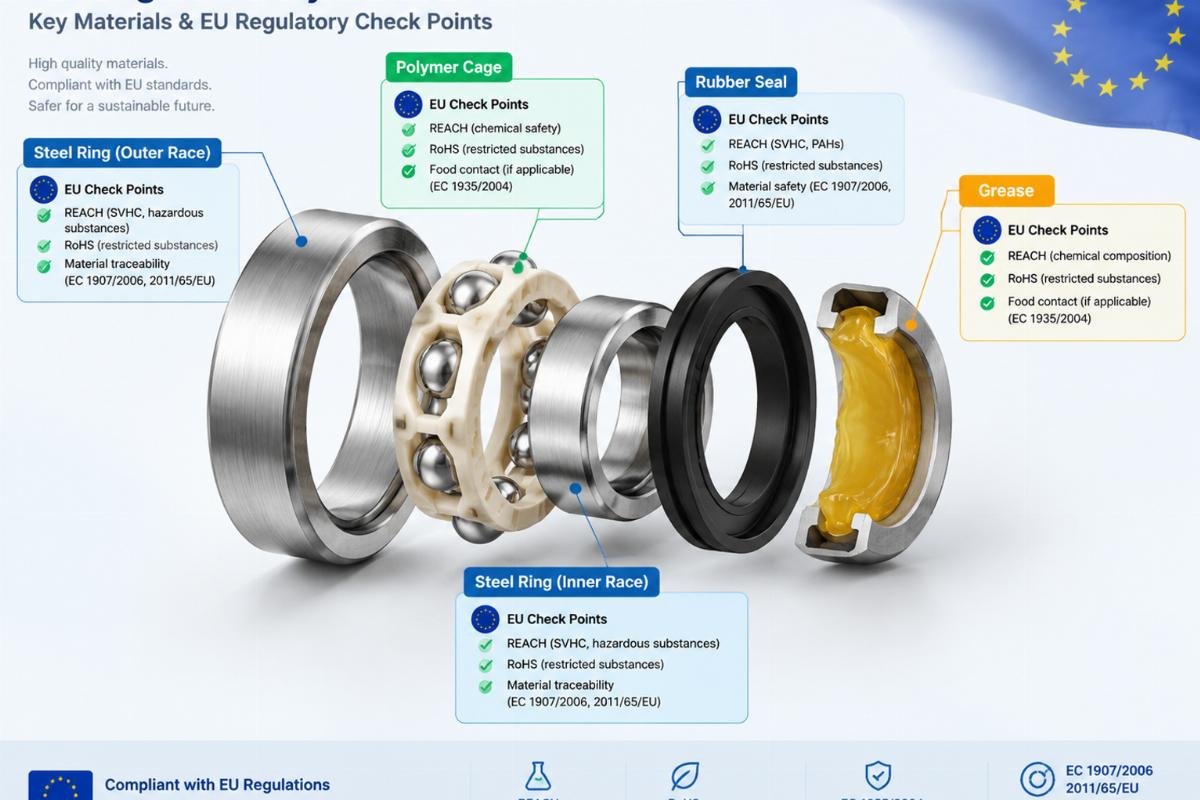
The responsibility lies with the manufacturer and the supplier to provide this traceability. Without a complete chain of documentation, the end-user assumes the liability. In my experience, suppliers who cannot provide a unified DoC for the whole bearing unit are often mixing components from different sources without verifying their combined chemical compatibility. This fragmentation is a major red flag during audits.
How to Choose the Right Grease for EU Food Bearings?
NSF H1 registration is the baseline, but thermal stability dictates actual safety.
Lubrication is the most vulnerable point in any bearing system. In food processing, the grease must perform two conflicting roles: reduce friction effectively and remain inert if it contacts food. The global benchmark for this is NSF H1 registration. This certification indicates that the lubricant contains only substances permitted for incidental food contact. However, having an H1 rating is not enough for the harsh environments found in many European food plants.
The key factor is migration. Even H1 greases have limits on how much can migrate into food. These limits are tested at specific temperatures. If a bearing operates in a sterilization tunnel at high heat, a standard H1 grease might break down or migrate faster than allowed. [NEED_CITE: Temperature-dependent migration limits for H1 lubricants] Conversely, in freezing applications like meat packaging, the grease must not stiffen to the point of causing bearing failure, nor should it leach additives as the temperature fluctuates.
| Grease Property | Standard Industrial Grease | NSF H1 Certified Grease | High-Performance Food Grade Grease |
|---|---|---|---|
| Food Safety Status | Not Safe | Incidental Contact Allowed | Incidental Contact Allowed |
| Migration Testing | None | Basic Screening | Rigorous Temp-Specific Testing |
| Chemical Resistance | Variable | Moderate | Robust against CIP agents |
| Documentation | MSDS Only | NSF Registration | Full DoC + Migration Reports |
I once reviewed a case where a dairy processor switched to a cheaper H1 grease to cut costs. The grease worked fine mechanically, but during Clean-in-Place (CIP) cycles, the caustic cleaners degraded the thickener in the grease. The result was a slimy residue that harbored bacteria, failing microbiological swabs. The grease was H1 certified, but it was not compatible with the cleaning regime. This highlights that selecting grease for EU food contact bearings requires matching the chemical profile to the specific sanitation process.
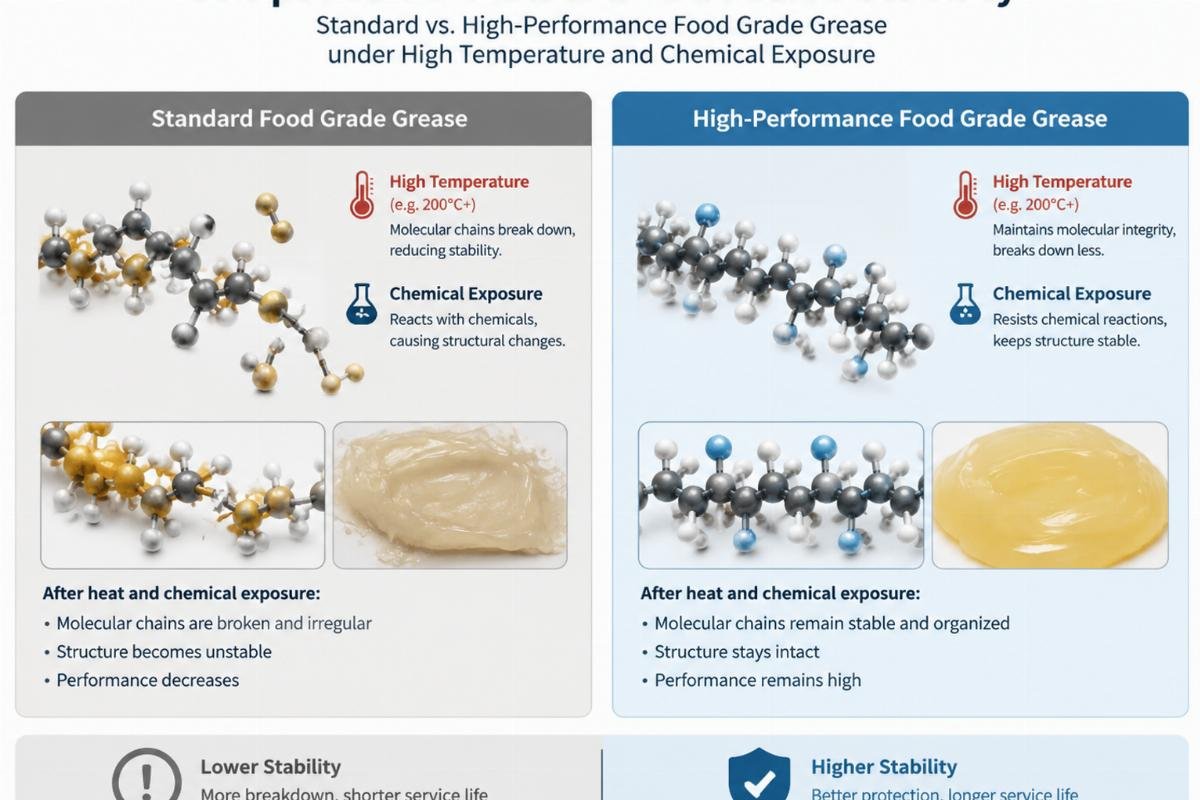
When sourcing, ask for the technical data sheet that details the base oil viscosity and the thickener type. Synthetic bases often offer better stability and lower migration risks than mineral oils, especially in extreme temperatures. Ensure the supplier can prove that the specific batch of grease meets the required standards, not just the brand name.
Which Bearing Materials and Seals Pass EU Inspections?
Material selection must balance corrosion resistance with mechanical integrity.
The structural components of the bearing must withstand both the mechanical loads and the aggressive cleaning environments. Stainless steel is the standard, but not all stainless steels are equal. AISI 440C is commonly used for its hardness and wear resistance, offering good protection against rust. However, in highly corrosive environments involving salt or strong acids, AISI 316L may be required. The trade-off is that 316L is softer and may have a shorter fatigue life under heavy loads. [NEED_CITE: Mechanical property comparison of 440C vs 316L stainless steel in bearing applications]
The seals are equally critical. They keep the grease in and contaminants out. Common materials include Nitrile (NBR), Fluoroelastomer (FKM), and Polytetrafluoroethylene (PTFE). NBR is cost-effective and works well for general purpose use, but it can degrade when exposed to certain fats or high temperatures. FKM offers superior chemical and heat resistance, making it ideal for baking or frying applications. PTFE is often used for its low friction and broad chemical inertness, though it can be more expensive.
| Component Material | Corrosion Resistance | Chemical Resistance | Typical Application |
|---|---|---|---|
| AISI 440C Steel | Good | Moderate | General food processing |
| AISI 316L Steel | Excellent | High | Acidic/Salty environments |
| NBR Seal | Moderate | Low/Moderate | Ambient temp, water-based |
| FKM Seal | High | High | High temp, CIP chemicals |
| PTFE Seal | High | Excellent | Extreme chemical exposure |
A beverage producer I worked with faced repeated seal failures. They were using NBR seals on bearings exposed to citrus-based cleaners. The acids caused the seals to swell and crack, allowing contaminated water to enter the bearing. Switching to FKM seals resolved the issue, but only after they verified that the new seal material was also compliant with food contact regulations. It is not enough to change the material; you must verify its certification.
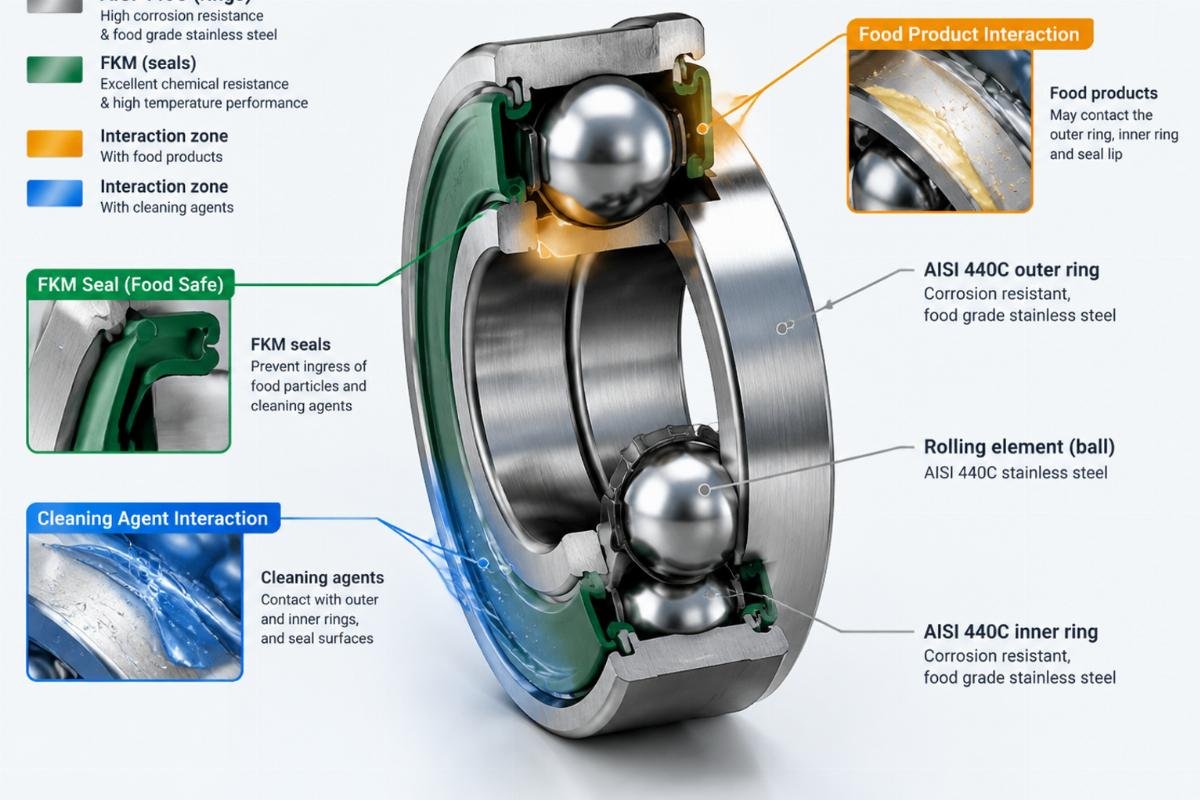
When evaluating EU food contact bearings, request material certificates for both the steel and the polymers. Ensure that the seal manufacturer provides evidence of compliance with relevant EU regulations. Mixing a compliant steel ring with a non-compliant seal renders the entire unit non-compliant.
How to Verify Supplier Compliance and Avoid Counterfeits?
Documentation is the only proof of compliance in a regulated market.
The market for food-grade components is rife with counterfeits and mislabeled goods. A bearing may look identical to a genuine product but lack the proper heat treatment or use unauthorized lubricants. For buyers in Europe, the risk is not just mechanical failure but legal liability. Verifying the authenticity and compliance of your supply chain is non-negotiable.
Start by demanding full traceability. A reputable supplier will provide a Declaration of Compliance that lists every component and its respective certification. This document should reference the specific regulations met, such as EU 10/2011 for plastics or NSF standards for lubricants. If a supplier hesitates or provides vague statements, walk away. [NEED_CITE: Importance of traceability documentation in food safety audits]
Another effective method is to cross-reference part numbers with the original manufacturer’s database. Major brands like SKF, FAG, and NSK have strict controls over their food-grade lines. Verify that the supplier is an authorized distributor or can prove the origin of the goods. In my role, I often see mixed-brand orders where one component is genuine and another is a substandard copy. This inconsistency can compromise the entire assembly.
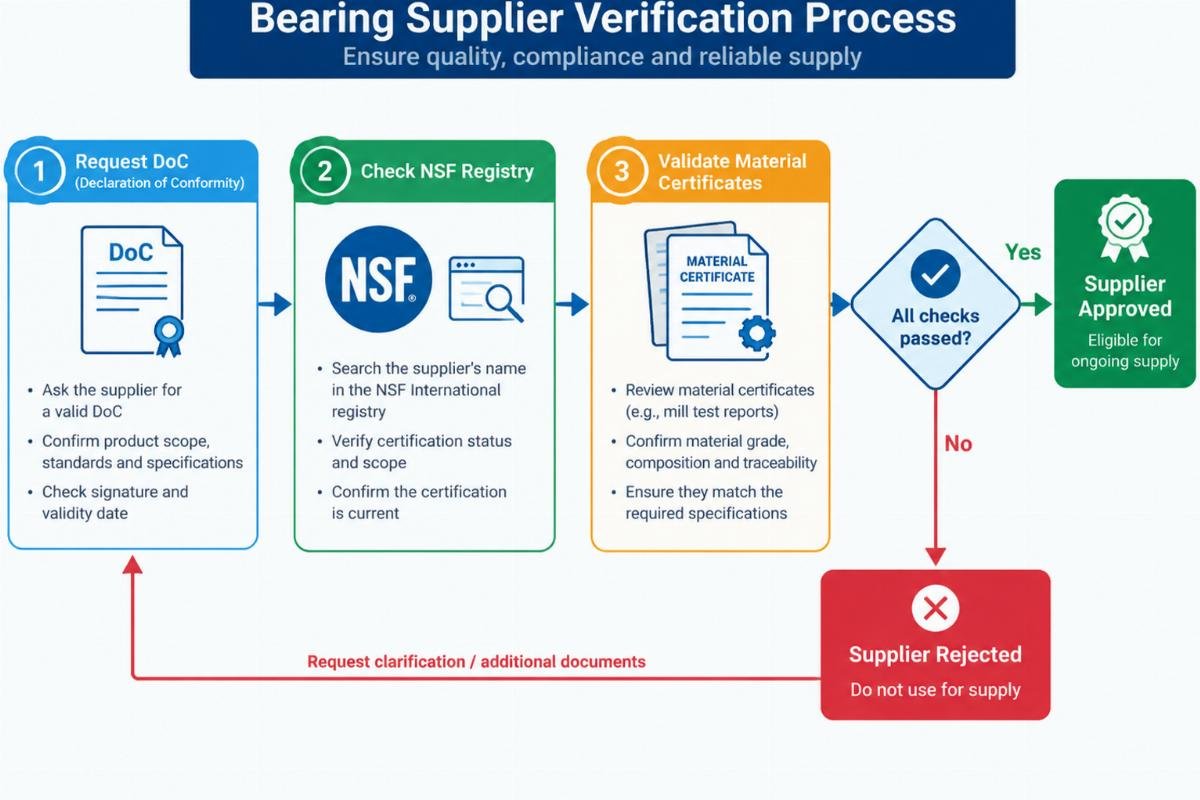
We handle these complexities daily by consolidating genuine products from premium global brands. Our approach ensures that every bearing, whether from SKF, FAG, or NSK, comes with complete traceability documentation. We do not just ship boxes; we provide the technical selection support needed to match the right bearing to the specific environmental constraints of your facility. This level of diligence prevents the costly mistakes that come from guessing at compliance. By focusing on verified sources and complete documentation, we help our clients maintain uninterrupted production and pass rigorous audits without stress.
Conclusion
Compliance is built on documentation, not just appearance.
Selecting the right EU food contact bearings requires a holistic view of materials, lubricants, and seals. Relying on stainless steel alone is insufficient if the grease migrates or the seal degrades. Always verify NSF H1 status and demand full Declarations of Compliance for every component. Proper sourcing protects both your machinery and your brand reputation.
Tagged

Written by
author
Editor covering global sourcing, supplier verification, and industrial product knowledge. Content is compiled from manufacturer specifications, industry standards, and hands-on experience with international B2B buyers. Every article is fact-checked before publishing to help procurement professionals make informed decisions.