RoHS Compliant Bearings: Wholesale Supplier for Bulk Orders
RoHS compliance bearings often cause customs delays due to missing heavy metal exemption declarations. Learn why blanket certificates fail and how precise documentation for brass cages prevents costly demurrage. Discover strategies for verifying material traceability across mixed-brand orders to ensure smooth global logistics.


RoHS Compliant Bearings: Wholesale Supplier for Bulk Orders
Most industrial bearings do not require full RoHS compliance.
RoHS compliance for bearings is triggered only by the regulatory category of the host equipment and regional customs requirements, not by the bearing component itself. Heavy metal exemptions are standard for specific alloys, and customs authorities demand precise exemption declarations rather than blanket certificates to clear shipments.
The humidity in Lagos hits you before the smell of diesel does. I stood on the tarmac, watching a container of spherical roller bearings bake under the West African sun. It had been stuck there for weeks. The issue was not the quality of the steel or the precision of the races. It was a single missing line in the documentation. The customs broker needed a specific heavy metal exemption clause for the lead content in the brass cages, but the supplier had sent a generic “RoHS Compliant” certificate that listed nothing but pass/fail results without context. That delay cost the client more in demurrage fees than the entire value of the cargo. It was a harsh lesson in how environmental regulations intersect with global logistics. [NEED_CITE: common causes of customs delays for industrial components in West Africa]
This experience reshaped how I approach sourcing. For distributors and OEMs managing mixed-brand orders, understanding when RoHS compliance actually matters is critical to avoiding costly bottlenecks.
Which Bearing Applications Actually Trigger RoHS Requirements?
Compliance depends on the final application of the machinery, not the bearing in isolation.
Bearings are components, not end-products. They fall under the Restriction of Hazardous Substances directive only when they are integrated into equipment that is itself regulated. If you are shipping bearings for use in heavy mining excavators or large-scale wind turbines, the regulatory landscape differs significantly from consumer electronics or medical devices. [NEED_CITE: scope of RoHS directive regarding industrial machinery vs consumer goods]
In many heavy-industry scenarios, the use of certain hazardous substances is permitted under specific exemptions. For instance, lead in copper alloys used for bearing cages is often exempt because no viable alternative exists that maintains the required mechanical properties. However, this exemption is not automatic. It must be explicitly declared. A buyer in the European Union might accept a standard declaration, but a customs officer in Southeast Asia or South America may require proof that the specific exemption clause applies to the alloy grade in question.
I have seen shipments held because the documentation treated all bearings as identical. A deep-groove ball bearing with a steel cage has different material implications than a spherical roller bearing with a brass cage. Treating them with the same generic certificate invites scrutiny. The key is to map the bearing type to its host equipment’s regulatory category. If the host machine is exempt or falls outside the directive’s scope, the bearing inherits that status, provided the materials are documented correctly.

How to Compare RoHS Compliance Across Different Bearing Brands?
Brand documentation practices vary significantly, requiring a matrix approach to verification.
When consolidating orders from multiple manufacturers, you cannot assume uniformity in how they report compliance. Global brands like SKF, FAG, and NSK have robust internal testing protocols, but their output formats differ. Domestic Chinese brands such as ZWZ, HRB, and LYC are increasingly compliant, but their documentation may lack the granular detail expected by strict customs authorities unless specifically requested. [NEED_CITE: comparison of documentation standards among major bearing manufacturers]
To manage this, I use a simple comparison framework when auditing suppliers for mixed-batch containers. This helps identify which brands provide ready-to-use exemption data and which require additional verification.
| Brand Category | Exemption Handling | Documentation Depth | Traceability Level |
|---|---|---|---|
| Premium Global Brands | Standardized exemption clauses included | Full batch-level material certs | Verifiable via serial number |
| Reliable Domestic Lines | Exemptions available on request | Sample-level or general declarations | Batch-level tracking |
| Unknown/Unverified Sources | Often missing or vague | Self-reported without test data | Not provided |
The risk lies in the “Unknown” category. A certificate that says “RoHS Compliant” without referencing the specific exemption for lead or hexavalent chromium is useless in a dispute. In one case, a distributor in Latin America received a container with mixed brands. The premium brands cleared customs quickly because their papers cited the exact EU exemption codes. The lesser-known brands were held for weeks because their certificates lacked these references, forcing the buyer to pay for third-party testing at the port.

What Specific Documents Prevent Customs Rejection?
Blanket certificates fail; you need exact exemption declarations for heavy metals.
A common misconception is that a RoHS certificate is a universal passport. It is not. Customs authorities are increasingly trained to look for specificity. They want to see the link between the material composition and the legal exemption. For bearings, the primary concerns are lead in brass cages and hexavalent chromium in certain surface treatments or passivation layers. [NEED_CITE: typical hazardous substances found in bearing components and their exemption status]
The document that prevents rejection is not just a certificate of compliance, but a Material Declaration that includes:
- The specific alloy composition (e.g., CuZn39Pb3 for brass cages).
- The reference to the relevant exemption clause (e.g., Exemption 6c for copper alloys containing up to 4% lead).
- Test method verification, such as XRF screening results or wet chemical analysis reports for hexavalent chromium.
I recall a shipment to a Middle East steel mill where the bearings were rejected because the passivation process was not clearly defined. The certificate said “compliant,” but did not specify whether trivalent or hexavalent chromium was used. Since hexavalent chromium is restricted, the absence of clarification was treated as non-compliance. We had to provide a detailed process sheet from the manufacturer confirming the use of trivalent chromium, which is safe and compliant. Without that specific paper trail, the cargo would have been returned.

How to Verify Material Traceability for Mixed-Batch Orders?
Cross-brand consolidation requires unified, auditable traceability files.
When you buy a full container of mixed brands and sizes, the administrative burden multiplies. You are not just checking one supplier’s paperwork; you are harmonizing data from ten different sources. The goal is to create a single, coherent file that satisfies the customs broker in the destination country. [NEED_CITE: best practices for document consolidation in multi-supplier logistics]
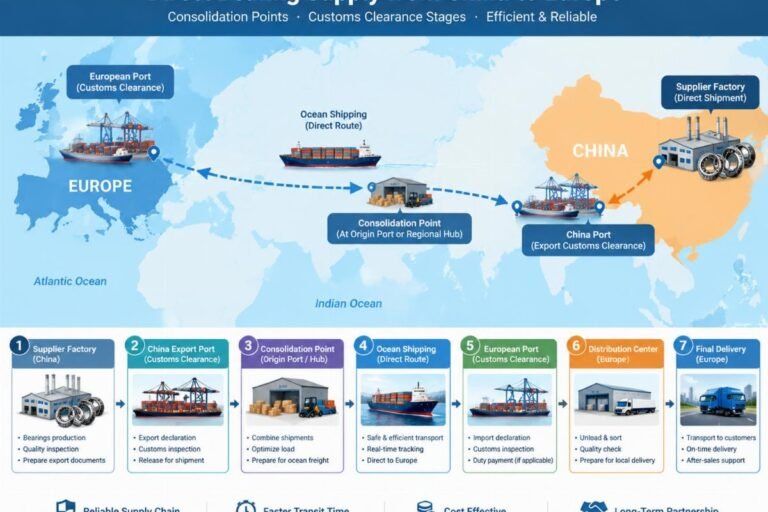
The process starts at the sourcing stage. Instead of collecting certificates after the goods are packed, I require material declarations for every part number before consolidation. This allows for early detection of gaps. If a specific bearing model uses a material that lacks a clear exemption path, it is flagged immediately.
For example, when preparing an order for a mining project in Africa, we consolidated bearings from five different brands. Each brand had its own format. We standardized the data into a single master spreadsheet that linked each part number to its specific material cert and exemption clause. This master file traveled with the bill of lading. When customs queried the lead content in the brass cages, the broker could point directly to the relevant line in the master file, backed by the original manufacturer’s test report. This reduced clearance time from weeks to days.
Traceability also protects against field failures. If a bearing fails prematurely due to material defects, having the batch-specific material cert allows for precise root cause analysis. It proves whether the failure was due to manufacturing flaws or operational stress, which is crucial for warranty claims and technical support.

Navigating RoHS compliance for bearings is less about getting a stamp and more about managing information. It requires understanding the interplay between material science, regulatory exemptions, and customs procedures. By focusing on specific exemption declarations and maintaining rigorous traceability across mixed brands, buyers can ensure smooth clearance and reliable performance. The difference between a delayed shipment and a successful delivery often comes down to the precision of the paperwork.
Conclusion
Precision in documentation prevents logistical paralysis.
RoHS compliance for bearings is a nuanced requirement driven by application and region. Success lies in securing specific exemption declarations and maintaining unified traceability for mixed-brand orders. This approach ensures both regulatory adherence and operational continuity.
Tagged

Written by
author
Editor covering global sourcing, supplier verification, and industrial product knowledge. Content is compiled from manufacturer specifications, industry standards, and hands-on experience with international B2B buyers. Every article is fact-checked before publishing to help procurement professionals make informed decisions.