ISO 5753 Radial Internal Clearance Values for Sale
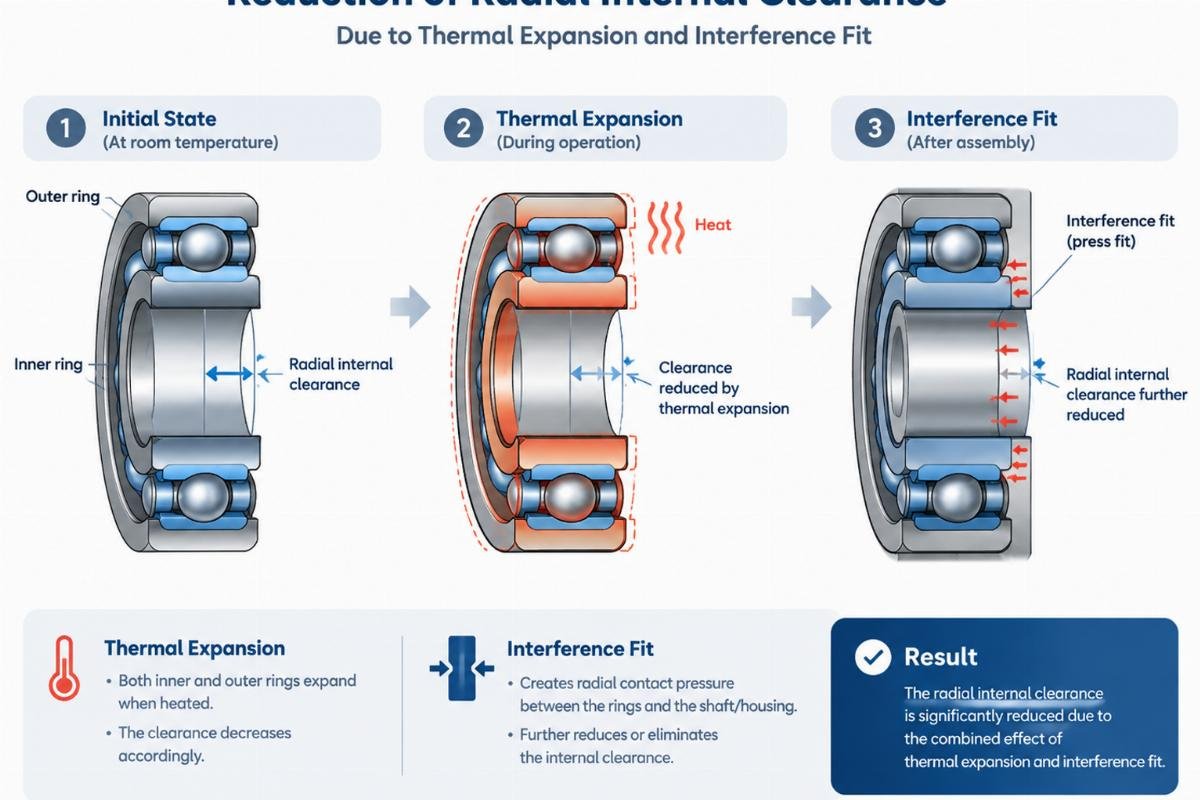
Master ISO 5753 radial internal clearance values by calculating thermal and fit losses to prevent bearing seizure. Learn to select correct C0, C3, or C4 groups for heavy machinery and ensure sufficient working clearance remains under load.

ISO 5753 Radial Internal Clearance Values for Sale
Larger clearance is not always safer.
Selecting the correct ISO 5753 radial internal clearance requires calculating temperature and interference fit reductions to avoid bearing seizure, rather than simply choosing the largest available group.
I still remember the humid air in a warehouse near Qingdao Port, watching a crate of spherical roller bearings being pried open. The destination was a vibrating screen in a West African mine. We had shipped standard C0 clearance units because the purchase order listed no special requirements. Two weeks later, the phone rang. The bearings had seized. The heat generated by friction and the heavy load had expanded the inner ring, eliminating the tiny initial gap and locking the rollers in place. That night taught me that catalog values are just starting points. The real working clearance is what remains after thermal expansion and mechanical fits have taken their toll. Understanding ISO 5753 radial internal clearance values is not about memorizing tables; it is about predicting how much space will be left when the machine is running hot and under load.
To get this right, you must look beyond the part number. You need to calculate the loss. This guide breaks down the groups, the physics of loss, and the selection logic that keeps heavy machinery running.
What Are the ISO 5753 Radial Clearance Groups?
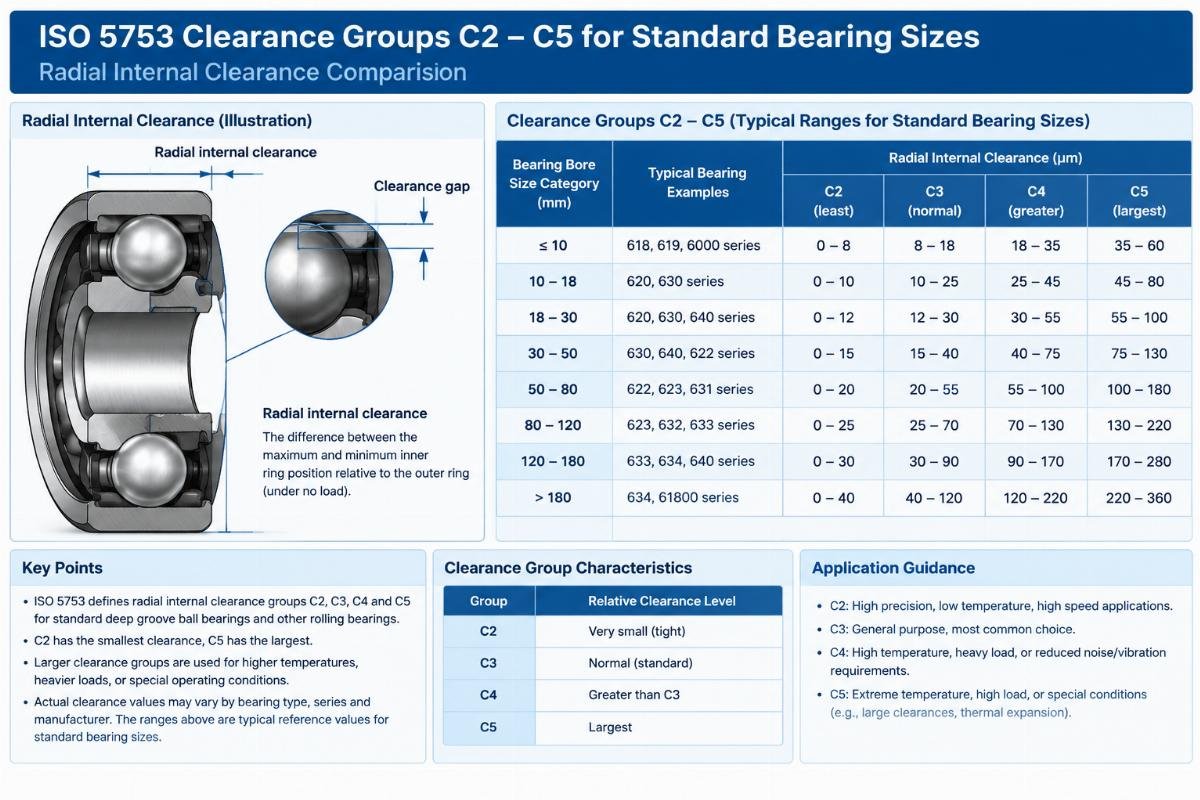
The ISO 5753 standard defines specific micron ranges for radial internal clearance, categorized into groups C2, C0 (Normal), C3, C4, and C5.
These groups are not arbitrary. They represent the physical space between the rolling elements and the raceways before the bearing is mounted. For deep groove ball bearings and cylindrical roller bearings, these values are critical. A C0 bearing has a small, standard gap suitable for most general applications where temperatures are moderate and fits are loose. As you move to C3 and C4, the gap widens to accommodate higher operating temperatures and tighter shaft fits.
| Clearance Group | Typical Application Context | Thermal/Fit Compensation Capability |
|---|---|---|
| C2 | Precision instruments, low noise motors | Minimal |
| C0 (Normal) | General industrial motors, pumps | Standard |
| C3 | Heavy machinery, high temperature environments | Moderate |
| C4 | Vibrating screens, severe duty applications | High |
| C5 | Extreme temperature differentials | Very High |
[NEED_CITE: ISO 5753 standard definitions for radial internal clearance groups]
A common mistake is assuming C3 is the default for all heavy industry. In reality, using a C4 in a precision gearbox can lead to excessive vibration and premature fatigue because the rolling elements skid rather than roll smoothly. Conversely, using C0 in a hot crusher application guarantees failure. The key is matching the group to the expected loss. When sourcing ISO 5753 radial internal clearance values, ensure your supplier provides certification that confirms the measured clearance falls within the specified group limits, not just the nominal value.
How Does Operating Temperature Affect Working Clearance?
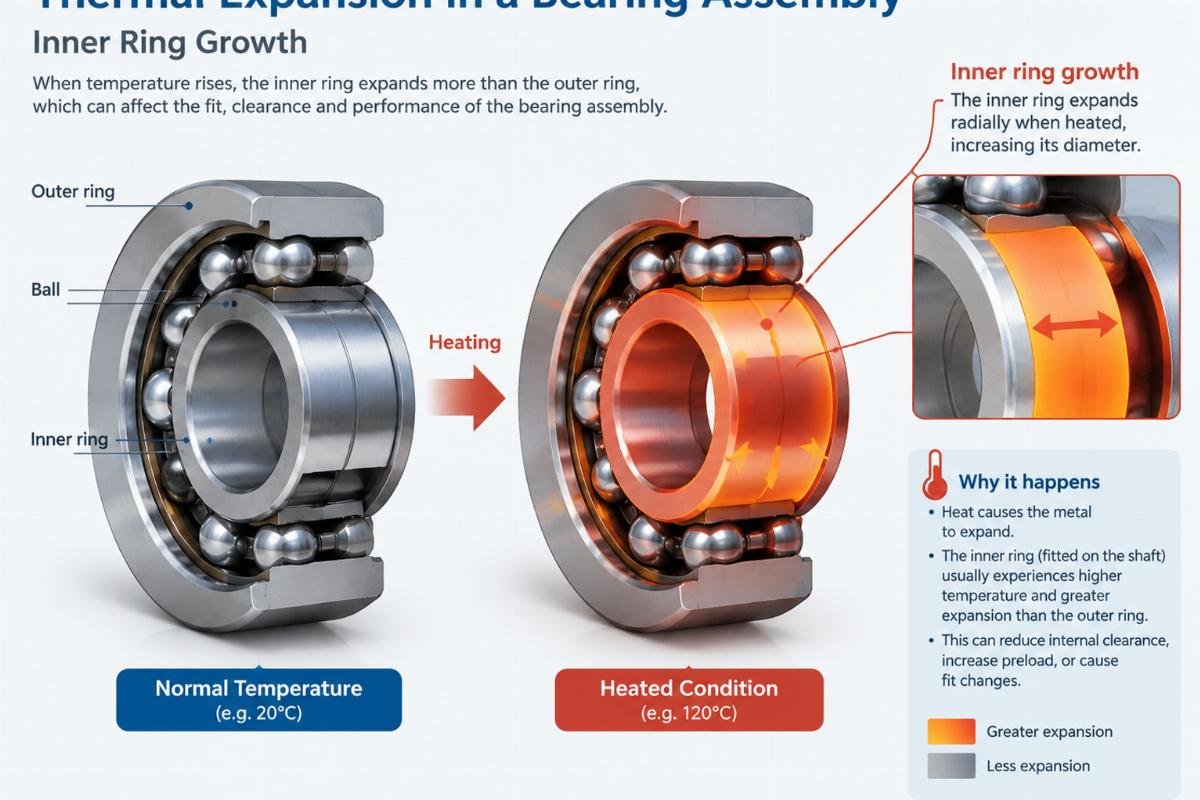
Thermal expansion reduces radial internal clearance because the inner ring typically heats up more than the outer ring, causing it to expand and close the gap.
In many industrial settings, the bearing inner ring is mounted on a rotating shaft that generates heat through friction and load. The outer ring, housed in a stationary block, often dissipates heat more slowly or is cooled by ambient air. This temperature differential causes the inner ring to expand radially outward. Since the outer ring is constrained by the housing, this expansion eats into the initial radial clearance.
Consider a mining vibrating screen. The operating temperature can rise significantly due to constant high-frequency vibration and heavy loads. If you start with a C0 clearance, the thermal expansion might consume the entire gap. The result is preload, which generates even more heat, leading to a thermal runaway and eventual seizure. In such cases, switching to a C3 or C4 clearance provides the necessary buffer.
[NEED_CITE: Thermal expansion coefficients for bearing steel and typical operating temperature differentials]
It is not just about the absolute temperature, but the difference between the inner and outer rings. A uniform temperature rise across the entire bearing assembly has less impact on radial clearance than a gradient. However, in most heavy-duty applications, the inner ring is hotter. Calculating this loss requires knowing the material’s coefficient of thermal expansion and the estimated temperature rise. Without this calculation, selecting ISO 5753 radial internal clearance values is merely guessing.
How to Calculate Clearance Loss from Interference Fits?
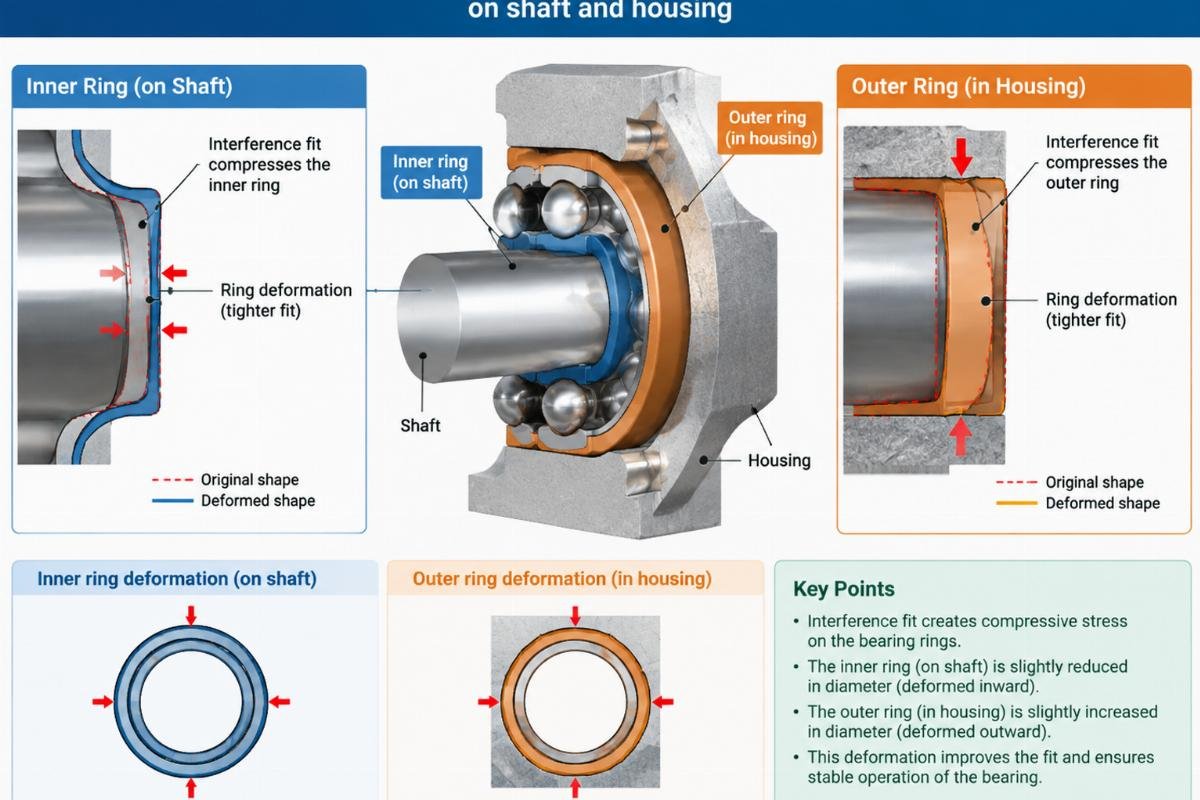
Interference fits reduce radial internal clearance by expanding the inner ring and compressing the outer ring, effectively closing the gap between rolling elements and raceways.
When a bearing is mounted with an interference fit, the inner ring is pressed onto a shaft that is slightly larger than the bearing bore. This forces the inner ring to stretch. Simultaneously, if the outer ring has an interference fit in the housing, it gets compressed. Both actions reduce the radial internal clearance. For cylindrical roller bearings, which are often used in heavy gearboxes, this loss can be substantial.
The amount of clearance lost depends on the magnitude of the interference and the geometry of the bearing. A tight fit on a thick-walled bearing ring causes more expansion than a similar fit on a thin-walled ring. Engineers often use formulas to estimate this loss, typically assuming that a significant portion of the interference value translates directly into clearance reduction.
| Fit Type | Impact on Inner Ring | Impact on Outer Ring | Net Clearance Change |
|---|---|---|---|
| Loose Fit | No expansion | No compression | None |
| Standard Interference | Slight expansion | Slight compression | Reduced |
| Heavy Interference | Significant expansion | Significant compression | Significantly Reduced |
[NEED_CITE: Mechanical engineering principles for interference fit clearance reduction]
A case from a European heavy-duty gearbox manufacturer illustrates this. They experienced repeated failures in cylindrical roller bearings. The root cause was not the load, but the shaft tolerance. The shaft was machined to the upper limit of the tolerance range, creating a heavier interference fit than anticipated. This fit consumed the entire C3 clearance, leaving the bearing with zero or negative clearance during operation. Switching to a C4 clearance group compensated for the fit loss and resolved the issue. When evaluating ISO 5753 radial internal clearance values, always subtract the estimated fit loss from the initial clearance to determine the residual working clearance.
How to Select the Right Clearance for Your Application?
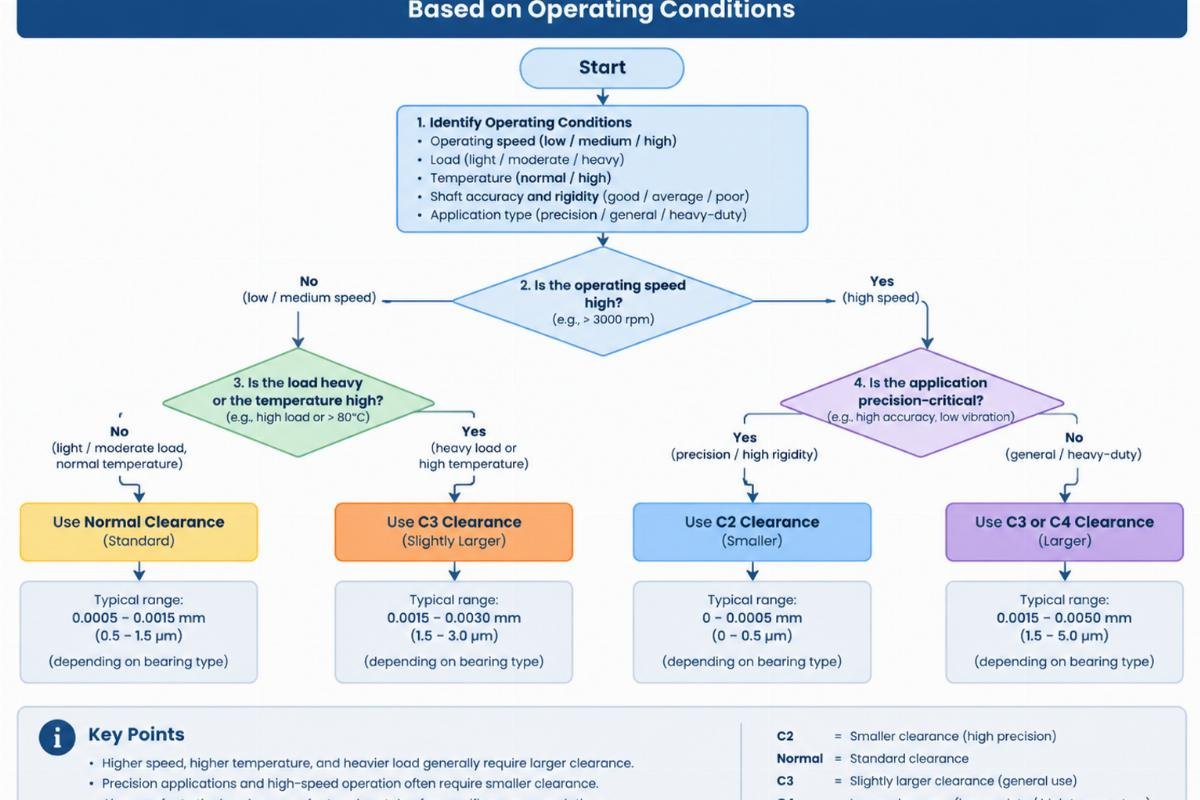
Selecting the right clearance involves calculating the total expected loss from thermal expansion and interference fits, then choosing a group that leaves sufficient positive working clearance.
This is a step-by-step process that moves beyond simple catalog lookup. First, identify the operating conditions. Is the application high-speed, high-temperature, or heavily loaded? Second, determine the mounting fits. Will the inner ring have a tight fit on the shaft? Will the outer ring be loose or tight in the housing? Third, estimate the temperature differential between the inner and outer rings during operation.
- Start with the baseline: Identify the standard clearance (C0) for your bearing size.
- Calculate fit loss: Estimate the reduction due to interference fits. For heavy fits, this can be several microns.
- Calculate thermal loss: Estimate the reduction due to temperature differences. A rule of thumb is that a significant temperature rise can consume several microns of clearance.
- Determine required working clearance: Ensure enough clearance remains for lubrication film formation and to prevent preload.
- Select the group: Choose the next highest clearance group (C3, C4, etc.) that covers the total calculated loss plus the required working clearance.
For example, in a high-speed motor where precision and low noise are critical, a C2 or C0 clearance might be ideal if temperatures are controlled. However, for a wind turbine main shaft, where loads are variable and temperatures fluctuate, a C3 or C4 is often necessary. The goal is to avoid both extremes: too little clearance leads to seizure, while too much clearance causes vibration and noise.
[NEED_CITE: Industry best practices for bearing clearance selection in varying operating conditions]
When urgency strikes, such as during an unplanned downtime event, having access to a broad inventory of these specific clearance groups is vital. Many suppliers stock only C0 and C3. Finding C4 or C2 units often requires long lead times. Our global network maintains spot inventory of these special clearances across major brands like SKF, FAG, and NSK, allowing for rapid deployment when standard options fail to meet the calculated requirements. This ensures that the ISO 5753 radial internal clearance values you select are not just theoretical, but physically available to keep your operations moving.
Conclusion
Correct clearance selection prevents failure by accounting for real-world losses.
Ignoring thermal and fit effects turns catalog data into a liability. By calculating the true working clearance, you ensure reliability and longevity. Always verify that your supply chain can deliver the specific ISO 5753 radial internal clearance values your engineering calculations demand, especially when standard stocks fall short.
Tagged

Written by
author
Editor covering global sourcing, supplier verification, and industrial product knowledge. Content is compiled from manufacturer specifications, industry standards, and hands-on experience with international B2B buyers. Every article is fact-checked before publishing to help procurement professionals make informed decisions.


