REACH SVHC Declarations for Bearings: Wholesale Supplier Guide
REACH SVHC Declarations for Bearings must cover rust oils and seals, not just steel, to prevent customs detention. Learn the mandatory documents and pre-shipment verification steps global distributors need to ensure smooth clearance and avoid costly port delays.

REACH SVHC Declarations for Bearings: Wholesale Supplier Guide
Most buyers assume REACH compliance ends with the bearing steel. It does not.
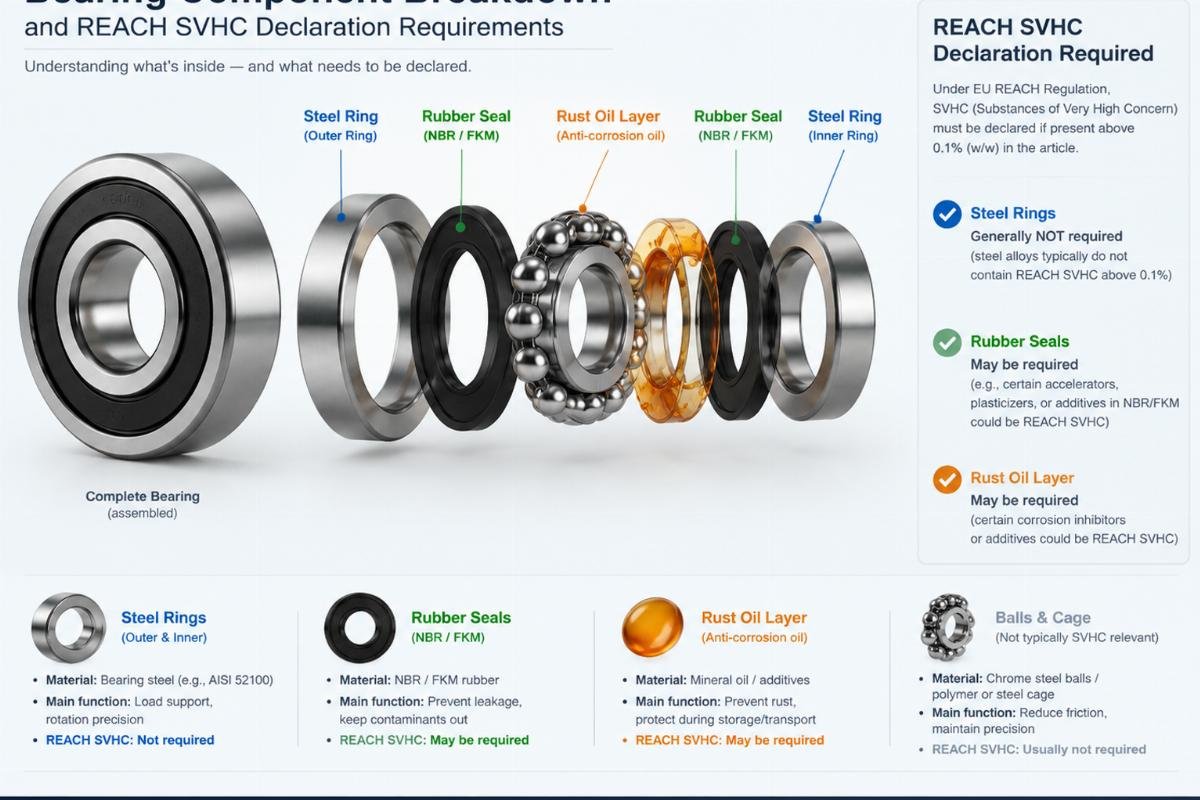
REACH SVHC declarations for bearings must cover every auxiliary material, specifically rust preventive oils and rubber seals, to prevent customs detention. A declaration limited to the metal ring is insufficient for European customs clearance or end-user audits.
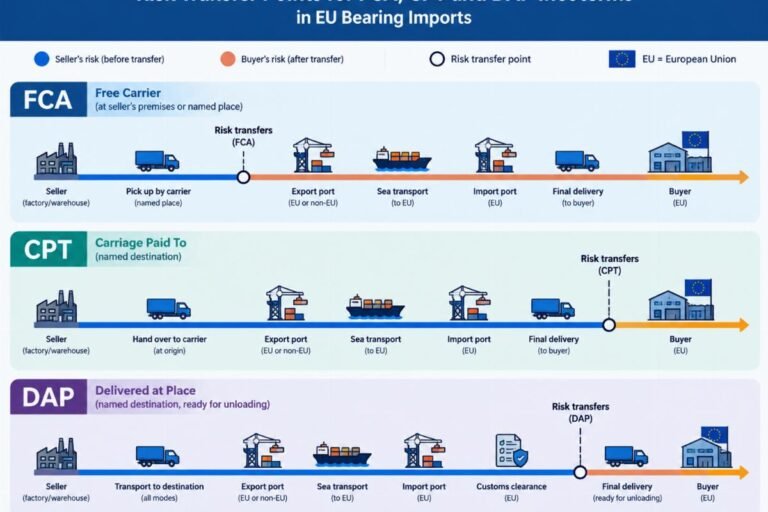
I learned this the hard way in Tanjung Priok Port. We had shipped several mixed containers of bearings to Jakarta. The paperwork for dimensions and brands was perfect. Yet, the entire shipment was held. The issue was not the bearings themselves but the absence of SVHC declarations for the rust oil applied during packaging and the elastomeric seals in insert bearings. The European terminal operator at the destination refused release until full chemical compliance was proven. Daily storage fees accumulated rapidly, turning a routine delivery into a financial drain. This incident shifted my perspective entirely. Compliance is not just about mechanical precision; it is about chemical traceability across the entire product assembly. [NEED_CITE: ECHA guidance on articles and complex objects]
Understanding this distinction is critical for any global distributor or OEM procurement manager. The following sections detail why these declarations are mandatory, what documents are required, and how to avoid port delays through rigorous pre-shipment verification.
Why Do Buyers Demand REACH SVHC Declarations for Bearings?
Compliance extends to rust oils and seals, not just steel.
Many suppliers believe that because bearing steel is an inert alloy, it automatically passes REACH regulations. While high-quality bearing steel generally contains no Substances of Very High Concern (SVHC) above the threshold, the auxiliary materials do not share this immunity. Rust preventive oils often contain phthalates or other additives that may be listed on the SVHC candidate list. Similarly, rubber seals used in deep-groove ball bearings or spherical roller bearings can contain plasticizers or stabilizers that trigger REACH thresholds.
The regulation applies to “articles,” defined as objects which during production are given a special shape, surface, or design. A bearing is an article. However, the substances contained within its components—such as the grease, the seal, and the coating—are also subject to scrutiny if they exceed 0.1% weight by weight. [NEED_CITE: EU REACH Regulation Article 3 definition of articles]
A European factory once audited our supply chain for their wind turbine maintenance program. They did not ask for the steel mill certificate first. They asked for the SVHC declaration for the nitrile rubber seals in the insert bearings. Their internal compliance software flagged the potential presence of certain phthalates commonly used in older rubber formulations. Without a specific declaration from the bearing manufacturer confirming the absence or presence of these substances below the threshold, they could not accept the goods. This is not an isolated case. End-users are increasingly liable for the chemicals in their supply chain, pushing the requirement down to component suppliers.
For wholesale distributors, ignoring this aspect means risking rejection at the customer’s receiving dock. It is no longer sufficient to provide a general statement of compliance. Buyers need item-specific data that traces back to the raw materials used in the seals and coatings. This demand drives the need for comprehensive REACH SVHC declarations for bearings that cover all constituent parts.

What Specific Documents Do End-Users Require for Customs Clearance?
Full traceability and SVHC threshold declarations are mandatory.
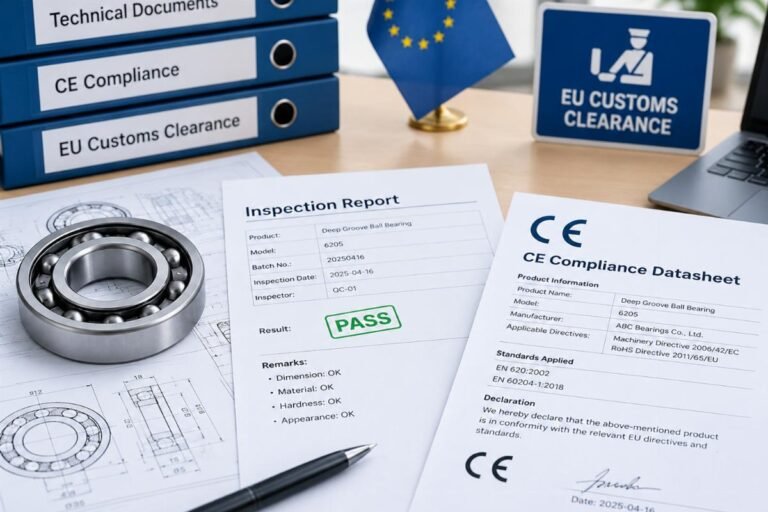
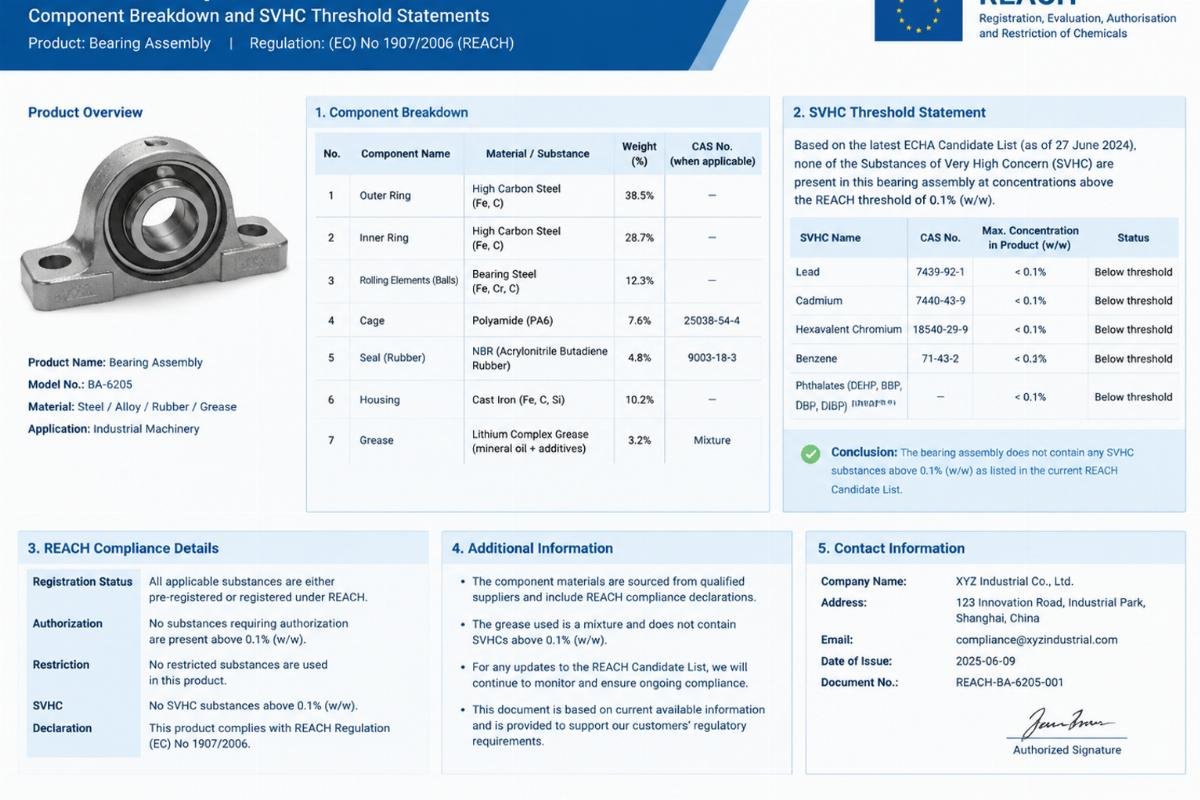
When clearing customs in the EU or dealing with strict corporate procurement departments, a simple invoice is not enough. The required documentation typically includes a detailed REACH compliance statement that explicitly lists the SVHC status for each component. This document must state whether any SVHC is present in the article in a concentration above 0.1% w/w. If present, it must identify the substance and provide safe use instructions.
Furthermore, for substances on the Candidate List that are intended to be released under normal or reasonably foreseeable conditions of use, notification to the European Chemicals Agency (ECHA) may be required. For most bearings, the release of substances from seals or oil is minimal, but the declaration of presence is still legally required for transparency. [NEED_CITE: ECHA SCIP database submission requirements]
A US buyer sourcing for a Latin American mining project faced significant delays because their supplier provided a generic “RoHS compliant” certificate instead of a REACH SVHC declaration. RoHS covers hazardous substances in electrical and electronic equipment, which does not fully align with REACH’s broader scope for mechanical components like bearings. Customs brokers in Rotterdam rejected the RoHS certificate as irrelevant for non-electronic mechanical parts. The shipment sat in bond for days while the supplier scrambled to produce the correct REACH documentation.
To avoid this, ensure your documentation includes:
- Component Breakdown: Separate declarations for steel, seals, cages, and lubricants/rust oils.
- Threshold Statement: Clear confirmation that no SVHC exceeds 0.1% w/w, or explicit identification if they do.
- Batch Traceability: Linking the declaration to specific production batches or lot numbers.
- SCIP Reference: If applicable, reference to the SCIP database entry for the article.
These documents form the backbone of successful customs clearance. Without them, even genuine, high-precision bearings can be treated as non-compliant goods.
How to Avoid Port Detention Caused by Missing Compliance Files?
Pre-shipment verification of auxiliary materials prevents costly delays.
Port detention is expensive. Beyond the direct costs of storage and demurrage, there is the reputational damage with the end client. The key to avoiding this is proactive verification before the goods leave the origin country. This involves checking the compliance status of every material used in the bearing assembly, not just the main structural components.
In my experience, the most common oversight is the rust preventive oil. Manufacturers often change oil suppliers based on cost or availability without updating the chemical compliance records. A batch of bearings might be produced with a new oil containing a newly listed SVHC. If the declaration is not updated, the entire shipment becomes non-compliant.
To mitigate this risk, implement a pre-shipment checklist:
- Verify Oil Composition: Request current safety data sheets (SDS) and REACH declarations from the lubricant or oil supplier.
- Check Seal Formulations: Confirm with the bearing manufacturer that the rubber compounds used in seals are free from restricted phthalates or other SVHCs.
- Consolidate Documentation: Ensure that the final REACH SVHC declarations for bearings match the specific part numbers and batches being shipped.
- Review Mixed Loads: For mixed-brand containers, verify that every brand and type included has valid, up-to-date declarations.
A Middle East distributor recently avoided a potential crisis by requesting updated declarations for a large order of tapered roller bearings just before shipment. The review revealed that one sub-supplier had changed the formulation of the cage material. The new declaration was secured in time, preventing what would have been a weeks-long delay at the destination port. This level of diligence is now standard practice for reliable supply chains.

How Does a Global Supplier Ensure Mixed-Brand REACH Compliance?
Strict sourcing audits and complete documentation for consolidated shipments.
Sourcing bearings from multiple brands like SKF, FAG, NSK, and TIMKEN, alongside domestic lines, creates a complex documentation landscape. Each manufacturer has its own process for generating REACH declarations. Some provide detailed component-level data, while others offer only high-level statements. For a supplier offering mixed-brand consolidation, harmonizing this data is crucial.
The challenge lies in ensuring that every item in a consolidated container meets the same compliance standard. A single non-compliant item can jeopardize the entire shipment’s clearance. Therefore, a robust system for collecting, verifying, and archiving declarations is essential. This involves maintaining direct lines of communication with manufacturers to obtain the most recent data, especially when SVHC lists are updated twice a year by ECHA.
We handle this by maintaining a centralized database of compliance documents for all stocked items. When a mixed-brand order is prepared, our team cross-references each part number against the latest SVHC list and retrieves the corresponding declaration. If a document is missing or outdated, it is flagged immediately, and the manufacturer is contacted for an update. This process ensures that when the goods are shipped, the accompanying REACH SVHC declarations for bearings are complete, accurate, and ready for customs inspection.
This approach not only protects the buyer from legal and financial risks but also streamlines the procurement process. Buyers receive a single, coherent set of documents for their entire order, regardless of the number of brands involved. This level of service transforms compliance from a bureaucratic hurdle into a competitive advantage.

Conclusion
Compliance is as critical as precision.
REACH SVHC declarations for bearings are not optional paperwork; they are a fundamental requirement for global trade. By focusing on auxiliary materials like rust oils and seals, and ensuring full traceability, suppliers can prevent customs delays and meet the strict demands of modern procurement. Rigorous pre-shipment verification and comprehensive documentation management are the keys to smooth, compliant international shipping.

Written by
author
Editor covering global sourcing, supplier verification, and industrial product knowledge. Content is compiled from manufacturer specifications, industry standards, and hands-on experience with international B2B buyers. Every article is fact-checked before publishing to help procurement professionals make informed decisions.