Satellite Antenna Positioner Bearings Wholesale Supplier
Satellite and Antenna Positioner Bearings determine signal stability, not just load capacity. Eliminate micro-jitter by selecting P4 precision angular contact bearings with correct thermal clearance. Verify cross-brand equivalents to maintain tracking accuracy during supply shortages.

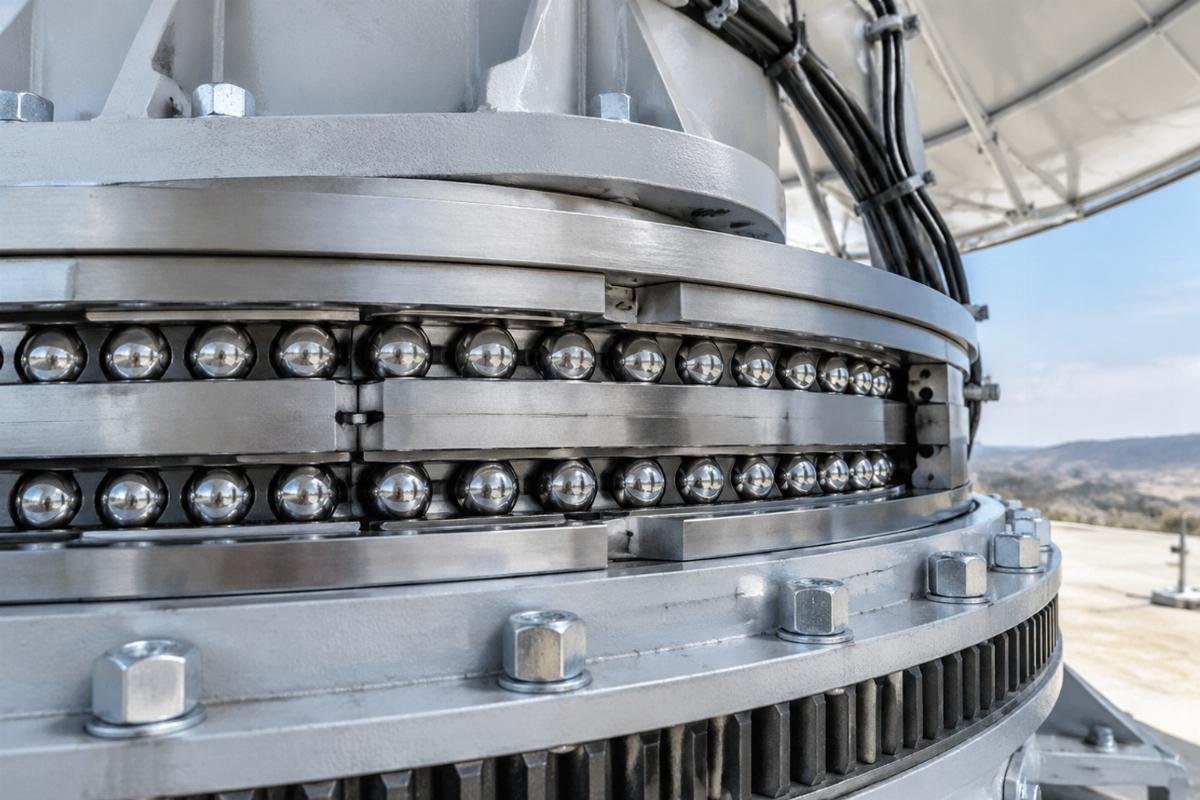
Satellite Antenna Positioner Bearings Wholesale Supplier
Standard deep-groove bearings are insufficient for high-precision satellite tracking.
The tracking accuracy and signal stability of satellite antennas rely entirely on the precision and internal clearance of positioner bearings, making rigorous selection and cross-brand matching critical. Most failures stem not from load capacity issues, but from micro-vibrations caused by improper preload or thermal binding in angular contact arrangements.
I learned this the hard way in a Dongguan quality control workshop years ago. We had a batch of satellite antenna positioners destined for Dubai. The client specified high-precision angular contact bearings, but our warehouse was out of stock on the preferred international brand. I approved a domestic alternative that matched the basic dimensions, assuming it would suffice for the light static load. The antennas shipped. Weeks later, the client rejected the entire shipment. The issue wasn’t that the bearings failed to turn; it was that they introduced micro-jitter during fine tracking. The signal locked, then drifted, then locked again. The root cause was a mismatch in internal clearance and preload consistency compared to the original specification. That mid-six-figure loss forced me out of the workshop and into the complexities of global bearing sourcing. Since then, I have focused on one principle: for satellite applications, the bearing is not just a mechanical component; it is the primary determinant of signal integrity.
Selecting the right Satellite and Antenna Positioner Bearings requires understanding that these systems operate under unique conditions. They face low rotational speeds but high combined loads from wind, gravity, and ice accumulation. The margin for error in radial runout is minimal. A deviation that would be negligible in a conveyor belt motor becomes a visible signal artifact in a parabolic dish. This guide breaks down the technical requirements for these critical components, focusing on precision classes, clearance selection, and the realities of supply chain substitution.
Why Do Antenna Positioners Demand Ultra-Precision Bearings?
Signal jitter is rarely a software issue; it is almost always a mechanical tolerance stack-up problem.
Satellite communication systems require continuous, smooth movement to maintain line-of-sight with geostationary or low-earth orbit satellites. Unlike industrial motors that rotate at thousands of RPM, antenna positioners move slowly, often stopping and starting frequently. This stop-start motion exacerbates any irregularity in the bearing raceway. [NEED_CITE: relationship between bearing geometric error and vibration in low-speed applications]
The primary enemy here is micro-vibration. When an antenna rotates, even a microscopic variation in the ball diameter or raceway waviness can cause the dish to “stick” and then “slip.” This stick-slip phenomenon creates phase noise in the received signal. To eliminate this, manufacturers must use bearings with strict tolerance controls. Standard P0 (ABEC 1) tolerances are generally inadequate for high-gain antennas. Instead, P4 (ABEC 7) or even P2 (ABEC 9) precision classes are required. These grades ensure that the radial runout and axial play are kept within micron-level limits.

In my experience, many distributors try to substitute standard precision bearings to cut costs. They argue that the load is light. This is a fundamental misunderstanding of the application. The load may be light, but the requirement for positional accuracy is extreme. A P4 bearing ensures that the inner and outer rings remain concentric under load, preventing the tilt that causes tracking errors. When sourcing Satellite and Antenna Positioner Bearings, verifying the precision class certificate is non-negotiable. Without documented traceability to ISO 492 standards, you are gambling with signal stability. [NEED_CITE: ISO 492 radial bearing tolerance definitions]
Angular Contact vs. Deep Groove: Which Fits Your Load Profile?
Deep groove bearings cannot handle the combined axial and radial forces generated by wind loading on large dishes.
A common misconception is that because an antenna dish is relatively lightweight, a standard deep groove ball bearing will suffice. This ignores the environmental forces at play. A large parabolic dish acts as a sail. In high winds, significant axial thrust is generated. Additionally, the weight of the dish creates a radial load, and the offset center of gravity creates a moment load. Deep groove bearings are designed primarily for radial loads with limited axial capacity. Under combined loading, they experience increased internal stress and premature fatigue.
Angular contact ball bearings are the mandatory choice for most professional antenna positioners. Their design allows them to support significant axial loads in one direction while handling radial loads. By pairing two angular contact bearings in a back-to-back or face-to-face configuration, engineers can create a rigid system that resists tilting moments from wind gusts. [NEED_CITE: load distribution mechanics in paired angular contact bearings]
| Feature | Deep Groove Ball Bearing | Angular Contact Ball Bearing (Paired) |
|---|---|---|
| Axial Load Capacity | Limited | High (Directional) |
| Rigidity | Low | High |
| Suitability for Wind Load | Poor | Excellent |
| Precision Availability | Common up to P4 | Common up to P2 |
| Installation Complexity | Simple | Requires Preload Adjustment |
I recall a project for a telecommunications provider in Southeast Asia. They were experiencing frequent motor overloads in their tracking systems. Upon inspection, we found they were using single-row deep groove bearings in the elevation axis. The wind load was causing the balls to skid rather than roll, generating heat and friction. Switching to a preloaded pair of angular contact bearings resolved the issue immediately. The motor current dropped noticeably, and the tracking became smoother. For any serious Satellite and Antenna Positioner Bearings application, angular contact designs are the only viable engineering solution.
How to Match Internal Clearance for Extreme Environments?
Tighter clearance is not always better; thermal expansion can cause catastrophic binding in outdoor installations.
One of the most frequent errors in bearing selection for outdoor equipment is assuming that the tightest possible clearance yields the best performance. In a controlled indoor environment, such as a machine tool spindle, this might be true. However, satellite antennas are exposed to extreme temperature fluctuations. A dish in a desert environment might face daytime temperatures exceeding 50°C and nighttime drops near freezing. Steel expands and contracts with temperature changes. If the internal clearance is too tight (such as C2), the expansion of the inner ring relative to the outer ring can eliminate all play, leading to heavy preload.
This unintended preload increases friction torque significantly. The tracking motor must work harder to overcome this resistance, leading to overheating and potential failure. In severe cases, the bearing seizes completely. Conversely, if the clearance is too loose (such as C3 or C4 without proper preload management), the bearing will exhibit excessive play, causing the antenna to wobble in the wind.

The solution lies in selecting the correct initial clearance group based on the operating temperature range and the fit of the housing and shaft. For most outdoor antenna applications, a normal clearance (C0) or slightly larger (C3) is often preferred, provided that the mounting fits are controlled. The key is to calculate the thermal expansion differential between the inner ring, outer ring, and the housing material. [NEED_CITE: thermal expansion coefficients of bearing steel vs aluminum housings]
In my sourcing practice, I often see clients request P4 precision with C2 clearance for outdoor use. This is a dangerous combination. I advise them to opt for P4 precision with C0 or C3 clearance, depending on the specific mounting arrangement. This ensures that the bearing maintains optimal internal geometry across the full temperature cycle. Proper grease selection also plays a role here, as viscosity changes with temperature, affecting the effective clearance. When evaluating Satellite and Antenna Positioner Bearings, the clearance code is just as critical as the precision class.
Cross-Brand Equivalents: Maintaining Precision During Shortages?
Substituting brands is possible, but only if dimensional and material equivalence is verified beyond the part number.
Supply chain disruptions are a reality in the global bearing market. Lead times for premium brands like SKF, FAG, or NSK can extend to many months. For MRO operators and OEMs, this downtime is unacceptable. The natural reaction is to seek cross-brand equivalents. However, “equivalent” is a loosely defined term in the industry. Two bearings may share the same ISO dimension code (e.g., 7008AC) but differ significantly in internal geometry, cage design, and steel purity.
For satellite applications, these differences matter. A cage made from polyamide might behave differently under UV exposure compared to one made from phenolic resin. The surface finish of the raceways, while meeting the same P4 tolerance, might have different roughness profiles that affect friction torque at low speeds. [NEED_CITE: impact of surface roughness on low-speed friction torque]
I maintain a comprehensive database of cross-references for major brands including SKF, FAG, INA, NSK, NTN, TIMKEN, KOYO, NACHI, and IKO, as well as reliable domestic Chinese lines like ZWZ, HRB, and LYC. When a client faces a shortage, I do not simply match the part number. I verify the specific suffixes indicating cage type, seal material, and precision class. For example, substituting an open bearing with a sealed one might seem harmless, but the seal adds friction that can disrupt delicate tracking algorithms.

A recent case involved a European distributor who needed a urgent replacement for a discontinued FAG series. We identified a technically equivalent NSK model and a high-grade domestic alternative. We provided detailed dimensional drawings and material certificates for both. The client tested samples in their lab, focusing on runout and starting torque. Both options passed, allowing them to keep their production line running. This level of technical validation is essential. Blind substitution risks the very signal stability that the antenna is designed to provide. When sourcing Satellite and Antenna Positioner Bearings from alternative sources, demand full traceability and technical data sheets, not just a catalog match.
Conclusion
Precision in satellite tracking is non-negotiable and mechanically determined.
The reliability of satellite communication systems hinges on the meticulous selection of positioner bearings. It is not enough to choose a bearing that fits; it must be the right precision class, the correct internal clearance, and the appropriate type for the load profile. Angular contact bearings with P4 or higher precision are the standard for a reason. Ignoring thermal effects on clearance or substituting brands without technical verification leads to signal jitter and system failure. Successful procurement requires a partner who understands these nuances and can provide verified, traceable solutions across global brands.
Tagged

Written by
author
Editor covering global sourcing, supplier verification, and industrial product knowledge. Content is compiled from manufacturer specifications, industry standards, and hands-on experience with international B2B buyers. Every article is fact-checked before publishing to help procurement professionals make informed decisions.