Pharmaceutical Equipment Bearings: Clean & Validated Wholesale Supplier
Pharmaceutical equipment bearings must ensure cleanroom compliance and full traceability to pass strict GMP validations. Discover why standard stainless steel fails and how sealed, pre-lubricated variants with FDA-approved lubricants prevent contamination. Secure audit-ready solutions with complete documentation for reliable pharma machinery performance.


Pharmaceutical Equipment Bearings: Clean & Validated Wholesale Supplier
Standard stainless steel is not enough for pharmaceutical compliance.
Pharmaceutical equipment bearings must prioritize cleanroom compliance, chemical resistance, and full material traceability to pass strict GMP validations. Using standard industrial bearings in pharma machinery leads to particle shedding, lubricant contamination, and failed audits. The only viable solution involves sealed, pre-lubricated variants with FDA-approved lubricants and complete documentation packages including heat numbers and cleaning certificates.
I still remember the silence on the phone when a German client rejected an entire container of tablet press bearings. The issue was not dimensional accuracy or load capacity. It was the lack of specific cleaning reports and material heat number traceability. The containers sat at Qingdao Port while I scrambled to understand why “stainless steel” was not sufficient. That incident reshaped my entire approach to sourcing. Now, every shipment of pharmaceutical equipment bearings undergoes rigorous dust-free packaging and verification before it leaves the warehouse. This is not just about selling parts; it is about ensuring that the bearing does not become the weakest link in a validated production line.
Understanding why standard bearings fail requires looking beyond basic corrosion resistance. In pharmaceutical environments, the primary risk is cross-contamination from particle shedding and non-compliant lubricants.
Why Standard Bearings Fail in Pharma Environments?
Particle shedding and non-compliant lubricants cause cross-contamination.
Most industrial buyers assume that because a bearing is made of stainless steel, it is safe for food or drug contact. This is a dangerous misconception. Standard stainless steel bearings often use general-purpose lubricants that are not FDA-approved for incidental contact. Under high-speed operation or frequent washdowns, these lubricants can migrate out of the seal and contaminate the product zone. [NEED_CITE: FDA guidelines on lubricant safety in food and pharmaceutical processing]
Furthermore, standard seals may not withstand the caustic chemicals used in Clean-in-Place (CIP) and Sterilize-in-Place (SIP) processes. When the seal degrades, microscopic particles from the bearing cage or rolling elements can enter the cleanroom environment. In a facility operating under ISO 14644 cleanroom classes, even a few microns of particulate matter can trigger a deviation report. [NEED_CITE: ISO 14644 cleanroom classification standards]
I once visited a packaging line where the operator replaced standard bearings with sealed, pre-lubricated variants. The result was a noticeable drop in cleaning downtime. The previous bearings required frequent disassembly for manual cleaning, which increased the risk of human error and contamination. By switching to components designed for washdown environments, the facility reduced maintenance frequency significantly. This shift highlights that pharmaceutical equipment bearings are not just mechanical components but critical elements of hygiene protocol.

Defining what makes a bearing truly “clean and validated” goes beyond marketing claims. It requires specific materials, sealing technologies, and documented proof of cleanliness.
What Defines a Truly “Clean and Validated” Bearing?
It requires specific materials, sealing, and FDA-approved lubricants.
A truly validated bearing starts with the alloy grade. Not all stainless steel is created equal. For pharmaceutical applications, 316L stainless steel is often preferred over 304 due to its superior resistance to pitting corrosion from chlorides and caustic washdowns. [NEED_CITE: Material compatibility charts for pharmaceutical cleaning agents] The surface finish also matters. A smoother surface reduces the area for bacterial adhesion and makes cleaning more effective.
Sealing is another critical factor. Standard rubber seals may degrade when exposed to steam sterilization or aggressive detergents. High-performance fluorocarbon elastomers (FKM) or PTFE seals offer better chemical resistance and temperature stability. These seals must maintain integrity during repeated thermal cycles without hardening or cracking.
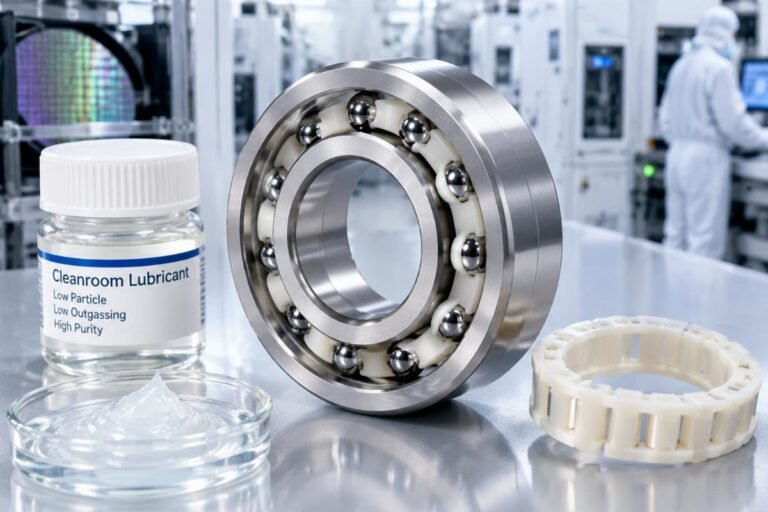
Lubrication is perhaps the most scrutinized aspect during GMP audits. Factory-applied lubricants must be NSF H1 registered or equivalent, ensuring they are safe for incidental food contact. Moreover, the application process must occur in a controlled environment to prevent initial contamination. Many buyers assume factory lubrication is clean, but only bearings lubricated in cleanroom conditions with verified protocols pass strict validation. [NEED_CITE: NSF International standards for H1 lubricants]
When I source pharmaceutical equipment bearings, I verify that the supplier provides certificates confirming the lubricant type and batch number. This level of detail ensures that if a question arises during an audit, the answer is documented and verifiable. It transforms the bearing from a commodity into a validated component.

Traceability is the backbone of GMP compliance. Without it, even the highest quality bearing is a liability.
How to Ensure Full Traceability for GMP Audits?
Heat numbers, material certs, and cleaning reports are mandatory.
During an FDA or EMA audit, inspectors do not just look at the machine; they look at the paperwork. They want to know exactly where every component came from and how it was handled. For pharmaceutical equipment bearings, this means providing full material heat numbers and cleaning certificates.
Material traceability protocols require that each bearing can be traced back to the specific batch of steel used in its manufacture. This allows for rapid recall if a material defect is discovered in the raw stock. A certificate of conformity (CoC) should include the heat number, material grade, and test results for hardness and dimensions. [NEED_CITE: Good Manufacturing Practice (GMP) documentation requirements]
Cleaning reports are equally important. These documents confirm that the bearing was cleaned using validated methods and packaged in a dust-free environment. The packaging itself must be suitable for cleanroom entry, often involving double-bagging and labeling with batch information. I insist on dust-free packaging for all pharmaceutical equipment bearings because a dirty package defeats the purpose of a clean bearing.
In one case, a packaging line provider faced an audit challenge because their bearing supplier could not provide individual heat numbers for a mixed batch. The delay cost them weeks of production time as they had to replace the components with fully documented alternatives. By contrast, providing complete validation documentation allows facilities to pass audits on the first attempt. This readiness is not just about compliance; it is about operational continuity.

Selecting the right bearing type depends on the specific machinery and its operational demands.
Which Bearing Types Suit Specific Pharma Machinery?
Match sealed deep-groove or stainless variants to mixers and presses.
Different pharmaceutical machines impose different stresses on bearings. Tablet presses, for example, operate under high cyclic loads and require precise alignment. Sealed deep-groove ball bearings are commonly used here because they handle radial and axial loads well while keeping contaminants out. The key is to choose variants with pre-lubricated, long-life grease to minimize maintenance intervals.
API mixers present a different challenge. They are subject to frequent and aggressive washdowns with caustic solutions. Here, 316L stainless steel bearings with robust FKM seals are essential. These bearings must withstand both the mechanical stress of mixing and the chemical stress of cleaning. Switching to these specialized bearings can extend service life significantly compared to standard options. [NEED_CITE: Case studies on bearing life in corrosive environments]
Packaging lines often run at high speeds and require low-noise operation. Precision-grade bearings with tight tolerances help reduce vibration and noise, which is critical in cleanroom environments where acoustic comfort and stability are valued. Additionally, these bearings must resist the dry conditions often found in packaging areas, where static buildup can be an issue.
When advising clients on pharmaceutical equipment bearings, I focus on matching the bearing specification to the machine’s specific duty cycle. A one-size-fits-all approach rarely works in pharma. For instance, a bearing suitable for a conveyor may fail quickly in a high-pressure mixer. Understanding these nuances helps equipment OEMs and facility managers make informed decisions that balance performance with compliance.

Conclusion
Compliance drives component selection in pharmaceutical manufacturing.
Choosing the right pharmaceutical equipment bearings is not just a technical decision but a regulatory necessity. From material grade to lubricant certification, every detail contributes to GMP compliance and operational efficiency. By prioritizing traceability and cleanroom-ready specifications, facilities can avoid costly audits and downtime. The goal is to ensure that every rotating part supports the integrity of the final product.
Tagged

Written by
author
Editor covering global sourcing, supplier verification, and industrial product knowledge. Content is compiled from manufacturer specifications, industry standards, and hands-on experience with international B2B buyers. Every article is fact-checked before publishing to help procurement professionals make informed decisions.