Tunnel Boring Machine Bearings: Genuine Wholesale Supplier for Bulk MRO Orders
Prevent catastrophic downtime by sourcing genuine Tunnel Boring Machine Bearings with strict traceability verification. Learn to identify refurbished traps through visual inspection and mill certificates while optimizing MRO strategies with mixed-brand consolidation for rapid emergency replacements in extreme tunneling conditions.

Tunnel Boring Machine Bearings: Selection, Traceability & MRO Sourcing Guide
Low-price TBM bearings are rarely budget-friendly; they are often refurbished traps.
Sourcing genuine Tunnel Boring Machine Bearings demands strict traceability verification and mixed-brand MRO capabilities to prevent catastrophic downtime caused by polished surfaces hiding micro-cracks or counterfeit documentation in extreme tunneling conditions.
I still remember the silence on a North American tunnel site when the cutterhead jammed. The project manager pointed at a batch of main bearings we had sourced from a Chicago trade show, attracted by the aggressive pricing. We installed them with confidence, only to face a complete shutdown months later. When we dismantled the housing, the spherical rollers showed faint polishing marks—evidence of refurbishment designed to hide subsurface fatigue. The accompanying mill certificates were forged, lacking the specific heat-batch codes required for verification. That single failure cost more in idle labor and penalty clauses than ten sets of original equipment manufacturer parts would have. This experience reshaped my approach entirely. I no longer look for the lowest invoice price; I look for verifiable metallurgical integrity. [NEED_CITE: common failure modes in heavy-duty rolling bearings per ISO 15243]
The transition from buyer to supplier was driven by this need for certainty. Today, when I consult with European contractors or Middle Eastern distributors, I start by highlighting what goes wrong. The market is flooded with components that look new but lack the structural resilience for high-shock, wet environments. Understanding how to distinguish these risks is the first step in securing reliable Tunnel Boring Machine Bearings.
Why Do TBM Bearings Fail Prematurely in Tunneling?
Extreme combined loads and contaminated wet conditions accelerate wear if bearings lack proper metallurgical integrity.
Tunnel boring machines operate in some of the harshest industrial environments on earth. The main bearing assembly must withstand massive axial thrust from the cutterhead, radial loads from the ground pressure, and continuous shock vibrations from rock fragmentation. Standard industrial bearings often fail here because they are not designed for such complex load vectors. [NEED_CITE: dynamic load rating calculations for combined axial and radial loads in heavy machinery]
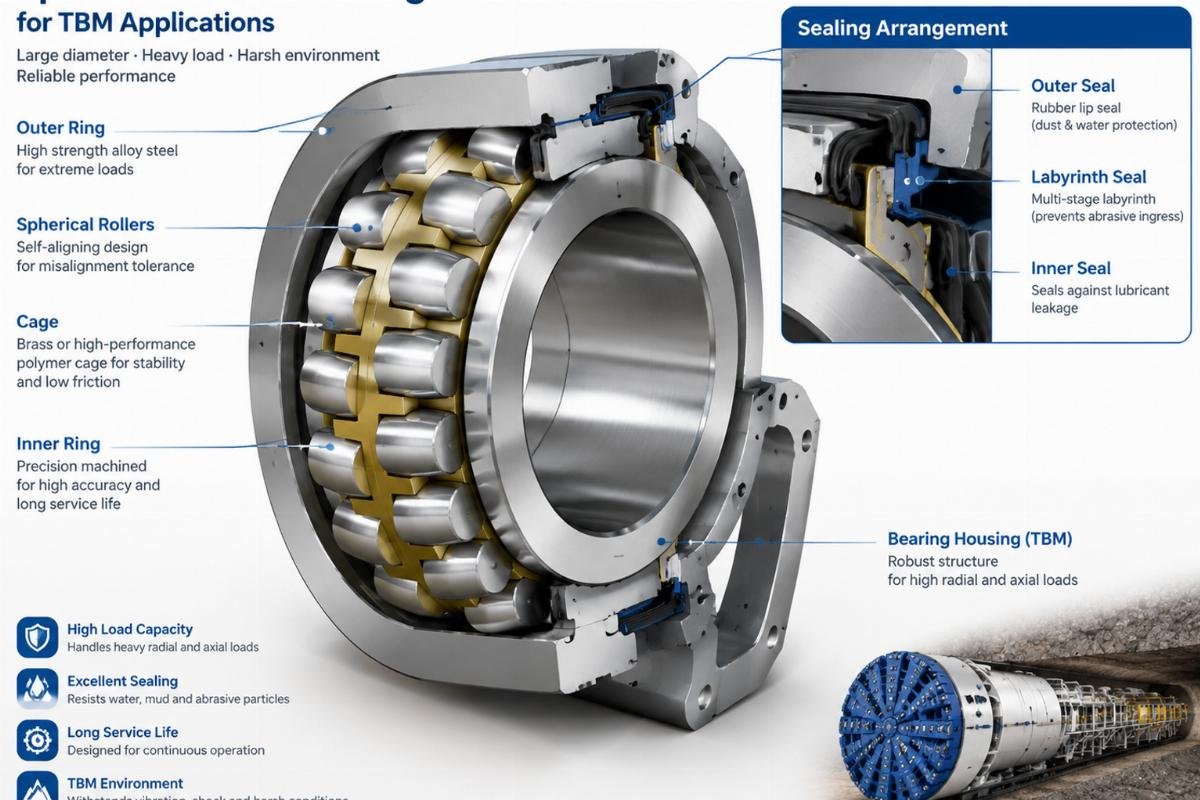
In my early procurement days, I overlooked the importance of the cage design and lubrication retention. A standard deep-groove ball bearing might suffice for a motor, but it will disintegrate under the misalignment stresses of a shield machine. The primary culprit for premature failure is usually not the load itself, but the ingress of slurry and water. Once contaminants breach the seal, they mix with the grease, creating an abrasive paste that grinds away the raceways.
I recall a project in Southeast Asia where a contractor used bearings with inadequate sealing for a wet clay tunnel. Within weeks, the lubricant had emulsified. The resulting friction generated excessive heat, leading to thermal expansion and eventual seizure. This is not a rare anomaly; it is a predictable outcome of ignoring environmental specifications. [NEED_CITE: sealing and lubrication methods for wet and contaminated tunnel environments]
To mitigate this, selection must focus on spherical roller bearings with robust contact seals and high-capacity cages. These components allow for slight misalignments without inducing edge stresses, which is critical when the TBM frame flexes under ground pressure. Furthermore, the steel quality must be verified. High-purity vacuum-degassed steel resists the initiation of micro-cracks that propagate under cyclic shock loading. Without this metallurgical foundation, even the best sealing system cannot prevent eventual fatigue failure.
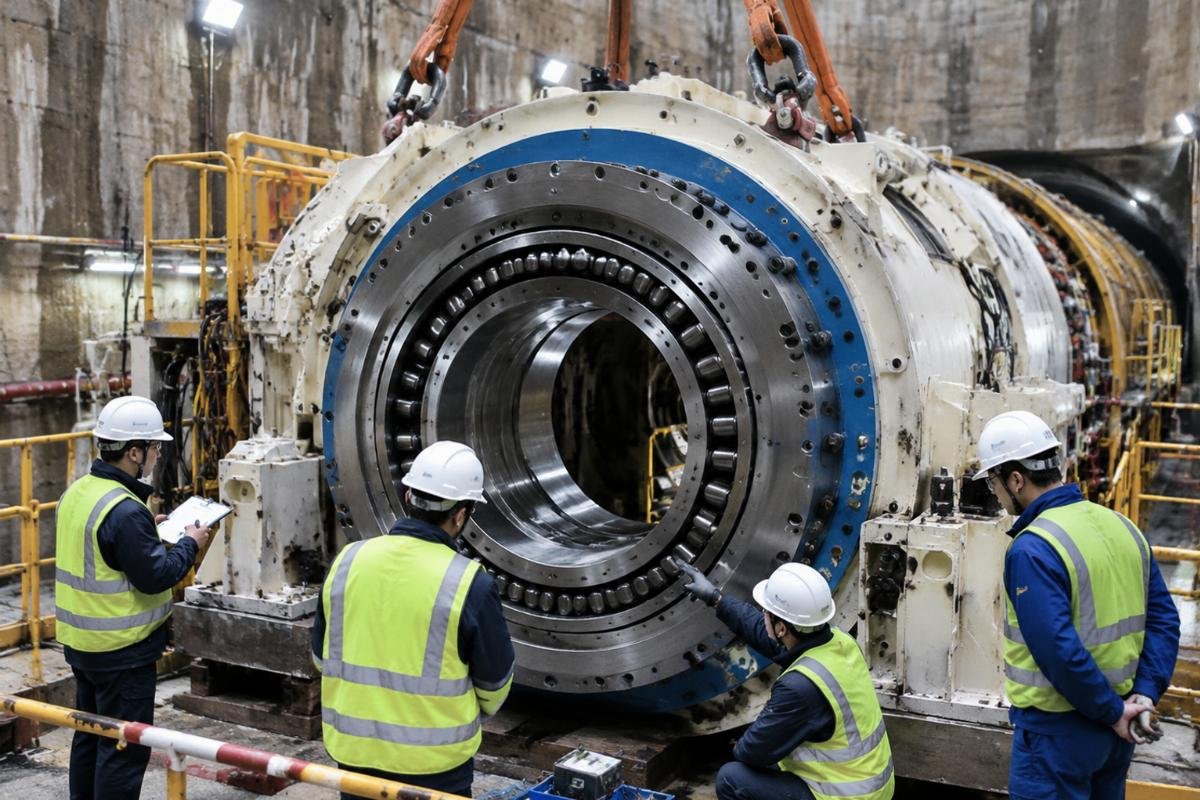
When evaluating Tunnel Boring Machine Bearings, always ask for the specific application history of the model. A bearing that performs well in a dry granite tunnel may fail rapidly in a soft, water-rich soil condition. The environment dictates the specification, not just the machine’s torque rating.
How to Spot Refurbished or Fake TBM Bearings?
Check for polishing marks on rollers and demand verifiable mill certificates, not just supplier declarations.
The most dangerous risk in the MRO market is the refurbished bearing sold as new. Skilled refurbishers can polish out minor surface defects, making the rollers look pristine. However, this process removes the hardened layer and hides subsurface cracks that will expand under load. Detecting these fakes requires a keen eye and strict documentation protocols.
Visually, inspect the roller ends and raceways. Genuine new bearings have a uniform, matte finish from precision grinding. Refurbished parts often show irregular shine or directional polishing marks that differ from the original manufacturing texture. Additionally, check the laser etching on the outer ring. Counterfeiters often use ink or low-quality engraving that fades or lacks the sharp depth of original factory markings. [NEED_CITE: visual inspection guidelines for identifying counterfeit rolling bearings]
Documentation is equally critical. A legitimate supplier will provide a mill certificate that traces the steel back to its production batch. This document should include the heat number, chemical composition, and hardening details. If a supplier offers only a generic “certificate of conformity” without specific batch data, treat it as a red flag. In my current practice, I reject any shipment that cannot link the physical part to its original manufacturing record.
| Inspection Point | Genuine New Bearing | Refurbished/Fake Bearing |
|---|---|---|
| Surface Finish | Uniform matte grind texture | Irregular shine or polishing marks |
| Markings | Sharp, deep laser etching | Faded ink or shallow engraving |
| Documentation | Specific mill certificate with heat batch | Generic conformity letter only |
| Packaging | Original branded box with security seals | Plain box or reused packaging |
A European contractor once faced a similar issue when a local vendor supplied what appeared to be premium brand bearings. Upon closer inspection by our technical team, the cage material was inferior, and the rollers showed signs of previous use. The vendor had simply cleaned and repackaged used components. By insisting on traceability, we avoided installing these parts, saving the project from a potential month-long delay. [NEED_CITE: importance of traceability documents in preventing counterfeit industrial parts]
When sourcing Tunnel Boring Machine Bearings, never compromise on verification. The cost of a detailed inspection is negligible compared to the expense of a failed installation.
What Are the Key Bearing Types for Shield Machines?
Spherical and tapered roller bearings dominate main shafts and gearboxes due to high shock-load capacity.
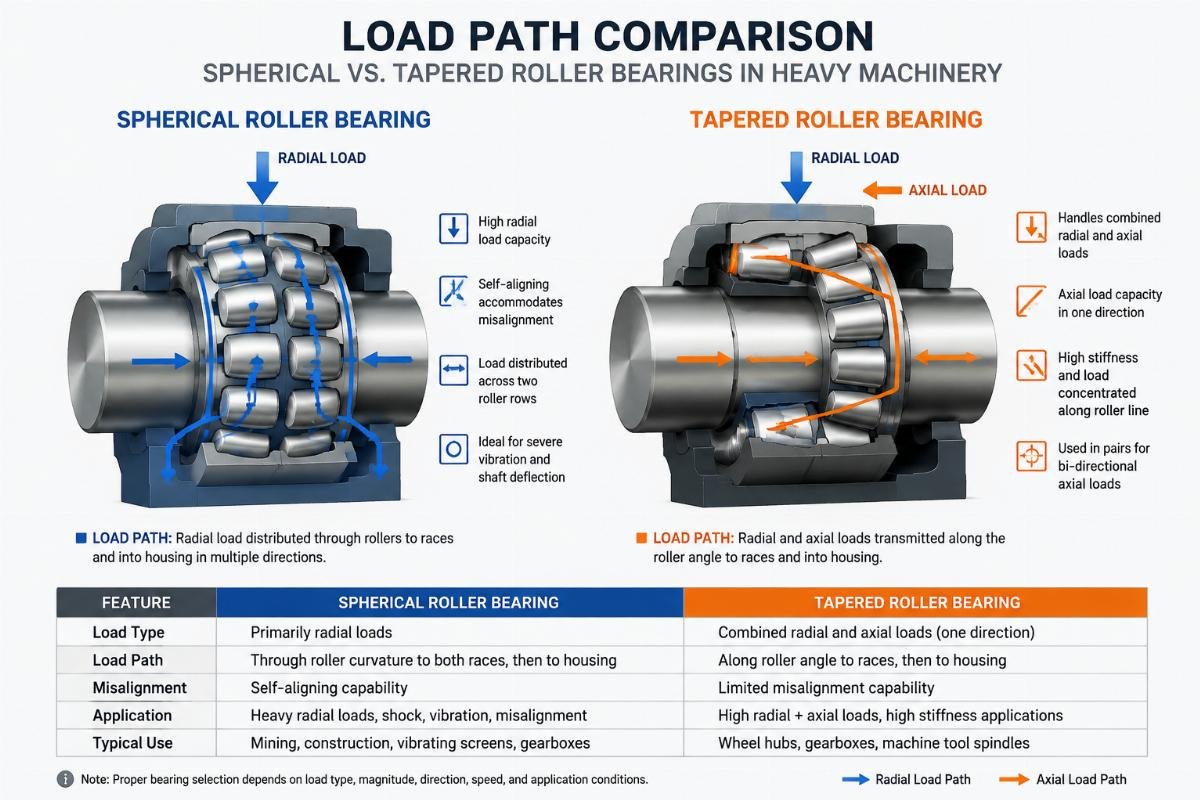
Not all bearings are created equal for TBM applications. The choice of type depends on the specific function within the machine. Main bearings require the ability to handle combined loads and misalignment, while gearbox bearings need high-speed precision and rigidity.
Spherical roller bearings are the standard for main shafts. Their two-row design allows them to support heavy radial loads and moderate axial loads in both directions. Crucially, they accommodate angular misalignment, which is inevitable in the flexible structure of a TBM. I have seen projects where cylindrical roller bearings were used incorrectly in the main position, leading to rapid edge loading and spalling because they could not tolerate the slight frame deflections.
Tapered roller bearings are typically found in the gearbox and cutterhead drive systems. They offer high rigidity and precise axial positioning, which is essential for gear meshing efficiency. However, they are less forgiving of misalignment than spherical types. Therefore, their mounting precision must be exact. [NEED_CITE: application guidelines for tapered vs spherical roller bearings in heavy equipment]
| Bearing Type | Primary Application in TBM | Load Capacity | Misalignment Tolerance |
|---|---|---|---|
| Spherical Roller | Main Shaft, Support Rollers | High Radial, Moderate Axial | High |
| Tapered Roller | Gearbox, Cutterhead Drive | High Radial, High Axial | Low |
| Cylindrical Roller | Motor Supports, Non-locating Ends | Very High Radial, No Axial | Low |
| Thrust Ball | Auxiliary Axial Positioning | Pure Axial | None |
In a recent consultation for a mining TBM upgrade, we replaced standard cylindrical bearings in the support rollers with spherical units. The change significantly reduced maintenance frequency because the new bearings could absorb the uneven ground pressures without inducing stress concentrations. This switch extended the service life meaningfully, proving that correct type selection is as important as brand authenticity.
When selecting Tunnel Boring Machine Bearings, match the bearing type to the specific mechanical role. Do not assume that a higher load rating alone ensures suitability; the kinematic behavior of the bearing must align with the machine’s operational dynamics.
How to Optimize MRO Sourcing for Emergency Replacements?
Mixed-brand consolidation and spot inventory are critical to avoid weeks of waiting for single-brand OEM channels.
Downtime in tunneling is expensive. When a bearing fails, the priority is rapid replacement. Traditional single-brand sourcing often involves long lead times, especially for large-diameter specialized units. Waiting for a specific brand’s factory to produce a replacement can halt a project for weeks.
A more effective strategy is mixed-brand MRO sourcing. By maintaining relationships with suppliers who stock multiple premium brands like SKF, FAG, TIMKEN, and NSK, operators can access immediate availability. Different brands may have equivalent models that meet the same dimensional and load requirements. Having the flexibility to substitute a unavailable brand with a certified alternative from another top-tier manufacturer ensures continuity. [NEED_CITE: benefits of multi-brand sourcing strategies for industrial MRO]
I once assisted a contractor in Latin America who needed urgent replacements for a shield machine overhaul. The specified brand had a six-week lead time. By leveraging a consolidated inventory of genuine alternatives, we sourced equivalent high-quality bearings from different manufacturers within days. The key was verifying that the alternative parts met the original equipment specifications for load rating and precision class.
This approach requires a supplier with deep technical knowledge and a broad spot inventory. It is not enough to simply have parts in stock; they must be genuine and traceable. Mixed-brand sourcing minimizes the risk of supply chain bottlenecks while maintaining quality standards. It transforms the procurement process from a reactive scramble into a strategic advantage.
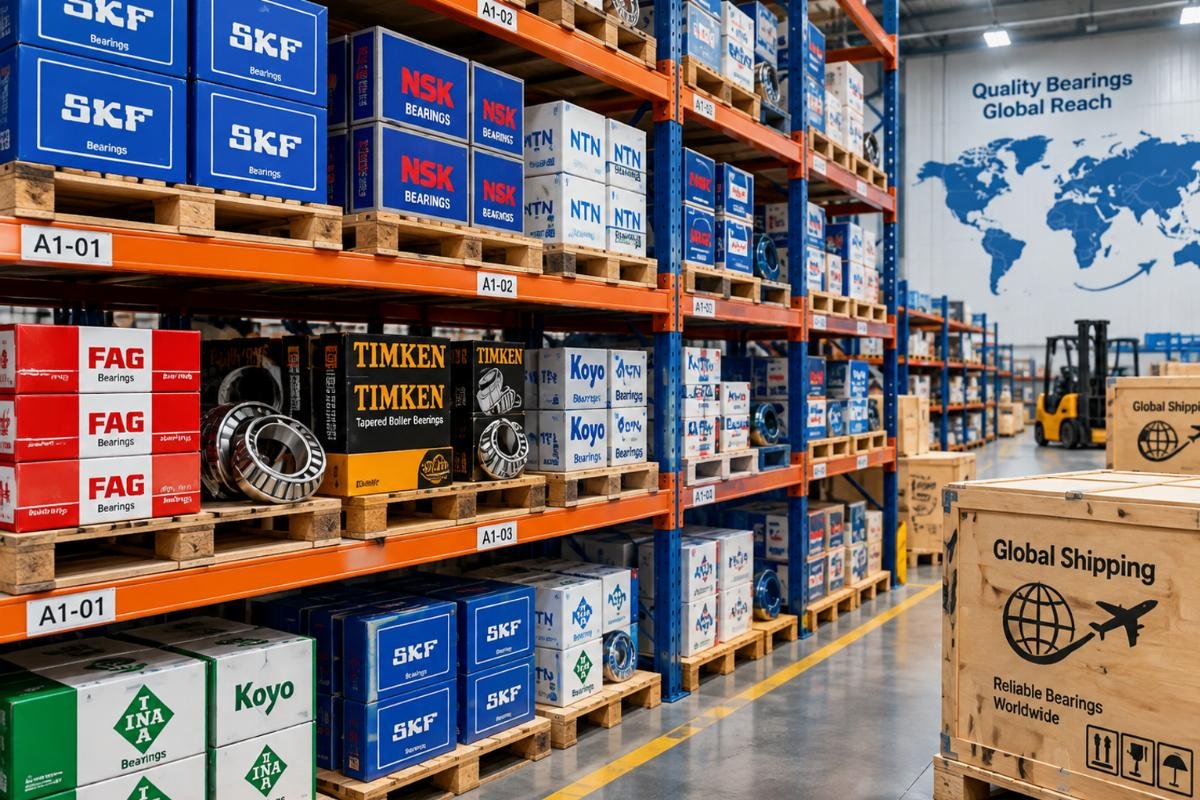
For MRO managers, building a network of suppliers who offer Tunnel Boring Machine Bearings across multiple brands is essential. This diversity provides the agility needed to respond to unexpected failures without compromising on quality or traceability.
Conclusion
Authenticity and agility define successful TBM bearing procurement.
Avoiding catastrophic downtime requires rigorous verification of traceability and a flexible sourcing strategy. By prioritizing genuine materials over low prices and leveraging mixed-brand inventory for rapid response, operators can ensure the reliability of their tunneling projects. Trust in documentation, not just appearance, when selecting Tunnel Boring Machine Bearings.
Tagged

Written by
author
Editor covering global sourcing, supplier verification, and industrial product knowledge. Content is compiled from manufacturer specifications, industry standards, and hands-on experience with international B2B buyers. Every article is fact-checked before publishing to help procurement professionals make informed decisions.